


Mr. “Good Afternoon”, goodbye.

The Fed is changing hands.
On Friday, May 15th, Jerome Powell will officially step down as Fed Chair, to be replaced by Kevin Warsh.
Powell earned the nickname “Mr. Good Afternoon” on social media, because markets often saw big moves when he began his press conferences with his trademark opening phrase, “Good afternoon.”
Hence, the title for today's report.
On a more poignant note, we now look back at Chair Powell's legacy, and outline what incoming Chair Warsh could mean for markets.
Powell's legacy as Fed Chair
Powell served as Fed Chair for 8 years — one of the most turbulent stretches in modern economic history.
The outgoing Fed Chair's tenure could be summed up in 2 key challenges:
1) Managing the post-Covid inflation surge - the worst since the 1970s.
The Fed had to raise interest rates aggressively in 2022-2023 to cool down soaring inflation amid the post-pandemic economic recovery.
However, Chair Powell and his colleagues on the FOMC (Federal Open Market Committee - the group that decides on what to do with US interest rates) though were criticized for being late too late in hiking rates.
Policymakers back then held on for too long the belief that inflation would be "transitory".
The US economy is now still contending with a prolonged period of above-target inflation, leaving the Fed with less ability to return interest rates to "normal"/neutral levels, albeit with multiple shocks to the global economy since the pandemic (Russia-Ukraine war, Trump trade tariffs, Iran war).
NOTE #1: The Fed has a goal of keeping inflation around 2%.
NOTE #2: The Fed's primary way for managing inflation is via interest rates (when inflation is running too high, the Fed raises rates, and vice versa).
2) Maintaining the Fed's independence.
More recently, the end of Powell's tenure as Fed Chair was marked by his resistance to President Trump's political pressures.
Despite Trump himself nominating Powell as Fed Chair, POTUS has attempted to undermine the Fed via:
- public demands for lower interest rates
- mud-slinging in the media: Trump threatened to fire Chair Powell on multiple occasions, even labelling Powell as "a stubborn mule and a stupid person"
- a criminal investigation into Powell's testimony in the Senate about the Fed's renovation works
- a separate legal case against Fed Governor, Lisa Cook
Right till the end, Powell championed the Fed's ability to set monetary policy based on their mandate: price stability and maximum employment.
Why is Fed independence important?
An independent central bank is a hallmark of major developed economies.
Without independence, the Fed risks becoming a political tool — cutting rates on demand, at the whims of political cycles, to please the government rather than managing the economy objectively.
How did markets fare during Chair Powell's tenure?
Jerome Powell began his tenure as Fed Chair on February 5th, 2018.
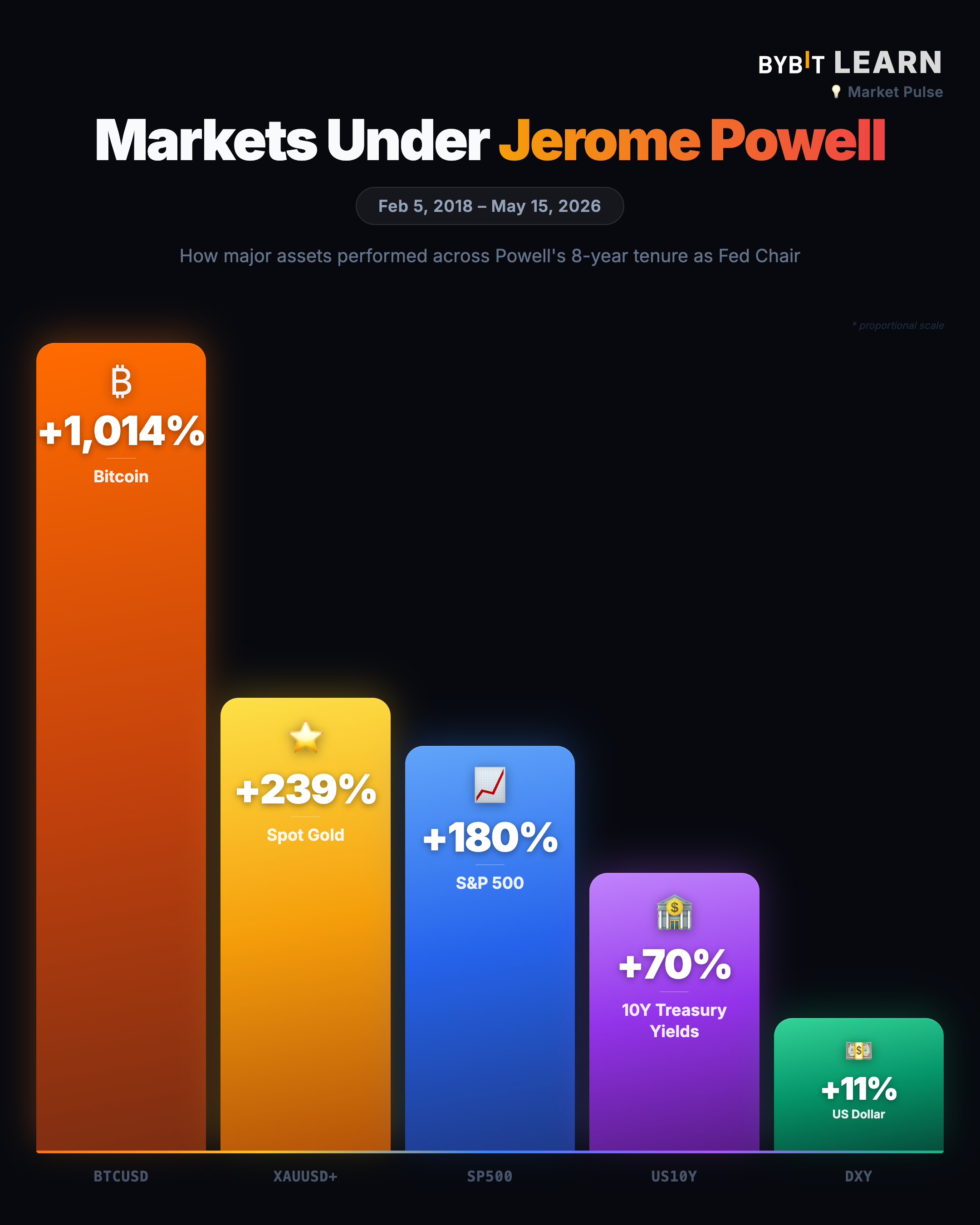
Since then, and just as an oversimplified overview (considering tremendous bouts of volatility over the years), here's how major assets have fared:
- The US dollar (as measured by the benchmark US dollar index - DXY) has risen 11%
- 10-year US Treasury yields (the market's so-called "risk free" rate) has climbed by 70%
- S&P 500 (SP500) - the most popular benchmark for US stock markets - soared 180% (prior to US market open on Friday, May 15th)
- Spot gold (XAUUSD+) has surged 239%
- Bitcoin (BTCUSDT) has skyrocketed 1014%!
What to expect from Fed Chair Warsh?
The Senate confirmed Warsh as the Fed's 17th Chair on May 14, 2026, in a 54–45 largely party-line vote.
Like Powell, Warsh was also chosen by President Trump, and here's what markets have gathered so far about the incoming Fed Chair
- Warsh has been critical of the Fed's inflation models and communications in the past. Changes ahead?
- He is expected to prioritize the Fed's credibility before making big policy moves, as he testified before policymakers earlier this year, though doubts still linger.
- Analysts warn his appointment is unlikely to deliver near-term rate cuts, given that elevated oil prices due to the Iran war may keep pushing US inflation higher.
- Bond markets are already pushing yields higher in anticipation of his tenure.
For contrast, markets have gone from expecting at least 2 rate CUTS in 2026 at the start of the year, to now predicting a greater-than-even chance (58% odds) for a Fed rate HIKE by year-end.
Why does this matter for traders and investors?
The Fed is the world's most influential central bank - it sets interest rates in the world's largest economy.
A central bank's interest rates affect our personal financial lives, from how much interest to pay on our mortgages, to how much interest we receive on our savings parked at the bank.
For traders and investors, US interest rates affect multiple asset classes, from the US dollar's performance, to the value of stocks and bonds, and even risk appetite that can either foster or hurt demand for cryptos.
The big question: How will Warsh impact markets?
All eyes are on June 17th, 2026.
That's when the Fed is due to make its next interest rate decision, but this time, with Chair Warsh at the helm.
Markets and analysts will be watching closely to see whether he maintains the Fed's independence — or aligns with biases out of the White House.
Potential Scenarios:
- Greater odds for US interest rates moving higher (Fed hikes rate) - with Warsh upholding Fed independence while staving off inflation's risks of shooting higher - should keep the US dollar stronger, while potentially weighing down the likes of gold (XAUUSD+ may fall) and perhaps even risk assets (e.g. stocks, cryptos, etc.)
- Greater odds for US interest rates moving lower (Fed cuts rate) - should Warsh grow more aligned with Trump's demands despite risks of inflation shooting higher - should weaken the US dollar, potentially boosting gold (XAUUSD+). However, US assets, such as stocks and bonds, may see some selling pressures should global investors lose faith in the Fed's independence under Chair Warsh.
DISCLAIMER: This article is provided for general information and reflects the author’s views only. It does not constitute investment advice, nor an offer or solicitation to buy or sell any financial instruments or digital assets. Your ability to access or use any products or services mentioned may be subject to the laws and regulatory requirements of your jurisdiction.