


Bitcoin bear market: Is the end near?

Bitcoin is once again moving lower today, trading around the $67,000 psychological level at the time of writing.
Last week's stunning rebound, after a similarly stunning drop to $60k, has been resisted at its 9-day simple moving average (SMA).
From peak to trough, the world's biggest crypto has fallen over 52% since its all-time intraday high of $126,195.50 registered on Oct 6th, 2025.
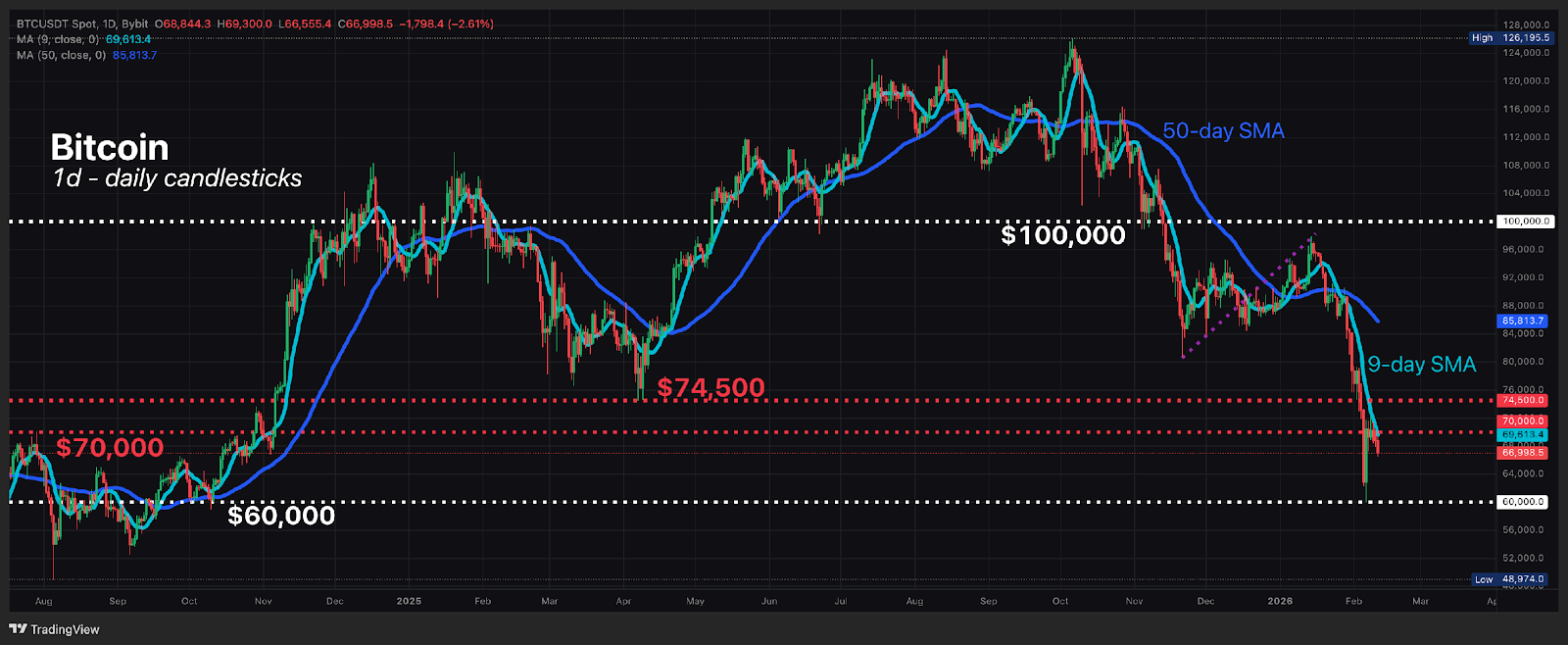
NOTE: An asset enters a "bear market" when its price has fallen 20% from its recent peak.
How low could BTC go?
Among crypto aficionados, this is arguably the most pressing question at present.
In an attempt to make an informed outlook, we refer to Bitcoin's past decade.
First, we outline the previous bear and bull markets, from peak to trough, since 2017:
Bear - 12 months (Dec 2017 till Dec 2018): down 84%
Bull - 35 months (Dec 2018 till Nov 2021): up 2100%
Bear - 12 months (Nov 2021 - Nov 2022): down 77%
Bull - 35 months (Nov 2022 - Oct 2025): up 711%
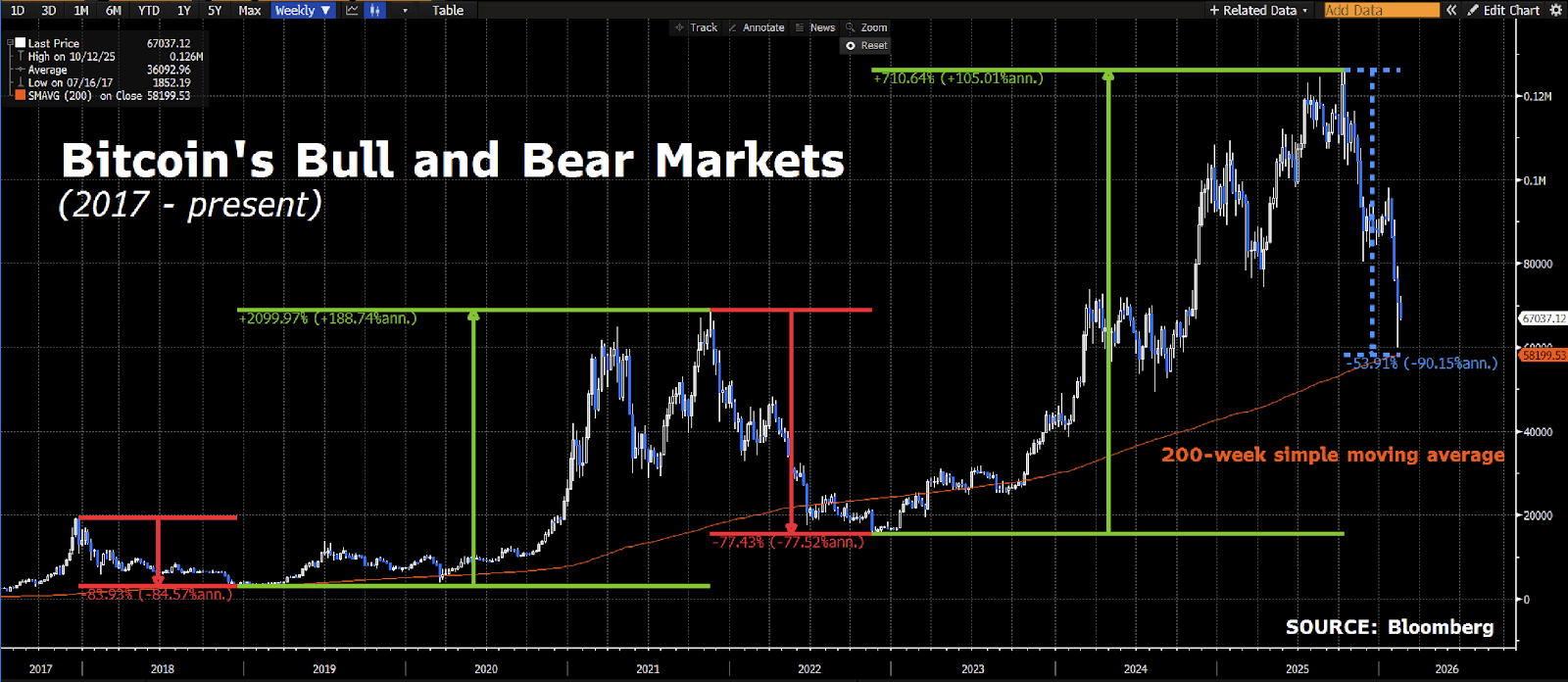
Going by the trend above:
Bitcoin's bear market takes 12 months to play out fully
Bitcoin then soars "to the moon" over the subsequent 3 years
Perhaps more importantly, from a % performance perspective, Bitcoin's market cycles have been more compressed:
Bear cycles have been shallower over the past decade (down 84% from Dec 2017 - Dec 2018 peak to trough VS. 77% in Nov 2021 - Nov 2022)
Bull cycles have also been "smaller" in % terms (up 711% from Nov 2022 - Oct 2025 trough to peak VS. 2100% surge between Dec 2018 - Nov 2021)
From a duration perspective, given that we're just 4 months into this current bear market (Oct 2025 record high - Feb 2026), we may only be one-third into this current bear cycle.
However, as we had covered in our 2026 Annual Crypto Outlook, it may well be different this time.
Watch the 200-week simple moving average (SMA)
For the immediate term, traders and long-term investors are eyeing the 200-week SMA.
Historically, when Bitcoin hits its 200-week SMA, this technical indicator has served as the launchpad for Bitcoin to go on a multi-year bull run.
(except during the 2022-2023 crypto winter, due to structural reasons)
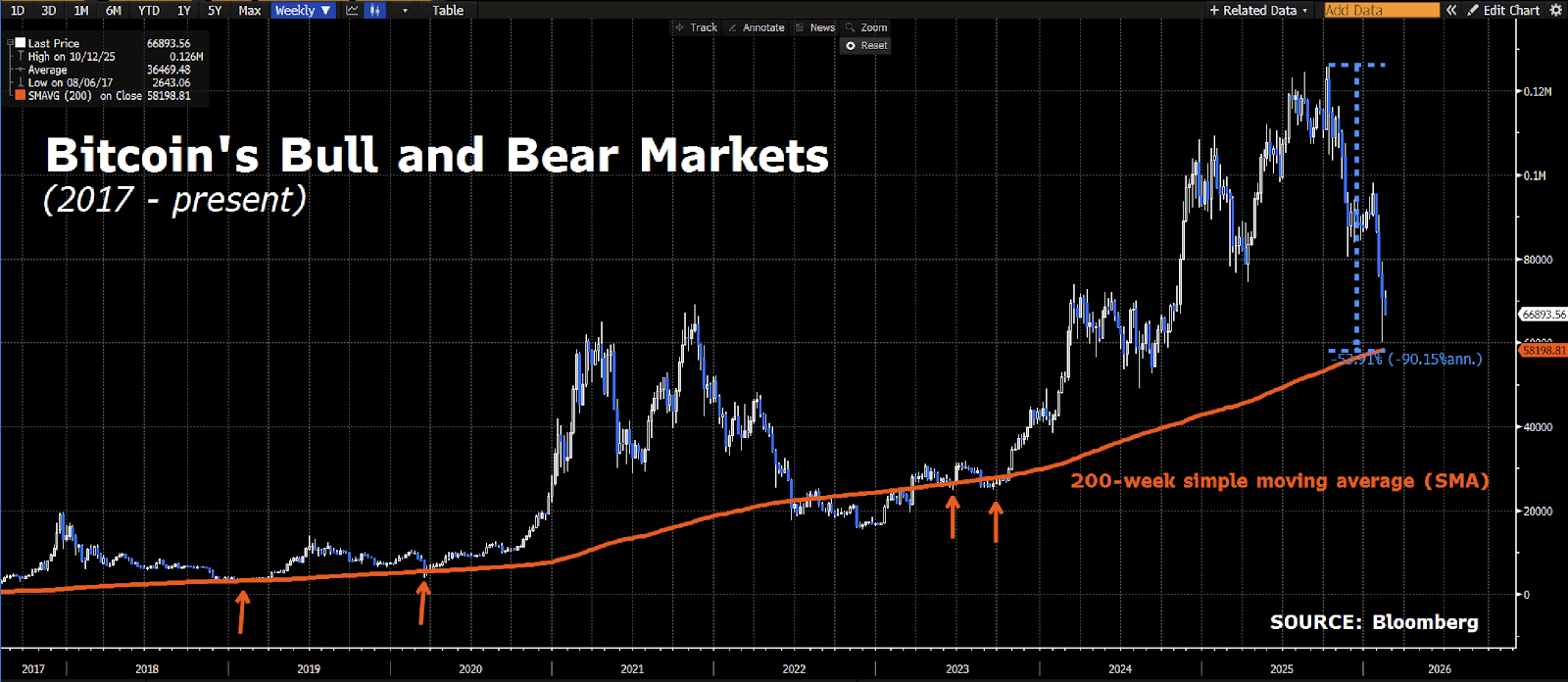
Note from the chart above, even if Bitcoin were to tumble to the $58,200 region (where its 200-week SMA currently resides), that would also mark a decline of "just" 54%.
This would be in keeping with the "compression" trend we have seen over past bear and bull cycles since 2017.
Whales starting to return, but who else?
Perhaps it's that thinking (200-week SMA offering historic support for Bitcoin) that enticed whales to buy-the-dip last week.
NOTE: Whale wallets hold more than 1,000 Bitcoin each.
According to research firm Glassnode, so-called "whale wallets" accumulated about 53,000 Bitcoins last week (Feb 2-9, 2026) - a period when Bitcoin fell to $60,000, which was a mere 3% away from its 200-week SMA.
Those 53,000 Bitcoins bought marked this cohort's biggest purchases since November 2025!
However, for proper context, about 170,000 Bitcoin have left such whale wallets (excluding ETFs and exchanges) since mid-December.
Hence, last week's purchases (53,000 bitcoins) are just less than one-third of the amount sold over the past couple of months.
Average BTC ETF investor under-water
In our recent report with Block Scholes (published February 5th), we note that the average BTC purchase price for ETF investors is $84,000.
At the current prices below $70k at the time of writing, the average person who invested into Bitcoin via exchange-traded funds (ETFs) is bearing losses.
Bitcoin ETF investors have also net sold about US$ 7.9 billion out since the October 2025 crash, with US$ 1.8 billion of those net purchases occurring so far in 2026.
As Bybit Learn's Chief Market Analyst, Han Tan, has shared with the media:
"There's still a notable lack of confidence-boosting catalysts along crypto's near-term horizon, even as sentiment has clearly detached from the constructive fundamentals."
In other words, crypto confidence requires a major boost which entices more funds flowing back into Bitcoin and co, in order to see a sustained recovery.
Such a catalyst may occur, though bulls (those hoping for higher prices) will be hoping that today's (Wed, Feb 11th) US jobs report, and Friday's (Feb 13th) US inflation data release may embolden more risk-taking activities on hopes that the Fed can lower US interest rates to support financial conditions and US economic growth.
But first, Bitcoin's 200-week SMA beckons, if prices do get there.