


Last price vs. mark price: What every Bybit trader needs to know for TP/SL

Mark price, index price and last traded price are the three pricing mechanisms Bybit uses to calculate margin, trigger liquidation and process take profit and stop loss (TP/SL) orders in derivatives trading. The difference between last traded price and mark price is especially important. It determines if your stop-loss fires before or after your position is liquidated. Bybit's margin calculation model makes understanding this distinction critical.
Key Takeaways:
Last traded price determines what price your orders fill at and your realized PnL, while mark price determines when your position gets liquidated and how much margin you’re required to hold.
Using mark price to trigger your stop-loss order ensures it fires before liquidation, but exposes you to slippage. Meanwhile, using last traded price gives better execution estimates, but risks your stop-loss order failing to trigger before the mark price hits your liquidation level.
Mark price directly drives real-time margin calculations on Bybit, making it essential for monitoring the gap between your liquidation price and the current mark price.
What is last traded price (last price)?
Last traded price is the latest price at which a derivatives contract for a specific cryptocurrency has been traded. It reflects the most current market conditions, as well as the most accurate representation of the market value of a cryptocurrency at a given moment in time. The last traded price is updated in real time and is used to determine a trade's realized profit or loss. Essentially, when a trader closes out their position, the profit or loss is the difference between the entry price and the last traded price.
On Bybit, the last traded price is anchored to the Spot price via the funding mechanism, keeping it closely aligned with the Spot market price. The exchange’s Dual-Price mechanism is designed to minimize price discrepancy, ensure a fairer trading environment and protect traders from malicious liquidation.
In the midst of volatile conditions, the last traded price can temporarily diverge from the mark price, causing unrealized PnL immediately after order execution. This is not a real profit or loss, but rather a signal to monitor the distance between your liquidation price and the mark price.
What is mark price?
The mark price is a benchmark for the value of the underlying cryptocurrency. It’s used to calculate the unrealized profit and loss of a trade, providing traders with a more accurate picture of the potential profitability of a trade.
Unlike the last traded price, the mark price is designed to prevent unfair liquidations triggered by market manipulation or temporary price spikes. It relies on a global Spot index, rather than relying only on Bybit's order book. This global Spot index, called the index price, is a weighted average of prices from the top Spot trading pairs across major exchanges by volume. It serves as the foundational input for mark price calculations across all contract types. If the index price from any Spot exchange is abnormal or unavailable, the mark price defaults to Bybit's last traded price.
The way that mark price is calculated varies by contract type, per the table below:
Contract type | Mark price formula |
Standard Perpetual contracts | Median of (Price 1, Price 2, last traded price) where Price 1 = index price × [1 + last funding rate × (time until funding /8)]; Price 2 = index price + moving average (2.5-minute basis). Moving average (2.5-minute basis) = moving average [(Bid1 + Ask1)/2 − index price], which measures every second in a 2.5-minute interval. |
Selected Perpetual contracts | Weighted formula using index price, mid-price deviation and clamp function, as below: (Index price + MovingAvg(DeltaPrice)) × C + Index price × (1 − C), where DeltaPrice = (Bid1 + Ask1) ÷ 2 − Index Price, measured every second; C = clamp (DeltaPrice ÷ MaxDeltaPrice, 0.3, 0.7), representing the degree of mid-price deviation each second; MaxDeltaPrice = R-minute maximum basis, measured every second (excluding the most recent data point). |
TradFi Perpetual contracts | Clamped within ±3% of index price, as below: Clamp [Perp mark price, Index × (1 − 3%), Index × (1 + 3%), where Perp mark price = median (Price 1, Price 2, last traded price); Price 1 = index price × [1 + last funding rate × (time until funding /8)]; Price 2 = index price + moving average (2.5-minute basis); Moving average (2.5-minute basis) = moving average [(Bid1 + Ask1)/2 − index price], which measures every second in a 2.5-minute interval. |
Pre-market Perpetual contracts | Equals estimated opening price during call auction; standard Perpetuals formula during continuous auction. |
Expiration contracts (Inverse futures contracts & USDC futures contracts) | Index price x (1 + basis rate) |
Why do we need both last price and mark price?
In derivatives trading, you don't own the underlying asset — you hold a contract linked to it. This distinction matters, because a single exchange's order book can be manipulated, spiked or thinned out in ways that don't reflect fair market value.
The last traded price shows you the price at which contracts are trading on Bybit, while the mark price tells you what the asset is worth across major exchanges. Together, they form Bybit's Dual-Price mechanism. The last traded price is used for realized PnL, while mark price triggers liquidation. This separation prevents temporary price distortions from wiping out legitimate positions.
Last price vs. mark price: Key differences
Feature | Last traded price (LTP)/last price | Mark price |
What it represents | The most recent price at which a trade was executed specifically on Bybit. | A fair value benchmark derived from the average price across multiple global exchanges (index price). |
How it's updated | Instantly, with every single trade execution on the platform. | Calculated continuously, mostly based on funding rates (standard Perps), mid-price deviation and a clamp function (selected Perps), and basis rates (Futures). |
Primary Use Case | Used for calculating Realized PnL and determining the entry/exit price of your orders. | Used for calculating Unrealized P&L, triggering liquidations and determining margin requirements. |
Manipulation risk | High: More susceptible to "scam wicks" or short-term volatility on a single exchange. | Low/resistant: Derived from multiple sources, making it extremely difficult to manipulate. |
How mark price affects your margin
Bybit's margin calculations are anchored to the mark price, meaning your margin exposure moves with the market in real time.
How this applies depends upon your margin mode:
Cross Margin: Both initial margin (IM) and maintenance margin (MM) are calculated using the mark price.
Isolated Margin: MM is calculated using the mark price, while IM is based on the entry price.
Portfolio Margin: Portfolio Margin is calculated based on stress-testing the overall risk of the portfolio, as hedging positions can offset each other to reduce margin requirements.
Because margin requirements are tied to the mark price, they adjust dynamically as the market moves. Consequently, a rising mark price on a short position can increase your position value. This pushes it into a higher risk limit tier, raising MM requirements and potentially triggering liquidation. Conversely, a falling mark price on a long position can reduce MM, improving your capital efficiency.
Always monitor your exposure closely when you have open positions on margin. For further details on margin calculation, please refer to this guide.
How to set last price or mark price for TP/SL on Bybit
To set a take profit (TP) or stop loss (SL) order on Bybit, you'll first need to set the last price or mark price as the trigger price. Here's a simple guide to doing this:
Log in to your Bybit account and go to the trading interface.
Select the cryptocurrency pair you want to trade.
Input your position size and choose either the Last, Index or Mark price as the trigger price for your TP/SL order.
Input your desired TP/SL price level.
Choose either a long or short position.
Confirm and place your order.
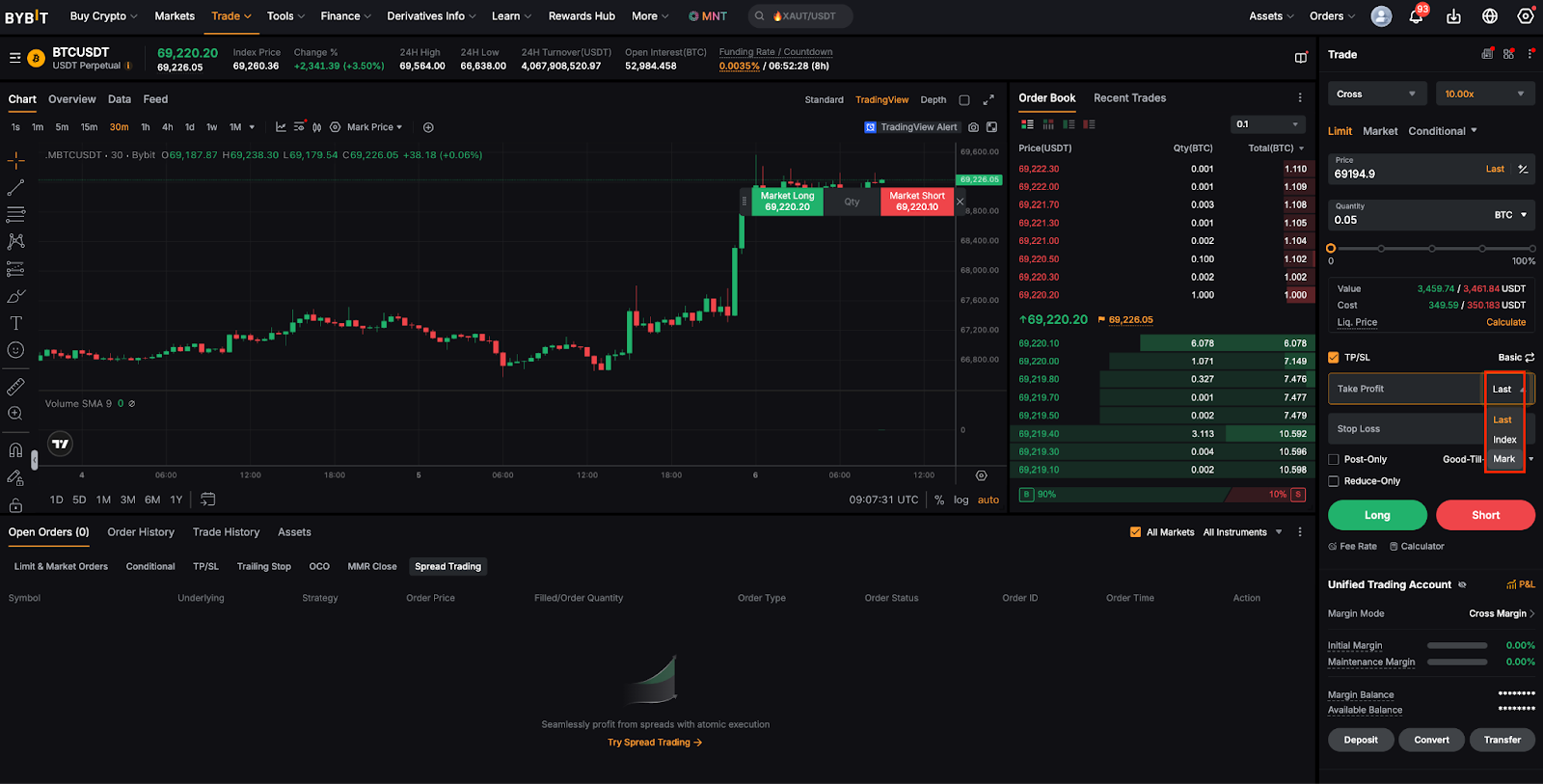
It’s worth remembering that TP/SL orders aren’t guaranteed to be executed at the exact price level you set, since they’re subject to market conditions and the availability of liquidity. Therefore, assess the risk involved, and monitor your trades regularly to minimize any potential losses.
Which trigger should you use?
On Bybit, you can set your TP/SL order using either the last price or mark price as your trigger price. Depending upon the market conditions, using either the last price or mark price as the trigger price may offer more benefits, making it imperative to know the differences — and how this will affect your trades.
Feature | Last price (LTP) trigger | Mark price trigger |
Pros | Execution accuracy: Provides a better estimate of your actual exit price, as orders are filled based on the available liquidity at the last traded price. | Liquidation protection: Your stop loss will almost always trigger before a liquidation occurs, as both the stop and the liquidation event use the same reference (mark price). |
Cons | Liquidation gap risk: There’s a risk that your stop loss will fail to fire before your position is liquidated, because liquidations are triggered by the mark price, which may move differently than the LTP. | Slippage risk: You may experience higher slippage. The order triggers based on mark price, but fills at the current LTP. If there is a wide gap between the two, your fill price might be worse than expected. |
Note that TP/SL orders aren’t guaranteed to execute at the exact price you set, because they’re subject to market conditions and available liquidity.
What to note regarding LTP and mark price when trading
In volatile markets, the last traded price can temporarily diverge from the mark price, resulting in an unrealized PnL immediately after order execution — which is not a real gain or loss. Additionally, note that risk limit tiers now adjust dynamically with the mark price, so a sudden price movement can raise your margin requirements. As such, you should always monitor the distance between your liquidation price and the mark price.
Conclusion
The last traded price and the mark price serve distinct yet complementary roles in derivatives trading. Last price affects order execution and realized PnL, while mark price primarily impacts unrealized PnL, liquidation triggers and margin calculations.
Deciding which trigger you assign your TP/SL orders depends upon your priority. Execution accuracy favors last price, while liquidation protection is achieved with mark price. Neither choice is universally superior, as the right choice depends upon your position size, margin mode and risk tolerance.
#LearnWithBybit
