


How to trade crypto futures on Bybit

Crypto futures let you take long or short exposure to a token's price without holding the asset itself. This distinction sounds minor until leverage is taken into account: a 2% price move against an unleveraged spot holding barely registers, while the same move against a 25x futures position can erode a meaningful chunk of your margin.
Bybit structures its futures market around three settlement currencies and two contract types, perpetual and expiration. Picking the right combination for your strategy is a fundamental part of derivatives trading.
In this guide, we show you how crypto futures contracts work on Bybit, which contract types you can choose and what risk controls deserve review before your first trade goes live.
Key Takeaways:
Futures contracts give you price exposure without requiring direct ownership of an asset, with leverage opportunities that can magnify both gains and losses.
Bybit offers contracts across Tether (USDT), USDC (USDC) and Inverse settlement. The two main types are perpetual and expiration-based futures.
Liquidation is triggered by the mark price, rather than the last traded price, a crucial detail many beginners overlook.
What are crypto futures contracts?
A futures contract is an agreement to exchange an asset, or its cash equivalent, at a set price on a future date. Perpetual contracts, one popular form of futures, skip the date restriction entirely: instead, they rely on periodic funding payments — exchanged between long and short position holders — to keep the contract price tracking the asset’s spot market value closely.
Traditional finance futures operate within regulated exchanges, fixed trading hours and a narrower asset range. They cover commodities, currencies and equity indices. In contrast, crypto futures trade continuously on cryptocurrency exchanges, with regulatory treatment varying sharply by jurisdiction — a detail worth noting, instead of assuming the same investor protections apply as for traditional finance contracts.
The core advantage of futures is directional flexibility. You can open a position for a price increase or decrease without buying or selling the underlying token. Leverage lets you control a larger notional position with less posted capital, though losses are calculated against your full exposure, not your margin alone. This is another important detail that beginners often overlook.
Types of crypto futures contracts on Bybit
Bybit's futures product line includes three settlement currencies and two key types of futures: perpetuals and expiration-based contracts. The table below outlines the main futures types on Bybit, along with their typical tickers.
Settlement type | Perpetual | Expiration-based |
USDC | BTCUSDC, ETHUSDC, SOLUSDC, etc. | NA |
USDT | BTCUSDT, ETHUSDT and dozens more | BTCUSDT-31JUL26, ETHUSDT-31JUL26 |
Inverse | BTCUSD, ETHUSD, XRPUSD, etc. | BTCUSD0925, ETHUSD0925 |
USDT and USDC contracts settle in their respective stablecoins, so profits and losses remain denominated in a dollar-pegged unit. This is why most beginning futures traders start here, rather than with inverse contracts.
Inverse contracts work differently: margin and settlement transact in the base cryptocurrency itself. For example, a BTCUSD position posts and pays out in Bitcoin (BTC), not in a stablecoin. This adds a nuance most newbies underestimate, since collateral value moves with the same asset you're trading, rather than staying fixed in dollar terms.
The symbol format indicates the contract type immediately, once you know how to read it. BTCUSDT represents a USDT perpetual contract, while BTCUSDT-31JUL26 denotes an expiration contract settling on that specific date. Inverse perpetuals drop the date entirely, as in BTCUSD, while inverse expiration contracts append a date in MMDD format, such as BTCUSD0925. Recognizing this pattern keeps you from accidentally opening the wrong contract type — which happens more often than you'd expect among newer traders scanning a long list of symbols.
Perpetual contracts carry no expiration date, and use funding rate payments that are exchanged periodically between long and short holders to stay close to the asset’s spot price. Expiration contracts — called Futures on Bybit to distinguish them from Perpetuals contracts — settle automatically at a fixed calendar date, based on the index price, closing every open position at that point regardless of your preference.
Leverage limits vary by contract and liquidity tier. For example, BTCUSDC perpetuals support up to 125x leverage, while smaller or thinner-liquidity assets have lower leverage ratios. For more details on futures contract rules, see Bybit's relevant help page.
How do crypto futures contracts work?
With futures contracts, you can choose to open either a long or a short position. Going long will profit you when you expect the price of the asset to rise. Conversely, going short is profitable when the asset’s price falls.
As an example, let’s say the BTCUSDT contract is priced at 50,000 USDT. If you open a position using 5,000 USDT of your own capital as margin with 10x leverage, you have an effective market exposure of 50,000 USDT (exactly 1 BTC). If the price climbs to 51,000 USDT, a 2% move, your position gains 1,000 USDT, which represents a 20% return measured against your initial margin. In this case, leverage scaled a modest price move into a much larger percentage outcome.
Let’s run the same math in reverse. A drop to 49,000 USDT erodes 1,000 USDT in margin, a 20% loss, with a slightly larger adverse move possibly pushing the position toward liquidation. This is the part beginners may frequently underestimate: leverage doesn't just amplify favorable outcomes — it amplifies whichever direction the market happens to move. If the movement is against you, e.g., a price increase while you hold a short position, your losses can magnify quickly.
The symbol itself indicates the settlement asset and expiration. BTCUSDT-31JUL26 settles in USDT on Jul 31, 2026, and closes automatically at the index price on that date.
Perpetuals never reach a settlement point like this. Instead, they rely on periodic funding flows between longs and shorts to keep the contract price near spot value indefinitely.
Maintenance margin is the minimum equity required to keep a position open. Once your equity drops below that threshold, liquidation automatically closes the position to contain losses within your posted collateral, rather than allowing the deficit to spread further. Bybit calculates this against the mark price, not the last traded price, something you should be aware of at all times. The mark price blends a spot index with a funding basis rate. This smoothes out the kind of thin-orderbook spike that could otherwise liquidate a position on a single erratic trade, rather than genuine, sustained market movement.
How to trade crypto futures on Bybit
In this section, we’ll provide screenshots of the relevant steps in the Bybit mobile app. The flow on the desktop version generally mirrors the same steps: navigate to Trade, then Futures, select the relevant contract, and set its order parameters before confirming the transaction.
Step 1: If you haven’t done so, open a Unified Trading Account (UTA). New account registrations are set to a UTA by default. Existing Standard Account holders can upgrade through account settings before attempting to trade futures contracts.
Step 2: Fund your UTA. Deposit crypto or fiat, and confirm you select the correct network before sending funds, since a wrong network selection can delay or strand your deposit. If your funds land in your Funding Account, rather than your UTA, transfer them to your UTA before placing an order.
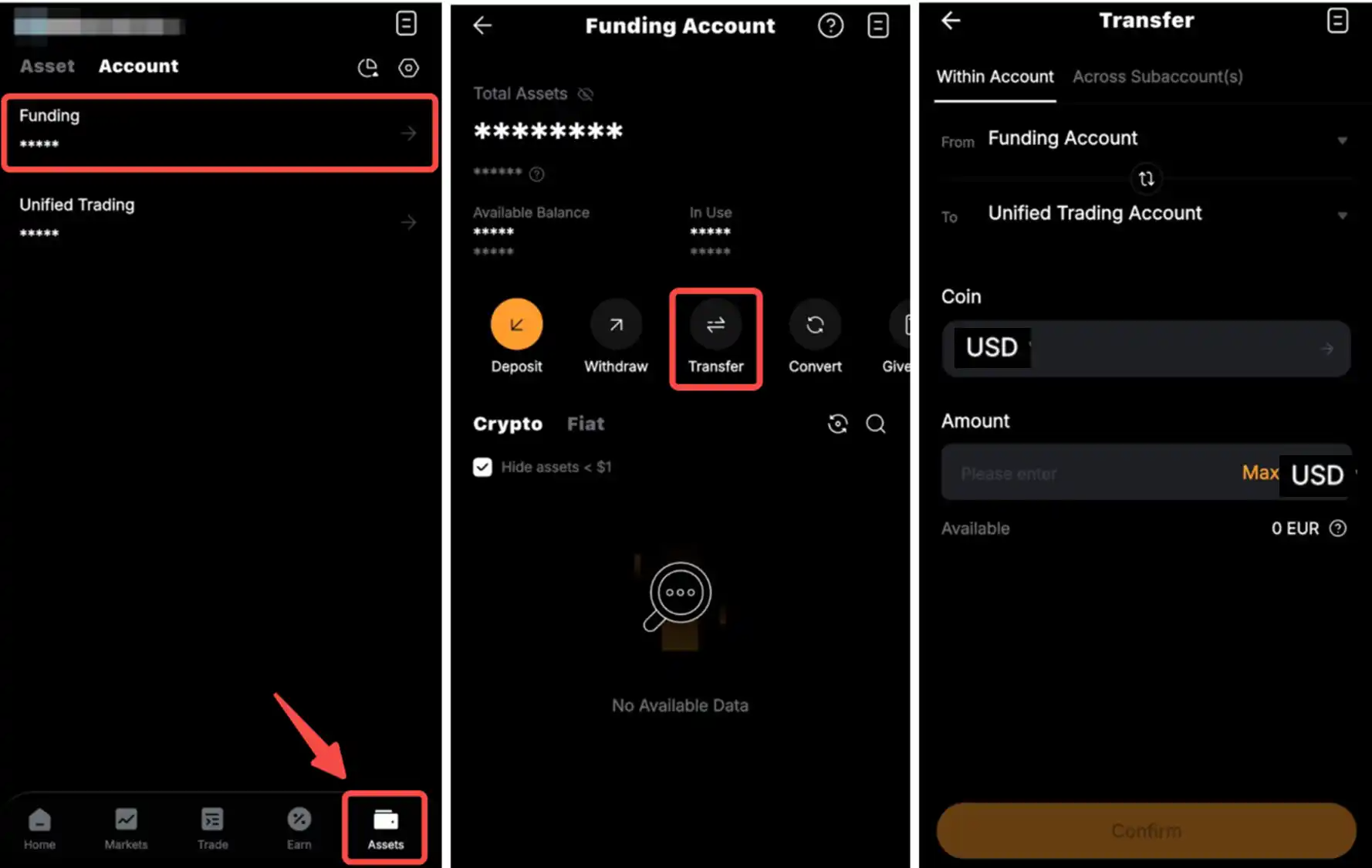
Step 3: Practice with Demo Trading. Where available, Bybit's demo environment lets you place orders and get familiar with the interface without risking real funds. This practice is well worth running through before your first live trade, rather than learning the mechanics under real market pressure.
Step 4a: Open a position. From the Trade menu item at the bottom of the Bybit App’s homescreen, select Futures. Then, tap on the default ticker in the top-left corner, choose the Perpetual or Futures tab, and select the USDC, USDT or Inverse sub-tab, depending upon your contract preference.
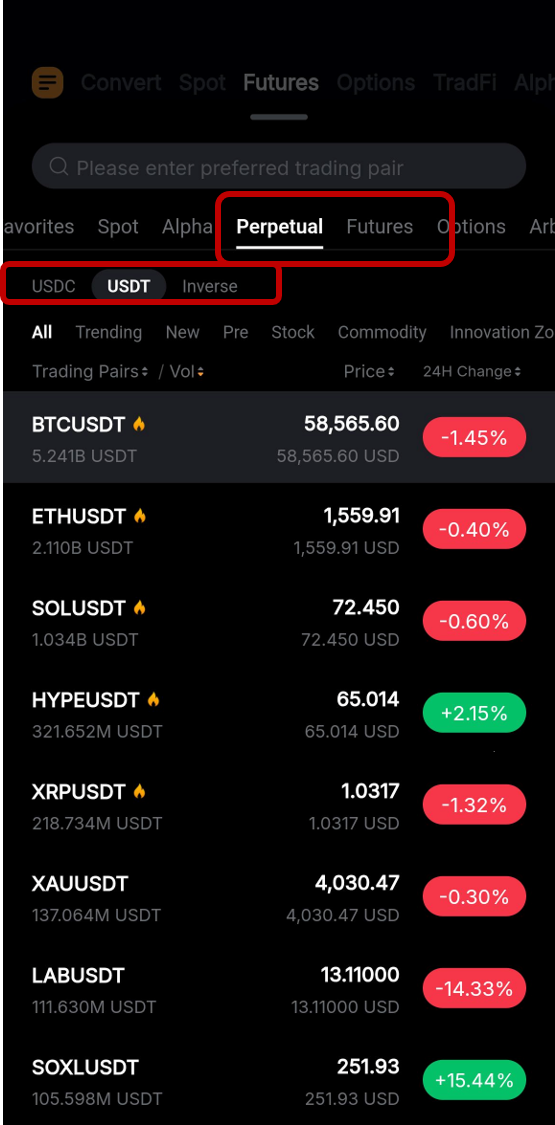
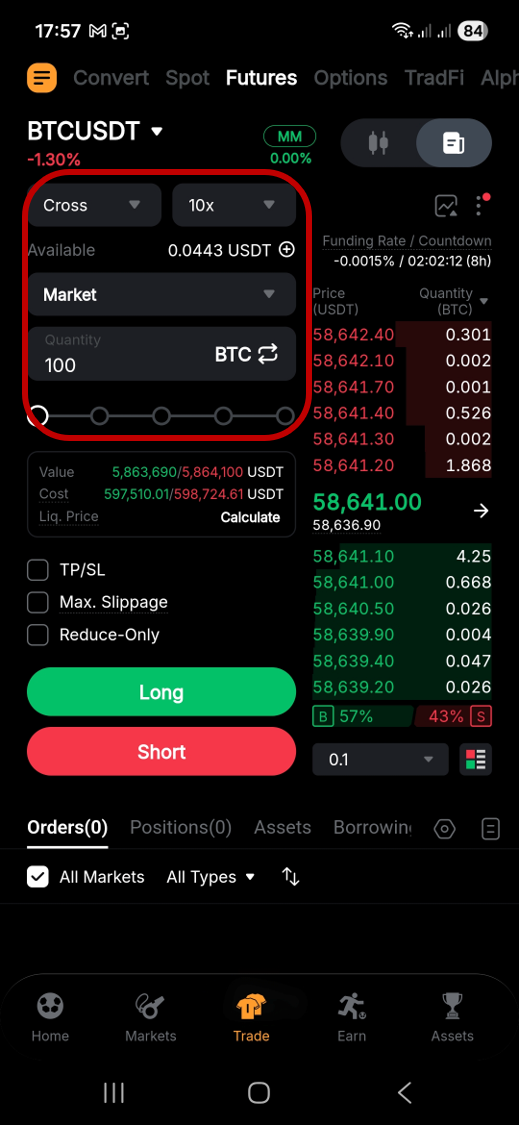
Step 4b: Tap on your preferred contract to open its trading interface. On the trading interface, first select your preferred margin mode: Isolated margin caps risk at the margin assigned to that one position, while Cross margin draws from your full account balance, absorbing larger swings at the cost of exposing more capital to a single trade. Portfolio margin is an advanced mode for traders managing several correlated positions at once, though beginning traders rarely need it on day one. For more detailed information on margin modes, consult this guide.
Step 4c: Set leverage via the slider or manual entry, pick your order type (Limit, Market or Conditional) and set your order amount.
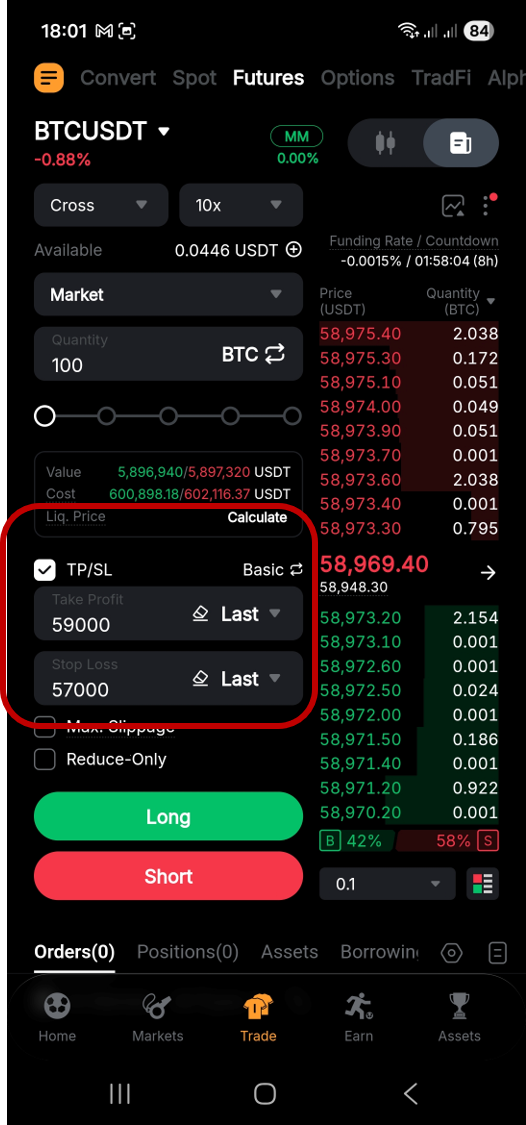
Step 5: Set TP/SL for risk management. Take-profit and stop-loss orders automatically close your position once price hits a set level. This matters more under leverage than in spot trading, since an adverse move can trigger liquidation before you could manually exit.
Check the TP/SL tickbox, then set your take-profit and stop-loss levels in the respective fields.
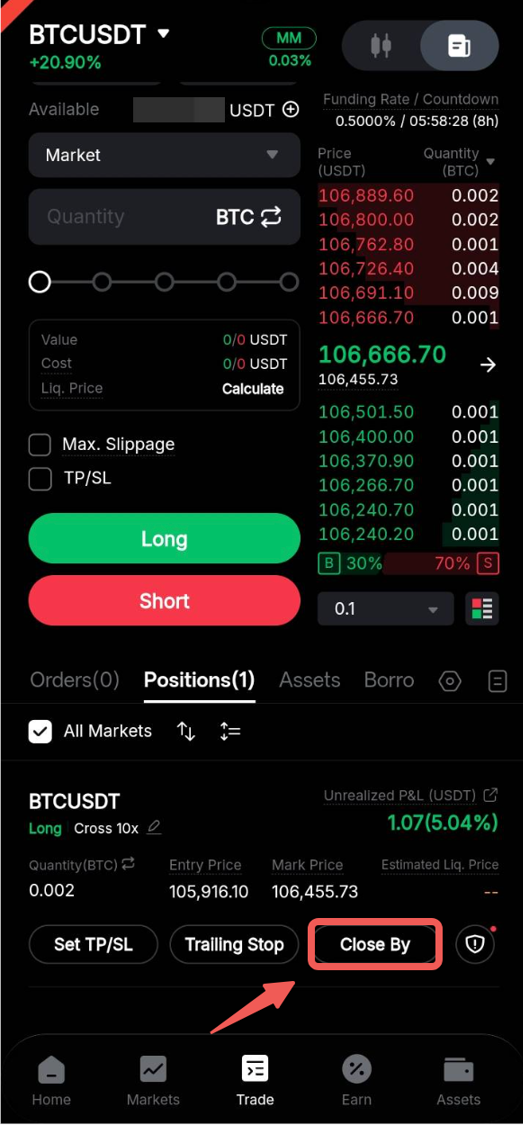
Step 6: Monitor and close your position. The Positions tab shows unrealized PnL, margin ratio and liquidation price. Close manually via Market or Limit orders, let TP/SL trigger automatically, or close part of the position if you'd rather scale out gradually (rather than exit all at once).
Common ways traders use crypto futures
Futures are used for a number of popular trading approaches and strategies, such as hedging, day trading, swing trading and more.
Hedging offsets risk in an existing spot holding by taking an opposing futures position, protecting against downside without forcing a sale of the underlying token. Day trading opens and closes positions within a single session, while scalping compresses that further, chasing small, rapid price movements across many trades in quick succession. Swing trading holds positions over days or weeks to capture a medium-term trend, and position trading stretches that horizon to weeks or months based on broader directional conviction, rather than short-term noise.
Whichever technique fits your style, the same principles apply across all of them: set stop-losses before entering (rather than reacting mid-trade), diversify instead of concentrating exposure in one correlated bet — and never risk capital you can't afford to lose outright.
Benefits of trading crypto futures on Bybit
Flexible leverage lets you pick a level matched to the contract and your own risk tolerance, rather than being locked into a single, fixed ratio across every trade. A trader who’s comfortable with volatility on a major pair like BTCUSDT might run higher leverage than they would on a thinner, more erratic altcoin contract. Bybit's per-contract leverage caps directly reflect that difference.
Transparent trading fees, with the most up-to-date rates published on Bybit's fee schedule, make it possible to calculate costs upfront instead of having them surface as a surprise after a string of trades.
Deep liquidity on major contracts helps support smoother order execution and tighter spreads. It also reduces slippage on both entries and exits, particularly in fast-moving markets where thin liquidity elsewhere would widen the gap between the expected price and the filled price.
Built-in risk controls — such as TP/SL orders and multiple margin modes — let you define an exit before you ever enter a position, rather than improvising under pressure once a trade has already moved against you.
Together, these features help you manage risk, though none of them changes the underlying volatility you're trading against.
Risks of crypto futures trading
Leverage amplifies losses with the same force it amplifies gains. A modest adverse move can erase a meaningful share of your margin faster than spot trading ever would.
Liquidation means losing your allocated margin outright. Under Cross margin mode, that exposure can extend beyond a single position to your broader account balance, since collateral is shared across open trades, rather than ring-fenced per position.
Crypto markets carry a level of volatility that spot traders can often tolerate, but leveraged futures traders cannot afford to ignore. Price swings of several percent within a single session aren't unusual even on major pairs, let alone smaller-cap contracts.
Funding fees on perpetual contracts accrue periodically. They’re credited or debited depending upon which side of the trade you're holding, and they can quietly erode returns on positions held over longer periods — particularly when the funding rates trend persistently in one direction.
Regulatory treatment of crypto derivatives is uneven across jurisdictions, adding a layer of uncertainty that lies entirely outside price risk, and is harder to hedge against directly.
Futures trading punishes a lack of risk management knowledge more severely than spot trading does. Therefore, anyone who doesn’t yet have a working grasp of margin requirements, liquidation triggers and mark-to-market mechanics should build that understanding before committing meaningful capital.
These risks are precisely why Bybit pairs leveraged products with TP/SL options and visible liquidation price tracking under the Positions tab, rather than leaving risk controls as something you configure only after a position is already underwater. Treating these tools as optional — rather than as a starting requirement — is where most avoidable liquidations originate.
Conclusion
Crypto futures offer flexible, capital-efficient exposure, along with hedging tools that spot trading can't replicate. However, this flexibility comes bundled with liquidation risk, funding costs and the amplifying effect that leverage has on both gains and losses. Beginning crypto futures traders should start with conservative leverage, confirm their margin mode and set TP/SL safeguards before opening positions.
None of these steps eliminate market risk entirely. But skipping them is how a manageable first trade can turn into an avoidable liquidation. Treat these risk controls as a firm prerequisite — not an option — before sizing up your positions.
#LearnWithBybit