


Bybit x FXStreet TradFi Report: NVIDIA, AI momentum and $5 trillion potential

Key Highlights:
NVIDIA stock is nearing record highs ahead of two massive investment deals
Intel and OpenAI partnerships signal continued AI growth, not a peak
RSI and MACD indicators show room for further upside
Next major milestone: $205/share, which would bring NVIDIA’s market cap to $5 trillion
Explore xToken with Bybit here.
Macroeconomic context: AI is still booming
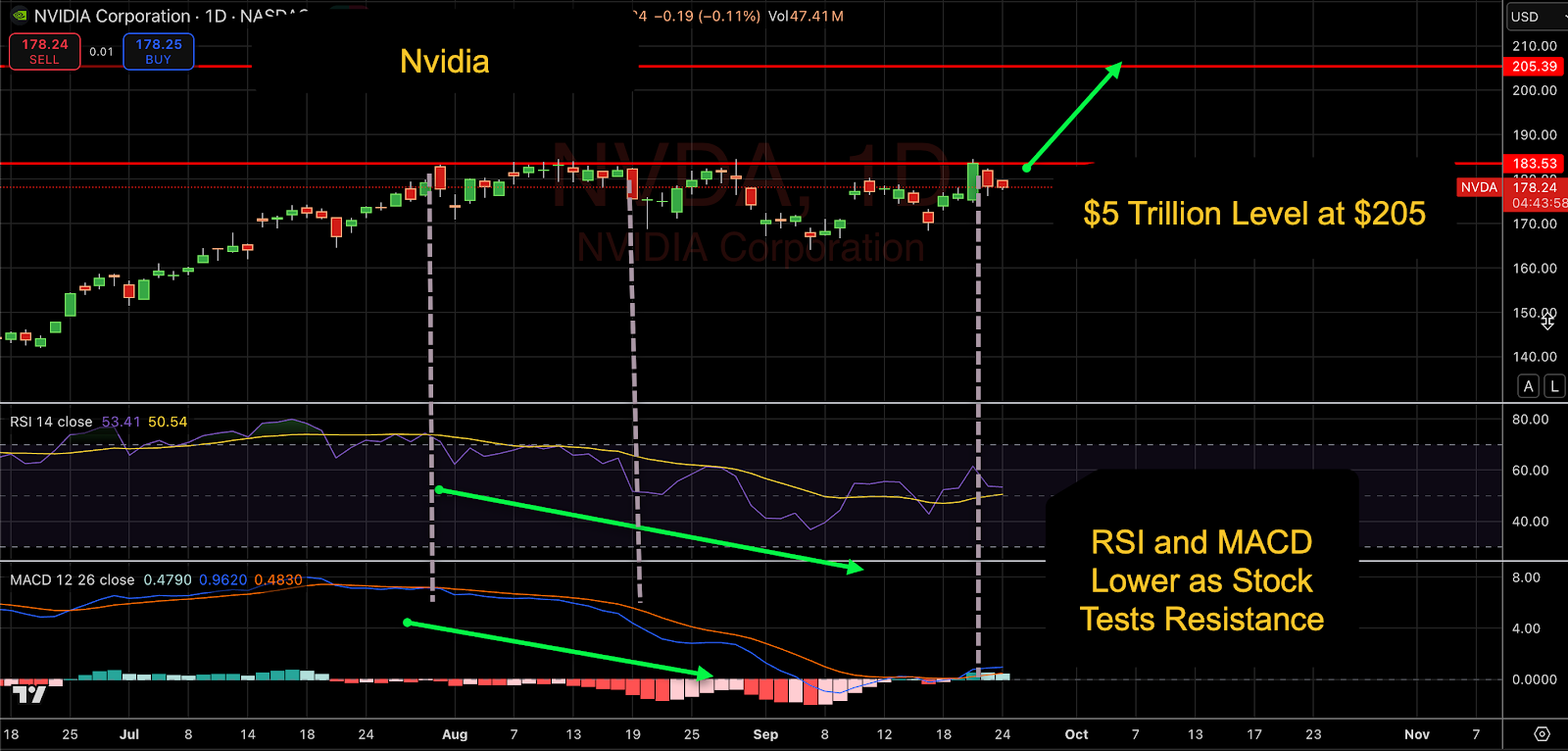
NVIDIA stock is trading close to its all-time high (ATH) of $183.61, reached on September 22. Similar levels were tested throughout July and August, making this a strategic pivot point. In technical terms, resistance zones that are tested multiple times often become breakout areas, triggering fresh demand.
Two key developments have fueled this latest uptrend:
1. $5 billion investment in Intel
NVIDIA recently announced a $5 billion investment in Intel. The two companies plan to work together to develop next-generation chips for data centers and personal computers. This deal immediately boosted confidence in both firms as Intel shares jumped more than 22% on the news, their best single-day gain in decades. NVIDIA’s stock also moved higher.
NVIDIA’s CEO called the deal a way to combine strengths from both sides and help build the next generation of technology. It also marks a rare partnership between two chipmaking giants who typically compete. By working together, they aim to speed up innovation in AI hardware and offer faster, more efficient solutions for growing global demand.
2. $100 billion partnership with OpenAI
NVIDIA is also teaming up with OpenAI in a massive new project. Their plan is to build large-scale data centers powered by NVIDIA hardware. As part of this effort, NVIDIA may invest up to $100 billion over time, starting with an initial $10 billion.
The goal is to meet the growing demand for AI systems. NVIDIA’s CEO described it as a “giant project” that could play a key role in the next phase of artificial intelligence. OpenAI will use millions of NVIDIA chips, and the first major delivery is expected in 2026. This partnership could shape the future of AI infrastructure, and marks one of the biggest hardware-focused deals in the space.
Is AI still in its early stages?
Despite ongoing questions about a potential AI bubble, these investment announcements point in the opposite direction. In the latest Fed meeting, Federal Reserve Chair Jerome Powell noted that AI might already be impacting the labor market. He said there are signs AI is contributing to job weakness, though the full effects are still unclear.
Meanwhile, workforce reshuffling due to AI is picking up pace. Companies like IBM have publicly acknowledged reducing head counts due to automation, and employment experts suggest many other firms are doing the same, just without naming AI directly. This supports the idea that AI remains in early expansion, not at saturation.
Risks: Geopolitics and competition
Primary risks to NVIDIA’s dominance include geopolitical tensions and rising competition. The ongoing trade war between the US and China could limit exports, while rival firms like AMD, Broadcom Inc. and ARM Holdings are scaling up their AI capabilities. As the market matures, NVIDIA may need to defend its lead against a broader field of challengers.
That’s why many traders prefer to diversify by holding an AI stock basket, such as NVIDIA, AMD, Broadcom Inc., Google, Amazon, Meta and Microsoft.
Technical analysis: Room to grow
NVIDIA stock has hovered near the $183 zone for the past two months. It first reached that level on July 31. Back then, the relative strength index (RSI) indicator on the daily chart signaled overbought conditions, and the stock corrected to $173 the next day.
Since then, each new test of the $183 level has shown decreasing RSI readings, indicating that the price is adjusting to the higher valuation. In fact, the September 22 record high of $183.61 was reached with RSI at just 61, far from overbought territory.
Meanwhile, NVIDIA’s moving average convergence divergence (MACD) indicator is nearly flat. despite the stock’s climb, confirming that technical pressure is moderate. This opens the door for another breakout.
The next major milestone is $205. That’s not just a round number, as it would mark a $5 trillion market cap for NVIDIA. For comparison, the entire crypto market is currently worth around $3.9 trillion.
Source: TradingView
Path to $205
A rise from the current stock price of $178.64 to $205 would represent a 15% gain. There are two main drivers that could fuel this move:
1. Macroeconomic momentum
If upcoming inflation data shows a slowdown, or if there is progress on trade negotiations between the US and China, broader market sentiment could improve and lift AI-related stocks like NVIDIA.
2. NVIDIA’s upcoming earnings report in November
Strong results, either from NVIDIA or other key AI players (such as Microsoft, Meta, Amazon or Google) could reinforce market confidence in the sector and push NVIDIA stock closer to the $5 trillion milestone at $205.
Conclusion: NVIDIA leads the AI wave
AI investment and adoption aren’t slowing down. If anything, the latest Intel and OpenAI deals show that the trend is accelerating. NVIDIA remains at the center of this shift, supplying the backbone for AI data centers and applications.
Both technical indicators and fundamental news point toward further upside. With RSI and MACD showing no major warning signs, and two multibillion-dollar partnerships confirmed, the stock could be preparing for a new leg higher.
NVIDIA isn’t just riding the AI wave — it’s building the infrastructure beneath it. And with a $5 trillion valuation in sight, the momentum remains strong.