


Bybit x FXStreet TradFi Report: How US labor data to be released this Friday will drive gold, crypto, and dollar volatility

Key Highlights:
October 3 NFP report could shape Fed’s next move
Rising unemployment and weak job creation are raising recession concerns
First Fed rate cut already in, more cuts likely if labor weakens
Gold at $3,800 and EUR/USD above 1.175 ahead of key data
US shutdown threat could delay NFP report and ETF approvals, and boost safe havens
Trade with Bybit Tradfi here.
Labor data as a core market driver
Labor data, especially US Nonfarm Payrolls (NFP), remains one of the most influential market catalysts. It provides a snapshot of the job market, and plays a key role in shaping Federal Reserve policy, which in turn impacts the US dollar, gold, silver, equities, and even crypto prices.
Strong job creation typically supports the dollar, weakens precious metal prices and boosts stock confidence. Conversely, rising unemployment often signals broader economic stress, pushing investors toward safe-haven assets like gold, silver and increasingly, Bitcoin.
Even commodities such as oil react to labor data: stronger job numbers imply more economic activity and demand for fuel, while weaker data may signal a slowdown in energy consumption.
Why October’s data matters more than usual
This month’s jobs reports carry extra weight for three reasons:
The job market is at a turning point. After years of steady employment gains, the US unemployment rate has started to rise. Fewer jobs are being created, and analysts are debating whether this signals a temporary slowdown, or something deeper. Some point to macro cycles, others to AI adoption and tariff-related uncertainty.
Rate cuts are now part of the story. On September 17, the Federal Reserve cut interest rates from 4.5% to 4.25%, its first cut of the year. The Fed cited weakness in the labor market as a key concern. Markets now expect more cuts in the coming months, especially if October labor data disappoints.
Monetary policy is back in play. The Fed’s next decision comes on October 29. That makes October’s labor data especially important. Any surprise in the numbers — positive or negative — could significantly shift interest rate expectations and asset pricing.
Jobs report calendar
Traders are closely watching two key jobs reports this week:
Wednesday, October 1 — ADP private payrolls report: This measures job creation in the private sector, and is seen as a preview of the broader NFP report. It doesn't include government jobs, but often sets the tone for the NFP report.
Friday, October 3 — NFP report (12:30 GMT): This includes total job creation, unemployment rate and wage growth. It’s considered a major trading event, especially ahead of a known Fed rate-decision window.
Consensus forecasts:
+52,000 new jobs
Unemployment rate: 4.3%
Wage growth: +0.3% month-over-month
Traders compare the actual numbers to these forecasts and adjust their positions accordingly. A major miss or beat can generate sharp moves across dollar pairs, metals and crypto.
Fed reaction function: Weak jobs = lower rates
The Fed uses labor data to determine how tight or loose monetary policy should be. A weak labor report tends to push the central bank toward further rate cuts. When rates fall, the dollar tends to weaken, boosting demand for assets that don’t earn interest, such as gold and Bitcoin.
More importantly, labor data influences how much capital stays in the US banking system. Lower rates prompt investors to seek better returns elsewhere, often in alternative assets, emerging markets or crypto.
US government shutdown risks
Adding to the uncertainty is the growing threat of a US government shutdown. Congress has until Wednesday to pass a funding bill. Without one, nonessential federal agencies — including the Bureau of Labor Statistics and the SEC — may shut down.
If that happens:
Friday’s NFP report may be delayed.
SEC decisions on ETFs, including for Solana and Litecoin, could be postponed.
Market anxiety could rise, supporting gold, silver and Bitcoin.
Historical precedent suggests that shutdowns create volatility. The last major one occurred in late 2018 and lasted 34 days, halting key government functions.
Technical setups
Gold
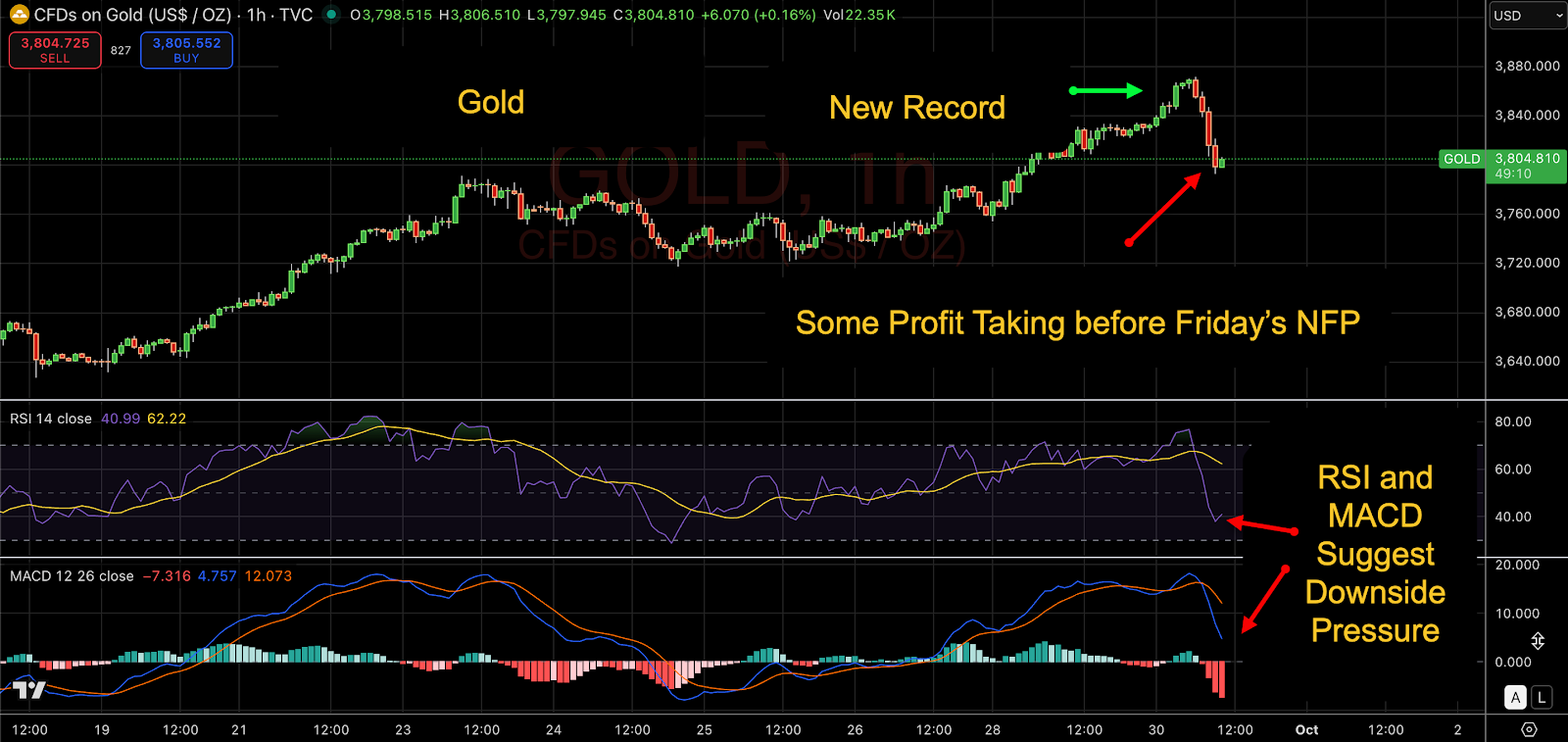
Gold is in a strong uptrend, having reached a new all-time high of $3,872 earlier this week. The price has since consolidated near $3,800 ahead of Friday’s report.
RSI (1-hour chart): Reached 78 at the high, signaling short-term overbought conditions
MACD: Turning negative, hinting at consolidation or mild pullback
Support: A drop below $3,800 could send prices quickly toward $3,750, with stronger demand likely near $3,700.
A weak NFP could restart the rally toward $3,872
Source: TradingView
EUR/USD
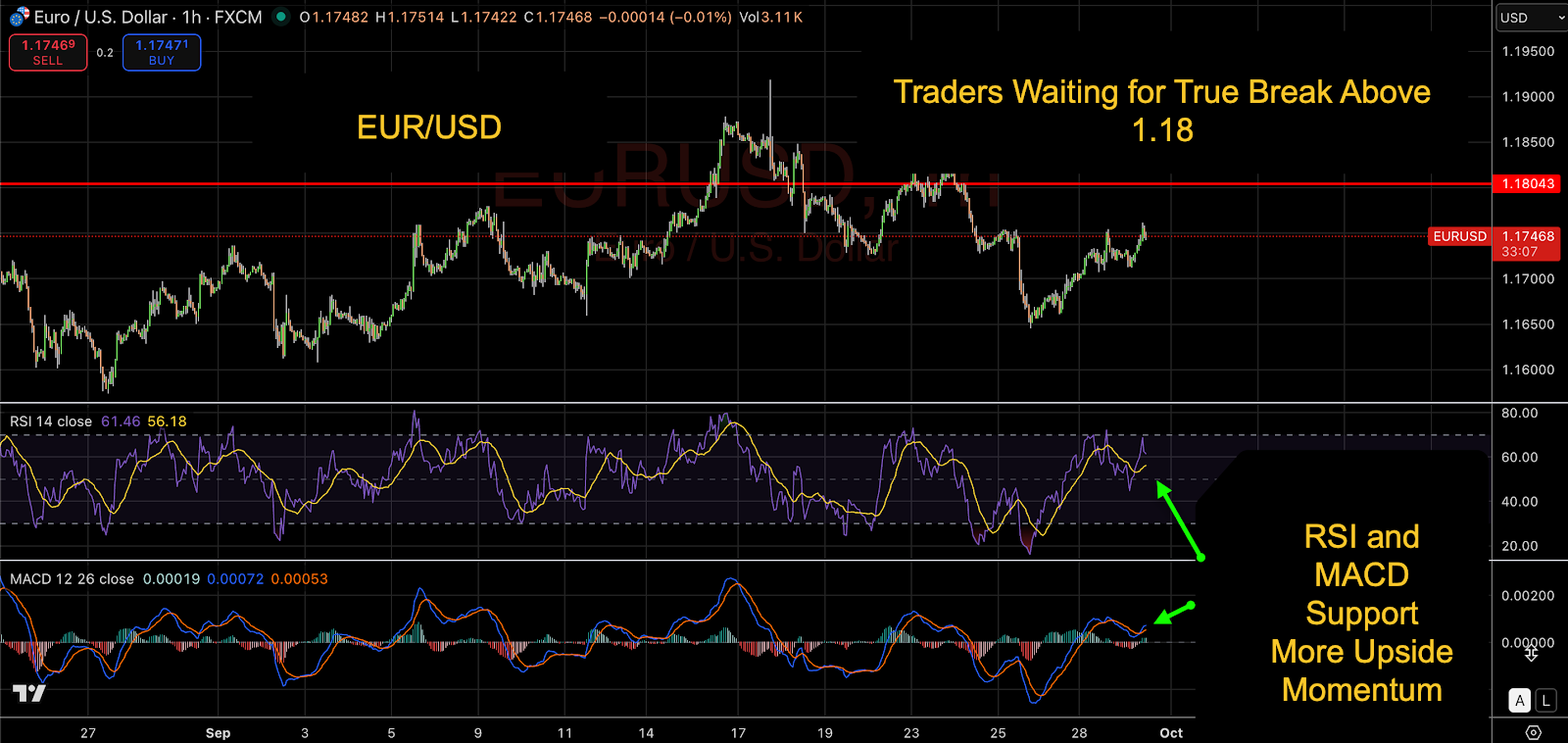
EUR/USD is trading above 1.175 as the dollar softens. This pair is highly reactive to labor data and Fed signals.
Key resistance: Currently at 1.18, it’s failed to break decisively in recent sessions
If breached: Could open the door to 1.20, a level last seen in June 2021
RSI: Neutral at around 62 on the 1-hour chart
MACD: Slightly positive, suggesting a potential breakout
Source: TradingView
Implications for crypto
A strong NFP report typically boosts confidence in the US economy, supporting the dollar, the stock market and, oftentimes, the crypto market as well. Bitcoin, in particular, tends to rally alongside risk assets when economic data surprises to the upside. However, a weak NFP print may have the opposite effect, putting pressure on the dollar and equities. Bitcoin is often treated as a hybrid asset. At times, it moves with gold during periods of market uncertainty, but it can also decline with stocks when investor confidence drops.
Conclusion
This week’s labor data could be pivotal. With the US economy at a potential inflection point and the Fed already starting to cut rates, stronger jobs numbers may fuel further gains in the dollar, stocks and crypto. Conversely, weak data could weigh on investor sentiment and trigger downside moves across equities, the dollar and Bitcoin. Gold and silver may benefit from that uncertainty. Traders should prepare for volatility and monitor both the ADP and NFP reports closely, as these could shape near-term direction across all major asset classes.