


Bybit x FXStreet TradFi Report — Gold and silver poised to shine as Fed prepares first rate cut

Key Highlights:
Fed expected to cut the interest rate from 4.5% to 4.25% on Wednesday
Market pricing in a 70% chance of rates at 3.75% by year end
Weak US jobs data raises expectations of further cuts and monetary support
Gold and silver are benefiting from lower interest rates and a rising money supply
Technical breakout patterns signal further upside for both metals
Trade gold with Bybit here.
Macroeconomic environment: Fed cuts, weak jobs and liquidity pressure
The Federal Reserve is widely expected to announce its first interest rate cut of the year this Wednesday, reducing the benchmark rate from 4.5% to 4.25%. Markets are also anticipating forward guidance from Fed Chair Jerome Powell, particularly regarding the potential for further cuts in November and December.
Currently, traders are pricing in a 70% probability that the federal funds rate will fall to 3.75% by the end of the year. That would mark a substantial shift in just three months, leading to a sharp decline in returns on interest-bearing products, such as bank deposits, treasury bonds and money market funds.
According to recent estimates, trillions of dollars remain parked in interest rate–linked financial products. If yields continue to drop, a significant portion of this capital may rotate into alternative assets, such as stocks, cryptocurrencies, gold and silver — all of which tend to benefit in a low-interest rate environment.
Yet interest rates are only part of the equation.
The Fed’s motivation to cut rates goes beyond inflation management. It also reflects growing concerns about the US labor market, which has shown clear signs of weakening. The most recent employment data revealed a rising unemployment rate of 4.3%, the highest level since November 2021, coupled with slower job creation.
There are several long-term forces contributing to this trend:
Mature labor cycle: After prolonged periods of low unemployment, economies tend to cool naturally.
Trade uncertainty: US tariff policies, especially renewed under Donald Trump, are dampening business confidence and hiring.
AI disruption: The rise of automation and AI has led many tech firms to reduce head counts aggressively.
In recent months, a growing number of companies have begun replacing roles with AI systems, though few admit it outright. Instead of directly linking layoffs to automation, firms often cite broad terms like “restructuring,” “cost optimization” or “strategic realignment.” But many experts say that job cuts often take place right after companies start using AI.
Some tech and fintech firms have openly stated that AI adoption has led to head count reductions, especially in customer service, HR and back-office operations. One high-profile firm reduced its staff from 5,000 to 3,000 after fully integrating AI into its workflow. Industry experts believe this trend is much wider than reported, masked by corporate messaging designed to avoid criticism. This means that the official job numbers might not show how much automation is truly affecting workers.
If this weakness persists, the Fed and US government may feel compelled to stimulate growth through fiscal support, increasing public spending and liquidity injections, much as during the COVID crisis. During that period, trillions of dollars were added to the US money supply, which helped drive gold from $1,500 to over $2,000 in a matter of months.
That historical parallel is now back in focus for many investors.
Why gold and silver shine in this environment
Precious metals, particularly gold and silver, are seen as scarce assets that tend to perform strongly when real interest rates fall and money supply expands.
Gold is already up 43% year-to-date (YTD) and trading at new all-time highs (ATH).
Silver has gained 47% YTD, but remains below its historic peak, offering significant catch-up potential.
The logic is simple: when cash and bonds lose appeal, and inflation or debt concerns rise, capital seeks refuge in assets that cannot be devalued or easily reproduced. Gold and silver offer exactly that.
The combination of lower interest rates, a slowing economy and potential fiscal stimulus creates ideal conditions for a metals rally.
Technical analysis
Gold
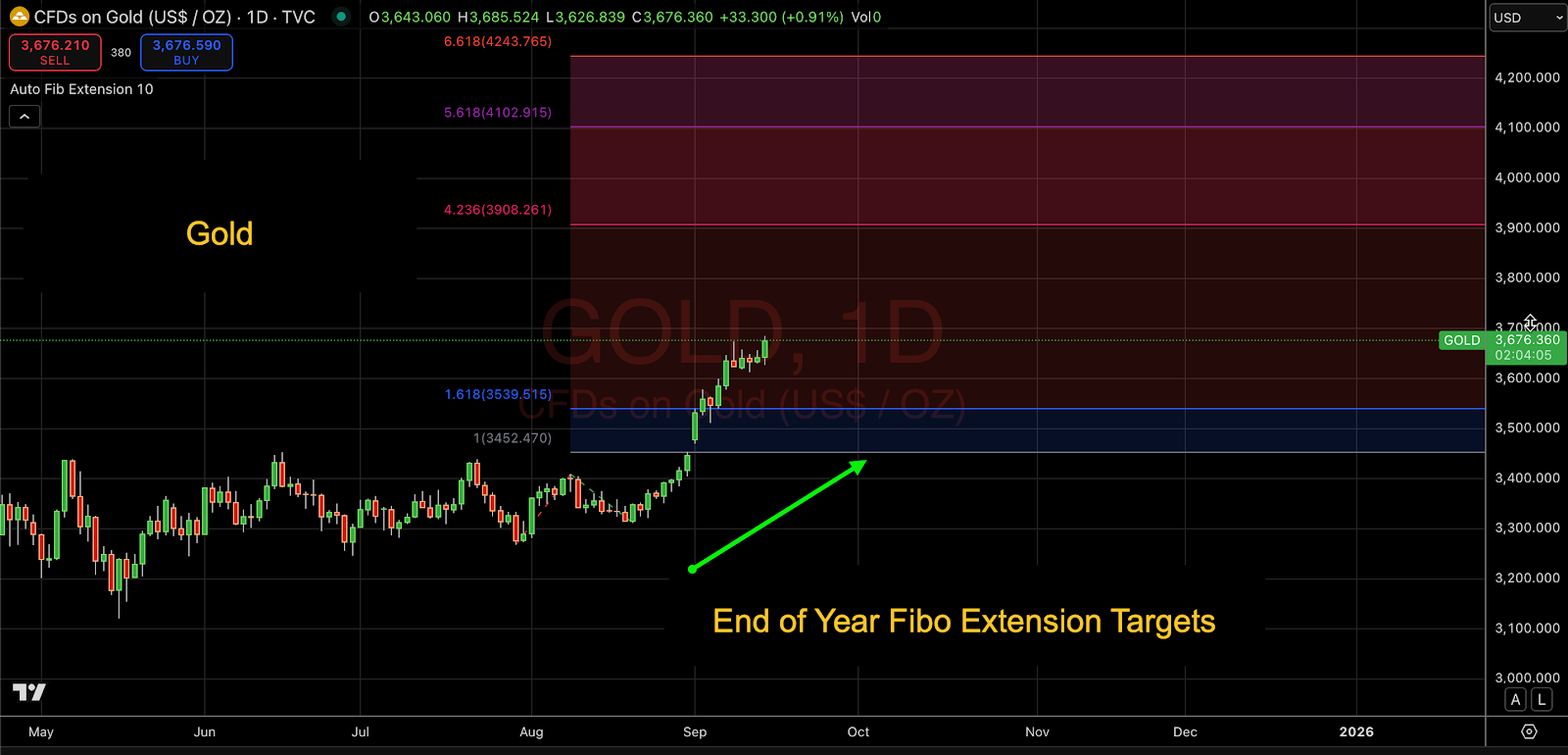
Gold is trading near $3,700, having recently broken through its all-time high (ATH). The technical setup suggests a continuation of the rally:
Resistance: The next key breakout level is $3,750.
Fibonacci extensions:
4.236 level = $3,900
5.618 level = $4,100
If the Fed signals multiple rate cuts, or if the unemployment narrative escalates, gold could surpass the $4,000 milestone in Q4 2025.
Source: TradingView
Silver
Silver is often viewed as gold’s more volatile sibling, offering both higher upside and sharper drawdowns. In 2025, the metal has outperformed most risk assets, and remains one of the best-performing commodities YTD.
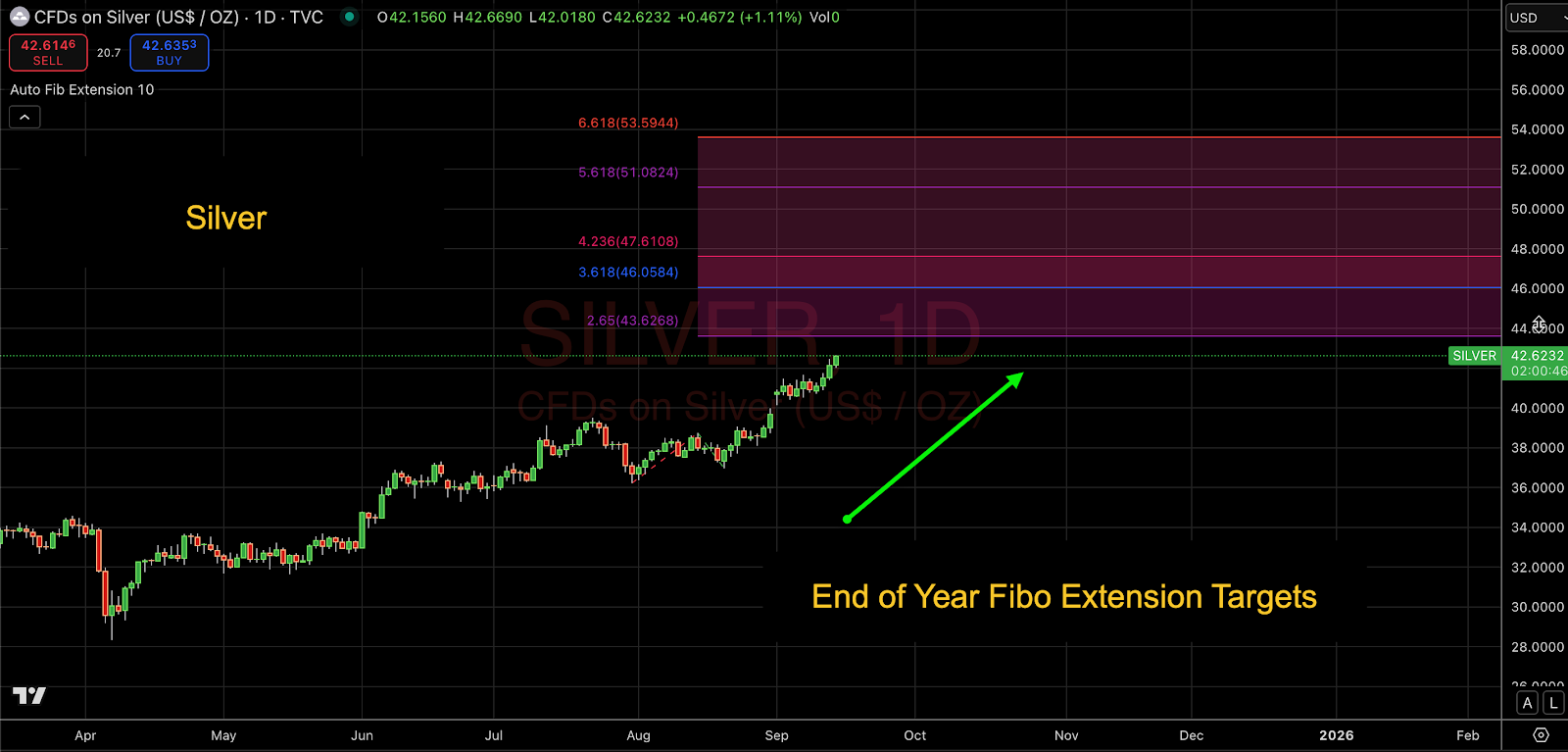
Current price: Near $42
Fibonacci targets:
2.65 extension = $43.62
3.618 extension = $46.00
ATH from April 2011 = $50.00
Given that silver remains below its 2011 ATH, many traders see this as a compelling opportunity. A move back to $50 would represent an additional 17% upside from current levels.
Source: TradingView
Conclusion: Metals outperforming as macro tides shift
Gold and silver are increasingly viewed as top-tier assets for 2025, offering inflation protection, yield alternatives and crisis hedges.
While tech stocks and cryptocurrencies like Bitcoin have also rallied this year, the major metals’ performance is more grounded in macro fundamentals: interest rates, money supply and structural demand for hard assets.
As of now (Sep 16, 2025):
Gold is targeting $4,000 by year end
Silver is making a run toward $50, its previous ATH
The Fed’s policy shift this week is expected to accelerate the rotation into metals
If weak labor data and monetary easing continue, gold and silver could become the clear winners of the second half of 2025.