


USDe and USDtb: Your guide to smarter yields on Bybit

Markets swing. Sentiment shifts. And most stablecoin holders are sitting on idle assets that are earning nothing. That's a missed opportunity most investors don't realize they're leaving on the table. Holding stablecoins through volatility is a rational move. But idle capital with zero yield is a significant opportunity cost.
The Ethena USDe (USDe) and USDtb (USDtb) stablecoins on Bybit close that gap, offering around 3.4%-3.75% APR simply for holding, with no decentralized finance (DeFi) protocols, external wallets, gas fees, or seed phrases to manage.
This article covers how these two stablecoins’ yield mechanisms differ, which one fits your risk profile, why Bybit is the right platform to earn yield on them, and how they connect to the broader Bybit Earn ecosystem.
Key Takeaways:
USDe generates yield through delta-neutral derivatives hedging, while USDtb anchors its yield to real-world US Treasury rates via BlackRock's BUIDL fund.
Rewards are calculated using your minimum hourly snapshot balance and are distributed daily to your Funding Account.
Both assets are accessible on Bybit with no DeFi complexity involved.
.png)
What are USDe and USDtb?
Both USDe and USDtb are USD-pegged stablecoins issued within the Ethena (ENA) ecosystem, but they represent two fundamentally different mechanisms for peg maintenance and yield.
USDe is a synthetic dollar. Its peg is maintained through automated derivatives positions, rather than fiat reserves, and its yield flows from the mechanics of those positions. It targets a higher, variable return, calibrated to conditions in crypto derivatives markets.
USDtb takes the opposite approach. It’s a fully backed stablecoin whose reserves sit predominantly in BlackRock's BUIDL fund, a tokenized vehicle holding US Treasury instruments. Its yield is anchored to real-world, risk-free rates, which makes it more stable, but also more modest in terms of returns.
While evaluating these two coins, you're choosing between two different yield architectures with different risk-return profiles. For a deeper breakdown of each asset, see our dedicated articles on USDe and USDtb.
Two stablecoins, two yield strategies
USDe: Crypto-native yield
Issued by Ethena Labs, USDe maintains its USD peg through delta-neutral hedging: Ethena holds spot crypto assets — primarily Ethereum (ETH), including liquid staking tokens such as stETH — and simultaneously opens equivalent short positions in perpetual futures markets. If the spot price rises, the short position loses the same amount; if it falls, the short gains. The result is a position whose dollar value stays flat regardless of price direction.
The gap between the spot position and the short generates yield. No traditional finance platform is needed here. When markets are in a bullish regime, perpetual futures traders pay a funding rate to hold long positions. Ethena, as the short counterparty, collects that rate. A second yield source comes from the staked backing assets themselves, such as stETH, which earns Ether staking rewards on top of the derivatives spread.
Combined, these two streams produce an APR of approximately 3.4%-3.75%. The rate is variable and adjusts with market conditions, particularly the direction and magnitude of perpetual funding rates. In extended bearish periods when funding rates turn negative, yields compress, which is a structural risk worth understanding before allocating.
Both holding USDe on Bybit and minting it directly through Bybit On-Chain Earn are available without whitelist restrictions, making access straightforward relative to the Ethena protocol.
USDtb: RWA-backed yield
While USDe derives yield from crypto derivatives, USDtb earns its returns in traditional finance. Over 90% of USDtb's reserves are invested in BlackRock's USD Institutional Digital Liquidity Fund (BUIDL), a tokenized fund that holds cash, repurchase agreements and US Treasury instruments. Each USDtb token represents a 1:1 claim against that reserve.
Due to this mechanism, USDtb’s yield aligns with real-world, risk-free rates, rather than crypto market sentiment. This makes USDtb considerably less volatile in its returns. When perpetual funding rates drop and USDe yield decreases, USDtb continues paying at a rate anchored to Treasuries. It thus acts as a stability buffer within an Ethena ecosystem position.
Current APR for USDtb is approximately 3.4%. The yield is deeply anchored to traditional finance, and is meaningfully more consistent than the USDe rate across market cycles. No staking or lockup is required, and Bybit is the first exchange to offer direct USDtb minting without access restrictions. For users who want exposure to on-chain yield with the risk profile of a T-bill, USDtb is a natural choice.
USDe vs USDtb: Side-by-side comparison
Both USDe and USDtb are pegged to the greenback, generate yield without requiring you to lock up capital and are accessible on Bybit with minimum friction. The difference between the two lies in how each asset is constructed, where its yield comes from and what kind of holder it’s built for.
USDe vs USDtb: Which one is right for you?
USDe and USDtb are built for different user types and risk profiles. The table below summarizes how they compare:
| USDe | USDtb |
Suitable user group | Yield-seekers comfortable with crypto-native instruments | Conservative users wanting institutional-grade stability and yields from real-world assets |
Main source of yield | Delta-hedging derivatives yield | Backed by RWA: BlackRock's BUIDL fund (US Treasury bills) |
Staking or lockup | No | No |
APR (approx.) | ~3.75% (variable, market-dependent) | ~3.4% (stable, TradFi-anchored) |
Peg mechanism | A synthetic USD deriving its relative peg stability from executing delta-neutral hedges | A blockchain-based token backed by institutional-grade tokenized US T-bills (BUIDL) |
How to mint/access | Buy on Bybit Spot, or Mint via USDe page | Buy on Bybit Spot, or Mint via USDtb page |
Other utility | Collateral for trading, DeFi integrations | |
Reward distribution | Rewards will be distributed to eligible users' Funding Accounts under their Main Accounts daily at 6AM UTC, according to hourly snapshots of USDe/USDtb balances held in Main Accounts, Subaccounts, Trading Bots and Unified Trading Accounts. Daily earnings are distributed to Funding Accounts under users’ Main Accounts each day at 6AM UTC. Earnings are calculated based on the lowest hourly snapshot balance of USDtb. |
Why Bybit? A platform you can trust
Bybit's position as one of the largest global derivatives exchanges reflects the institutional-grade infrastructure behind its platform.
Bybit maintains a publicly verifiable proof of reserves, meaning its 1:1 asset backing can be confirmed on-chain, rather than taken on faith. The majority of user assets are held in cold storage, kept offline, and are insulated from the attack surface that hot wallets expose. Across multiple jurisdictions, Bybit operates under regulatory frameworks that impose compliance obligations and audit requirements.
Users who are specifically earning with USDe or USDtb accumulate rewards in their Funding Accounts daily, and the assets backing those rewards remain on a platform with auditable reserves.
Why earn on Bybit?
Top-tier global exchange: Bybit is one of the largest exchanges by derivatives trading volume. It provides the liquidity depth and institutional counterparty access that makes USDe's funding rate yield structurally viable.
Proof of Reserves: Bybit features 1:1 asset backing, publicly verifiable on-chain with a cryptographically auditable commitment.
Cold storage security: The majority of user assets are held offline, reducing exposure to exchange-level hacks and/or hot wallet vulnerabilities.
Regulated operations: Bybit is compliant across multiple jurisdictions, with ongoing obligations around audits, capital requirements and user protections.
No DeFi complexity required: No decentralized wallets, gas fees or seed phrases are needed. Simply log in, buy or mint, and hold. Rewards accumulate automatically in your Funding Account.
Bybit Earn: What's next
Although USDe and USDtb are a clean entry point into stablecoin yield, they're not the only yield-generating opportunities on Bybit. Once you're earning with either asset, you have an on-ramp into the broader Bybit Earn ecosystem, a tiered structure that scales from passive holding to active yield strategies.
Spread arbitrage is one intermediate step worth knowing about. The core logic is simple: borrow stablecoins at a lower interest rate using margin, then invest the borrowed amount into USDe or USDtb at a higher yield. The gap between the borrowing cost and the earning rate is your spread. Bybit's margin trading infrastructure makes this accessible to non-institutional users, and the Bybit Learn guide to stablecoin spread arbitrage covers the mechanics in detail.
USDe and USDtb are just the beginning
Once you're earning with USDe or USDtb, you can stay exactly where you are — or also explore the full line of Bybit Earn products.
1. Easy Earn: Set-and-forget. This is the starting point for most beginners. Flexible savings let you withdraw at any time, while fixed-term deposits offer higher rates in exchange for a defined lockup period. Easy Earn is best for crypto newbies, and for passive holders who want principal protection with predictable returns.
2. On-Chain Earn: DeFi, simplified includes liquidity mining and staking across assets such as ETH and Solana (SOL). Since Bybit curates the on-chain opportunities and handles the underlying complexity, you get exposure to on-chain yield without having to manage wallets or gas. On-Chain Earn is most suitable for users who are ready to step beyond simple holding.
3. Advanced Earn: Structured products. This offers the highest-yield tier, with correspondingly higher risk products:
Dual Investment lets you execute buy-low/sell-high strategies around a target price.
Double-Win captures opportunities regardless of market direction.
Discount Buy accumulates selected assets at a lower entry price.
Advanced Earn products are best for yield maximizers who are comfortable with conditional payoff structures, and who can tolerate high risk.
How to get started
To start earning with USDe or USDtb on Bybit in just minutes, follow these steps:
1. Log in to your Bybit account (or create one), which takes about two minutes.
2. Complete KYC Identity Verification (at least the Standard Level).
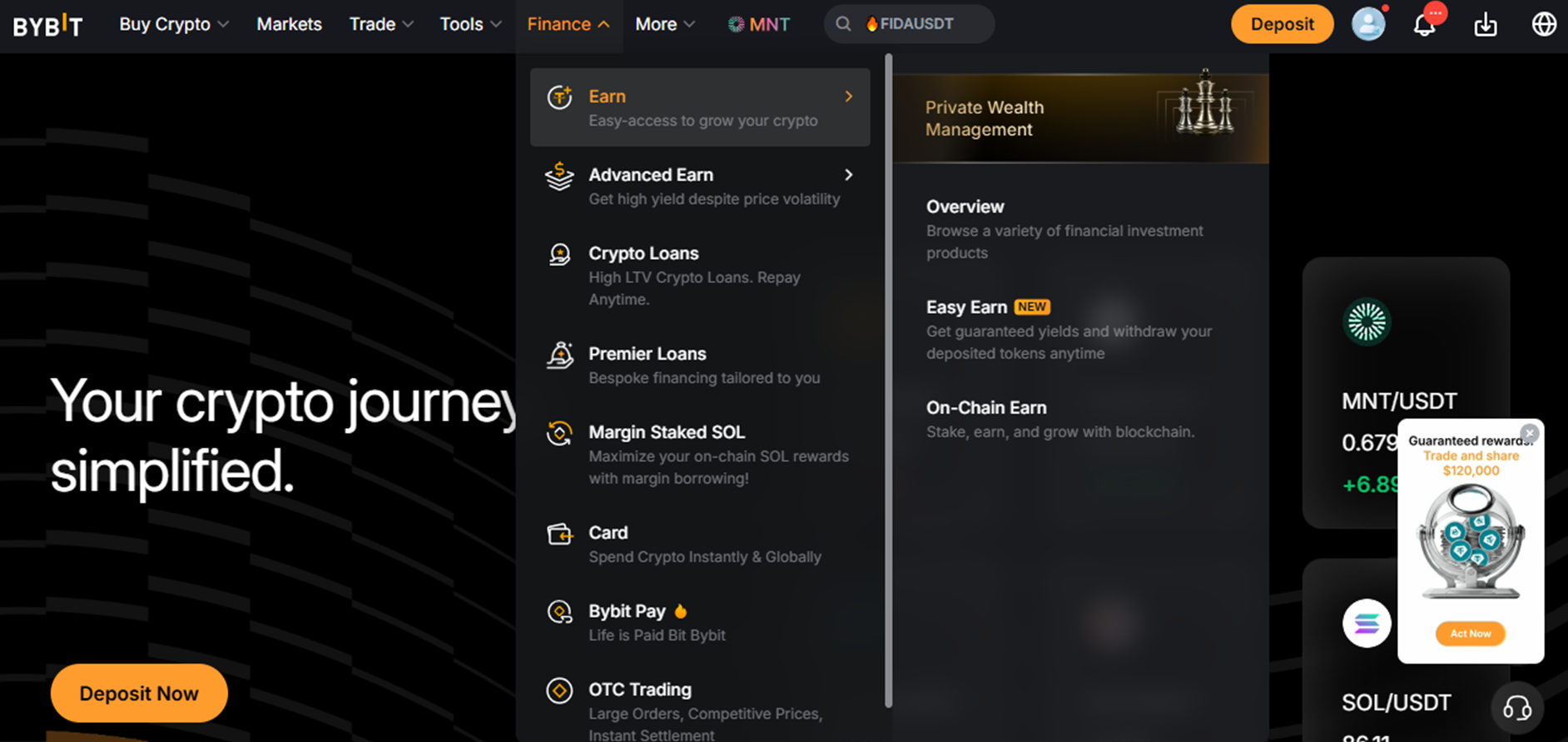
3. Visit Bybit’s homepage, hover over Finance in the top menu and click on Earn.
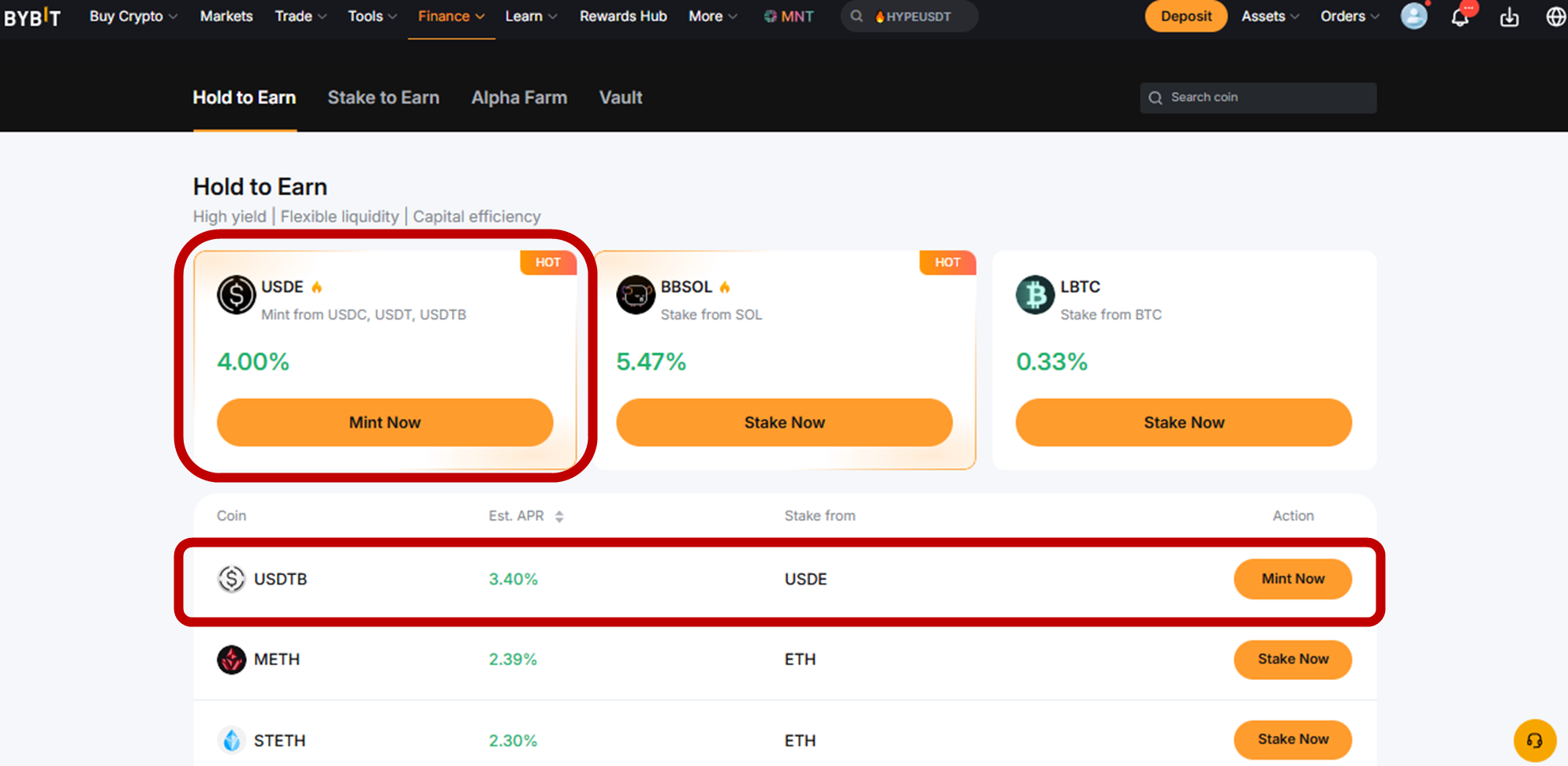
4. Select the Hold to Earn tab, locate the offerings for USDe or USDtb and click on Mint Now.
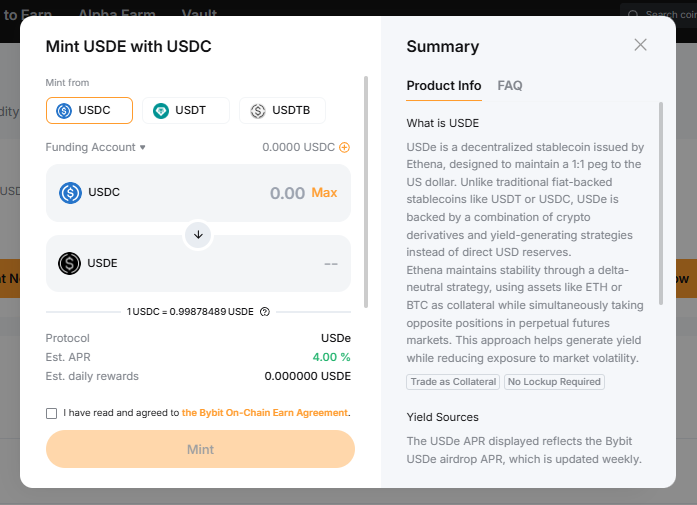
5. Specify the amount you’d like to mint, check the box to acknowledge the terms of the service and click on Mint.
Alternatively, you can mint your assets by directly accessing their respective Earn pages (USDe or USDtb). You can then hold the minted asset in your account and earn yield, with nothing else required on your part.
The bottom line
Idle stablecoins actually have a real cost. USDe and USDtb are two structurally distinct answers to that problem: one draws yield from crypto derivatives mechanics, while the other helps you earn yield based on US Treasury rates. Neither method requires staking or lockups. Choosing between them comes down to your tolerance for yield variability, not your tolerance for complexity, as neither requires DeFi experience to access. On Bybit, both USDe and USDtb are available to hold, mint, and earn from with the same account you already use to trade.
Note: Yields are approximate and are subject to market conditions. This article is for educational purposes only and does not constitute financial advice. Please review Bybit's terms and product disclosures before you invest.
#LearnWithBybit