


From DAI to USDS: Unlocking an open Sky for a more rewarding future

In September 2024, MakerDAO, a pioneering decentralized finance (DeFi) protocol, underwent a significant transformation by rebranding itself as Sky (SKY). This rebranding was part of the project's comprehensive strategy to enhance scalability, user engagement and regulatory compliance. The major changes that came with the rebranding include token upgrades, whereby the platform’s stablecoin, Dai, was upgraded to USDS (Sky Dollar) while the governance token MKR was rebranded to SKY.
Let’s take a deeper look at USDS and its role on the Sky platform.
Key Takeaways:
USDS, a stablecoin, is the upgraded version of Dai within the new protocol known as Sky, which itself is a rebrand of the DeFi platform MakerDAO.
Notably, its holders can accumulate Sky Token Rewards (STRs) for holding USDS.
What is USDS crypto?
USDS (United States Dollar Sky) is the upgraded version of the Dai stablecoin, launched under the newly rebranded Sky protocol (formerly MakerDAO). Like DAI, USDS is a decentralized, overcollateralized stablecoin designed to maintain a 1:1 peg with the US dollar.
However, USDS significantly improves scalability, user incentives and regulatory positioning, making it a next-generation solution for DeFi.
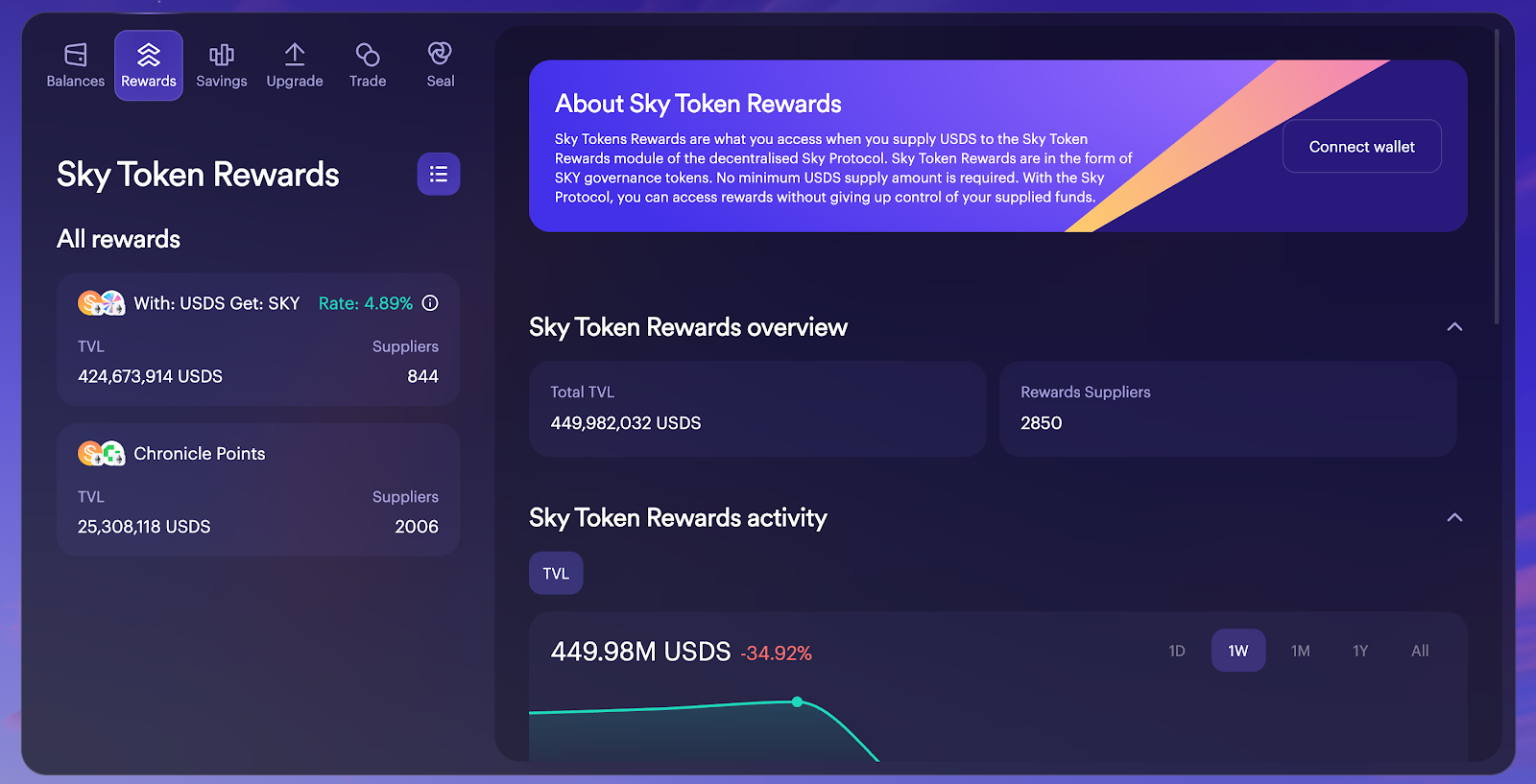
One of the standout features of USDS as a stablecoin is that it creates yield farming opportunities for its investors. With USDS, you can access the Sky Savings Rate (SSR) feature, which allows you to participate in the Sky ecosystem's governance by accumulating Sky Token Rewards (STR) (presented in the form of SKY tokens).
SSR also features a variable automated token accumulation feature, whereby you receive Savings USDS (sUSDS) to supply your USDS stablecoins to the SSR program. This passive earning potential offers a major advantage for users seeking yield without complicated staking or locking mechanisms.
Sky uses a dynamic model that adds USDS to the SSR pool every few seconds. Over time, the value of sUSDS in the particular pool increases. You can then opt to redeem your sUSDS for USDS, and receive the USDS you initially supplied in addition to the USDS equivalent you’ve accumulated.
These rewards serve as an incentive mechanism, enabling users to passively grow their holdings while supporting the health and stability of the Sky ecosystem.
Source: app.sky.money
How to upgrade from DAI to USDS
Upgrading from DAI to USDS is straightforward. Users can visit Sky.money and initiate the upgrade directly through a noncustodial, user-controlled process.
The platform provides a simple interface on which users connect their wallets, exchange their existing DAI for an equal amount of USDS and instantly become eligible for yield accumulation and other Sky ecosystem benefits. There are no fees for the upgrade, and users retain full control of their assets at all times.
USDS isn’t just a stablecoin; it’s an evolution of DeFi money. With passive earning through Sky Token Rewards and a smooth, secure upgrade path, USDS sets a new standard for the way decentralized stablecoins can deliver value and financial empowerment to users worldwide.
USDS vs. DAI
USDS and DAI are both decentralized stablecoins originally developed under the MakerDAO ecosystem (now Sky). While they share the same core principle — overcollateralization and the maintenance of a 1:1 peg with the US dollar — USDS represents a major evolution of DAI, introducing additional incentives designed to enhance user experience, scalability and regulatory alignment.
DAI has long been a favorite in the DeFi ecosystem, allowing users to generate stablecoins by locking up crypto collateral such as ETH. DAI features a savings program, the DAI Savings Rate (DSR), from which people can earn Savings DAI (sDAI). While the DSR program is still running, upgrading to USDS lets you earn two types of rewards through the SSR program: sUSDS tokens and Sky Token Rewards (STRs).
In addition, USDS is well positioned to meet regulatory requirements, aiming for broader mainstream adoption while maintaining decentralization.
Below is a comparison table between DAI and USDS:
| DAI | USDS |
Backing | Overcollateralized crypto assets | Overcollateralized crypto assets |
Peg | 1:1 to USD | 1:1 to USD |
Rewards | sDAI | suSDS and STRs |
Regulatory alignment | Decentralized | Enhanced regulatory focus |
Governance | MKR tokens | SKY tokens |
Is USDS safe?
USDS is backed by collateral that’s deposited in Sky vaults by borrowers. In return, the reserves for these vaults are backed by three main assets:
Cryptocurrency (e.g., ETH and staked ETH)
Real-world assets (RWAs), such as US government bonds
Stablecoins (mainly USDC).
With a market cap of over $8 billion, USDS is the currently third-largest stablecoin after USDC and USDT.
USDS's smart contract is more complex than that of typical stablecoins, as it includes liquidation mechanisms and a peg-stability module. However, an audit of USDS’s smart contract in September 2024 didn’t report any significant risks with the stablecoin. Notably, S&P Global Ratings has assigned USDS a stability assessment score of 4 out of 5, indicating constrained ability to maintain its peg under certain conditions.
Additionally, the proposal to include a freeze function for USDS, which bestows upon the Sky protocol the power to halt USDS transfers between wallets, has sparked heated discussions within the community, highlighting the ongoing conundrum of balancing security measures with principles of decentralization.
Closing thoughts
The evolution of DAI to USDS marks a major leap forward for DeFi. By combining DAI's trusted and overcollateralized model with additional passive earning opportunities through Sky Token Rewards, USDS empowers users to enjoy greater financial benefits with less complexity.
The streamlined upgrade process and stronger regulatory positioning set the stage for broader adoption and a more resilient future. As Sky continues to build, USDS represents more than just a stablecoin — it’s the foundation of an open, accessible and more rewarding financial ecosystem for everyone.
#LearnWithBybit