


Tokenized stocks — and where to buy them

Traditional stock markets and crypto markets have long operated in separate environments, with different infrastructure, hours and gatekeepers, and distinct regulatory requirements. Tokenized stocks merge these two asset classes by placing representations of real-world equities and ETFs directly on blockchain platforms, enabling such assets to be traded with a crypto wallet at any time.
This development is part of the broader real-world asset (RWA) tokenization trend, which is bringing everything from government bonds to commodities and real estate onto blockchains. Bybit has moved into this space through a partnership with Backed Finance, listing xStocks — tokenized equities backed 1:1 by real underlying assets — on its Spot market.
Key Takeaways:
Tokenized stocks are blockchain-based tokens that track real-world equities and ETFs, with the underlying assets held in regulated custody on a 1:1 basis.
Unlike traditional equities, tokenized stocks trade on crypto infrastructure, requiring no brokerage account, fixed market hours or standard settlement delays.
Bybit users can access tokenized US stocks and ETFs through xStocks on both the Spot market and Bybit Alpha, funded directly from their Unified Trading Account (UTA).
What are tokenized stocks?
Tokenized stocks are blockchain-based tokens that represent exposure to publicly traded equities and ETFs, with each token backed by the underlying asset, held securely in regulated custody, typically on a 1:1 basis. Custodial backing distinguishes tokenized stocks from purely synthetic on-chain instruments, giving each token a price anchor in the traditional finance (TradFi) system.
The price exposure is structurally similar to owning the stock outright: when the underlying equity moves, the token is designed to move with it. However, the infrastructure is entirely different. Traditional equities settle through brokers and stock exchanges under regulated timelines. In contrast, tokenized stocks settle on-chain, meaning they can be held in a crypto wallet, transferred peer-to-peer and traded across both centralized and decentralized cryptocurrency platforms. While holders don’t receive voting rights or direct dividend entitlements, they do get the economic exposure the tokens provide.
How do tokenized stocks work?
The issuance process for tokenized stocks starts when an issuer, such as Backed Finance, acquires the actual underlying shares on a traditional exchange, and deposits them with a regulated, independent custodian. Based on the acquired tokenized share count, an equivalent number of tokens is minted on a smart contract–compatible network. This mint-to-custody ratio is the foundation of the 1:1 backing claim.
Price tracking depends upon two mechanisms:
oracle-based data feeds, which pull reference prices from the primary market
an arbitrage loop in which market makers issue or redeem tokens with the issuer whenever the on-chain price diverges from the underlying stock price on exchanges like the NYSE or Nasdaq-100
Redemption may require completing know your customer (KYC) and anti-money laundering (AML) procedures directly with the issuer. Secondary market participants on platforms like Bybit can buy and sell without a direct relationship with the issuer. Tokens can also move into decentralized finance (DeFi) protocols, functioning as collateral in lending markets or contributing to liquidity pools. This flexibility extends their utility well beyond simple price-tracking exposure.
Benefits of tokenized stocks
A key advantage of tokenized stocks is the creation of 24/7 trading opportunities. Traditional equity markets operate within fixed trading hours, meaning any market-moving event outside those hours cannot be acted upon until the next open. Tokenized stocks offer around-the-clock access, eliminating this constraint.
Fractional ownership is another benefit. A single share of a high-priced equity can run into hundreds or thousands of dollars. But tokenized stocks remove that floor, letting you gain exposure at any size without minimum lot requirements imposed by a broker. No brokerage account is required, as you trade directly from a crypto wallet or exchange account.
For traders outside the US, these assets provide access to blue chip US equities and major ETFs. You no longer need to navigate foreign broker restrictions or residency requirements.
Additionally, DeFi composability is a key benefit of tokenized stocks. Composability adds a layer of capital efficiency that traditional share ownership doesn’t support. Digital assets can serve as collateral in lending protocols or be deployed to liquidity pools, generating additional yield.
Risks and considerations
The regulatory classification of tokenized stocks is still not fully settled across most jurisdictions. Depending upon where you’re located, these instruments may be treated either as securities, derivatives or crypto assets, with each category carrying different compliance obligations and levels of investor protection.
Unlike exchange-listed equities in the US, tokenized stocks aren’t protected by traditional protections, such as SIPC coverage, that apply to brokerage accounts.
Counterparty risk also runs deeper for tokenized stocks than in conventional equity trading. The value of each token depends entirely upon the issuer maintaining 1:1 custodial backing. Operational failure, insolvency or regulatory enforcement against the issuer or custodian could compromise that backing.
Liquidity depth for tokenized stocks tends to be thinner than on traditional exchanges, which means that spreads can widen under pressure. Price deviation from the underlying asset is a related concern: during off-market hours, when the primary exchange is closed and oracle feeds reflect mostly sentiment rather than executed prices, the on-chain token price can drift. Thus, the market for tokenized stocks is driven more by sentiment than by a real-time reflection of the underlying asset.
What are xStocks on Bybit?
Bybit's xStocks are tokenized representations of US stocks and ETFs. These tokens are issued by Backed Finance, and are listed directly on Bybit's Spot market. Each token is backed at a 1:1 ratio by its underlying asset, and is held by a regulated custodian. The available range of xStocks spans individual high-market-cap equities, such as Apple (AAPLX), Tesla (TSLAX) and NVIDIA (NVDAX), as well as index trackers like the State Street® SPDR® S&P 500® ETF Trust (SPY).
By offering xStocks, Bybit functions as a secondary market on which you can buy and sell tokenized stock assets. Issuance and redemption remain entirely managed by Backed Finance while you trade xStocks directly through Bybit’s Spot interface or Bybit Alpha. Because xStocks are based on Solana (SOL), they can be withdrawn to compatible on-chain wallets, traded on decentralized exchanges (DEXs) (such as Jupiter and Raydium) and deployed within Solana-based DeFi protocols.
How to trade xStocks on Bybit
Trading xStocks requires a Bybit account with Standard Identity Verification completed. xStocks aren’t available to institutional users, market makers, accounts registered in jurisdictions not serviced by Bybit, or users in Australia, Japan and all European Economic Area (EEA) member states.
To trade xStocks via Bybit’s Spot market, follow the steps below:
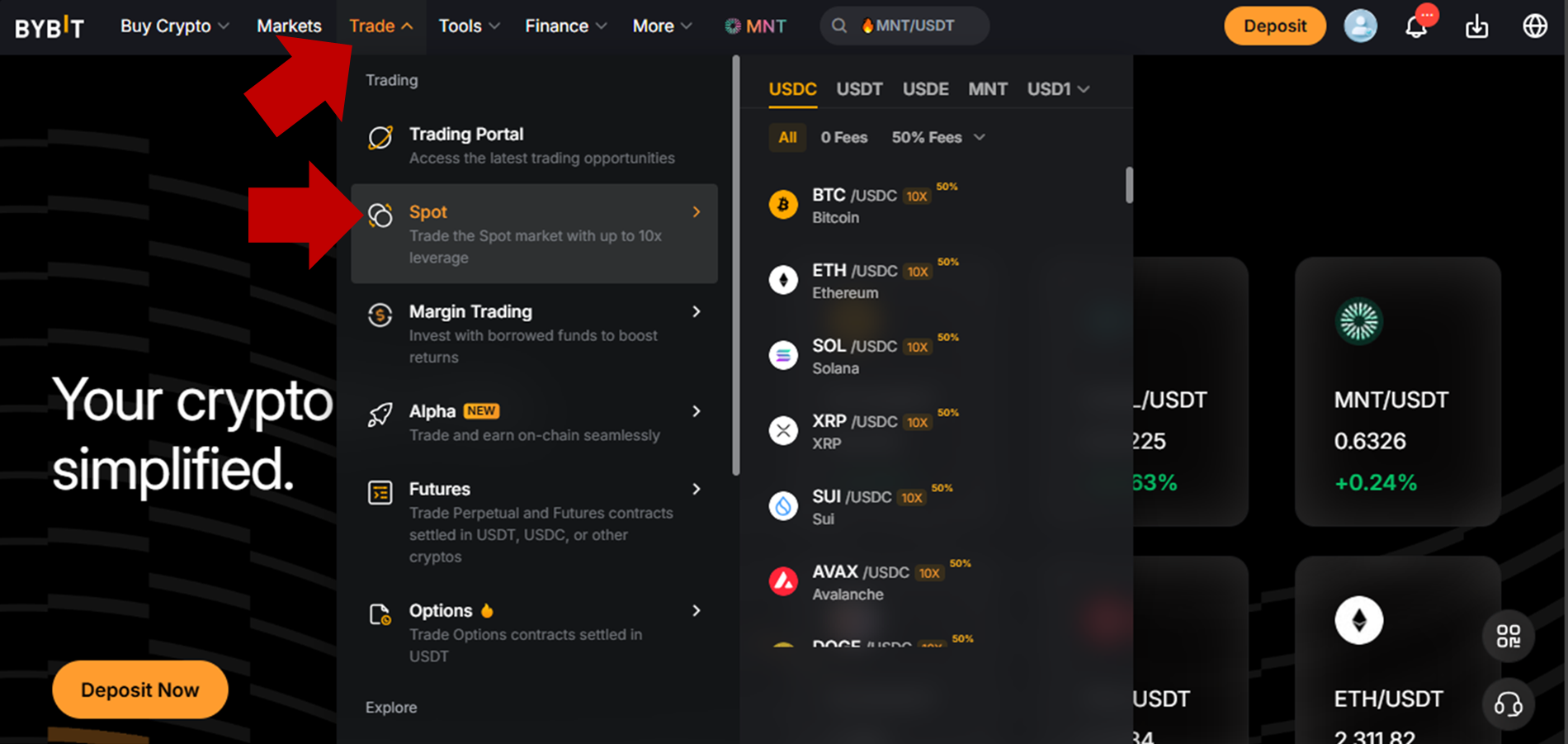
Step 1: Visit Bybit’s homepage, click on Trade in the top menu and then click on Spot.
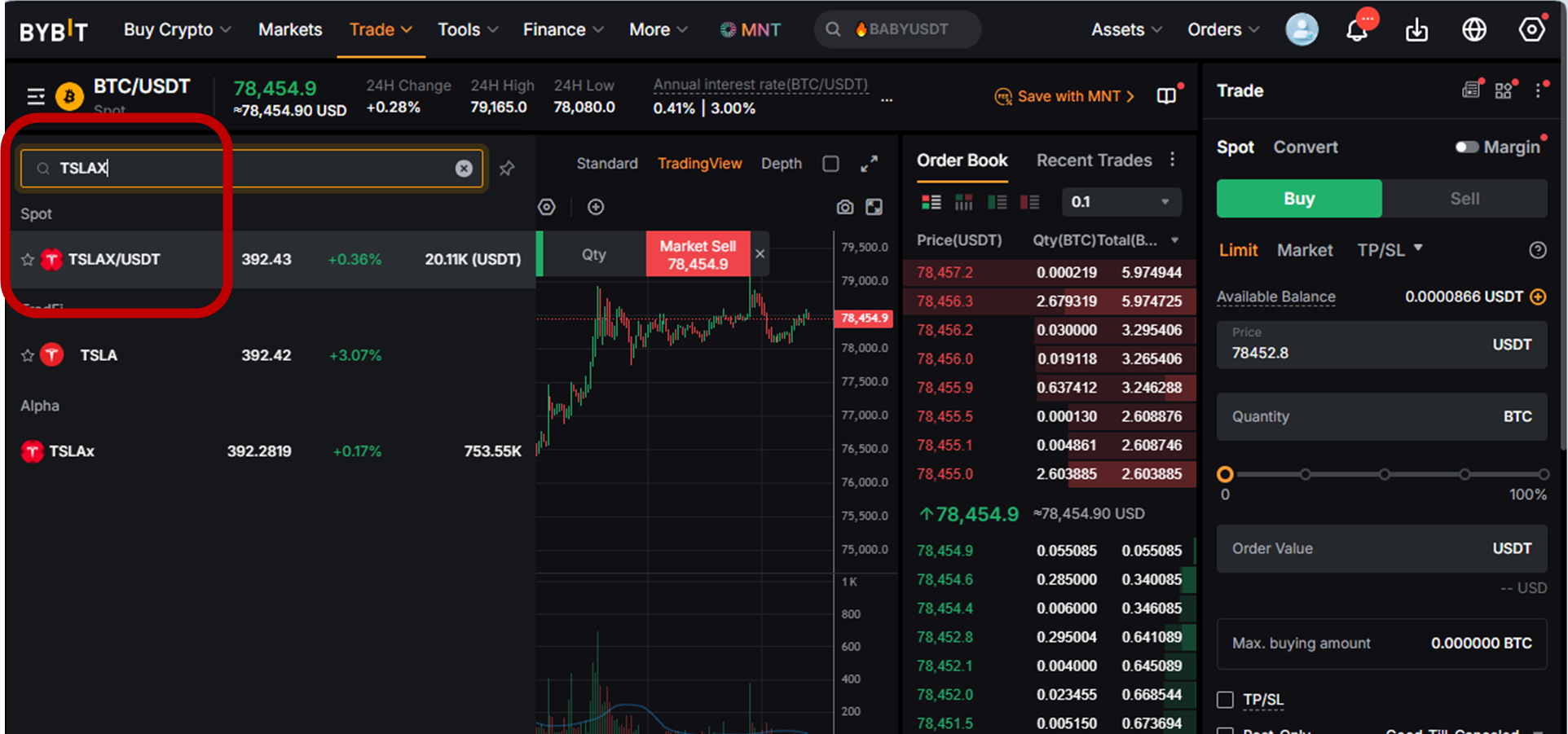
Step 2: On the trading page, search for your preferred xStock asset, e.g., TSLAX, by typing its name in the search box in the top-left corner. Click on a pair in the list of available options.
Step 3: In the order panel on the right, specify your order details — direction of trade (Buy or Sell), order type (Market, Limit or more advanced types), quantity, target price (for Limit and Conditional orders). Then, click on Buy/Sell at the bottom of the panel to place your trade.
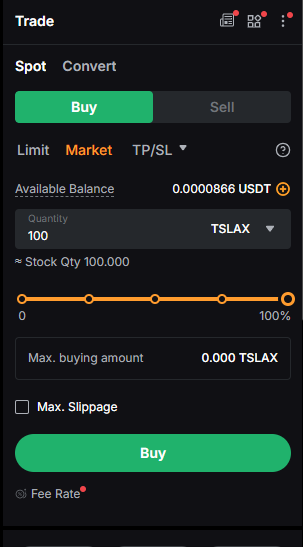
As with other Spot trades on Bybit, orders involving xStocks utilize capital directly from your Unified Trading Account (UTA).
xStocks are also available via Bybit Alpha. The same UTA balance applies, and gas fees are automatically converted from your payment token (with no manual gas management needed).
Closing thoughts
Tokenized assets aren’t just a novelty product — they’re a functional bridge between traditional capital markets and on-chain infrastructure. Holding a custody-backed stock token representation of Apple, Tesla or the S&P 500 in a crypto wallet — tradable even on a Sunday or at midnight — offers traders unmatched advantages and flexibility.
Bybit's xStocks offering gives crypto-native traders direct exposure to US equities without requiring a brokerage account or satisfying stringent capital or residency requirements. As the RWA sector expands — involving more assets, more chains and deeper DeFi integration — the boundary between a crypto portfolio and a traditional investment portfolio will keep narrowing. xStocks is one of the more tangible examples of this process that’s already underway.
#LearnWithBybit