


Using stablecoins to enter and exit RWA positions

Stablecoins are the primary on-ramp and off-ramp for real-world asset (RWA) trading. When you enter a tokenized Treasury, real estate or credit position, you typically pay with a stablecoin. When you exit, you receive one back. Understanding how this cycle works — and which stablecoin to use — is foundational to operating in RWA markets.
Key Takeaways:
Stablecoins function as the settlement currency for most RWA products. They are the medium through which positions are opened, held and closed.
USDT offers the deepest exchange liquidity for acquiring a stablecoin position. USDC is more commonly required by institutional RWA platforms.
The entry and exit workflow follows four stages: acquire stablecoins, enter the position, hold, and exit. Each stage has its own timing, cost and risk profile.
Why stablecoins are the settlement layer for RWA
Most RWA products — tokenized bonds, Treasury bills, credit instruments and equity baskets — are denominated and settled in stablecoins. The reason for this is practical: stablecoins hold a predictable value. This makes them a suitable unit of account for both subscription and redemption in dollar-denominated products.
Using a stablecoin to enter a position also eliminates the cost basis complications that come with paying in a volatile asset. A payment in BTC or ETH means that the purchase price fluctuates with the paying asset, not the RWA product. A stablecoin payment keeps both sides of the transaction in the same unit.
Stablecoins also enable near-instant on-chain settlement. A smart contract settling an RWA subscription in USDC doesn’t depend upon banking hours, clearing windows or correspondent bank availability. This is one of the structural advantages of on-chain RWA infrastructure over traditional fund subscriptions.
One distinction worth understanding is that payment stablecoins (USDT, USDC) are settlement instruments. They do not generate yield. Yield comes from the RWA position itself — that is, from the underlying asset. Holding stablecoins in a wallet earns nothing. Deploying them into a tokenized Treasury product, however, earns the yield of the underlying government instruments.
USDT vs. USDC: Which stablecoin to use for RWA trading
Making the right choice depends upon the platform you’re using and the product you’re accessing.
USDT
As of May 2026, USDT has a market cap of approximately $189.3 billion. It’s the most liquid stablecoin on most centralized exchanges, including Bybit. In addition, it’s the default quote currency across the widest range of trading pairs. For most users, USDT is the most efficient starting point.
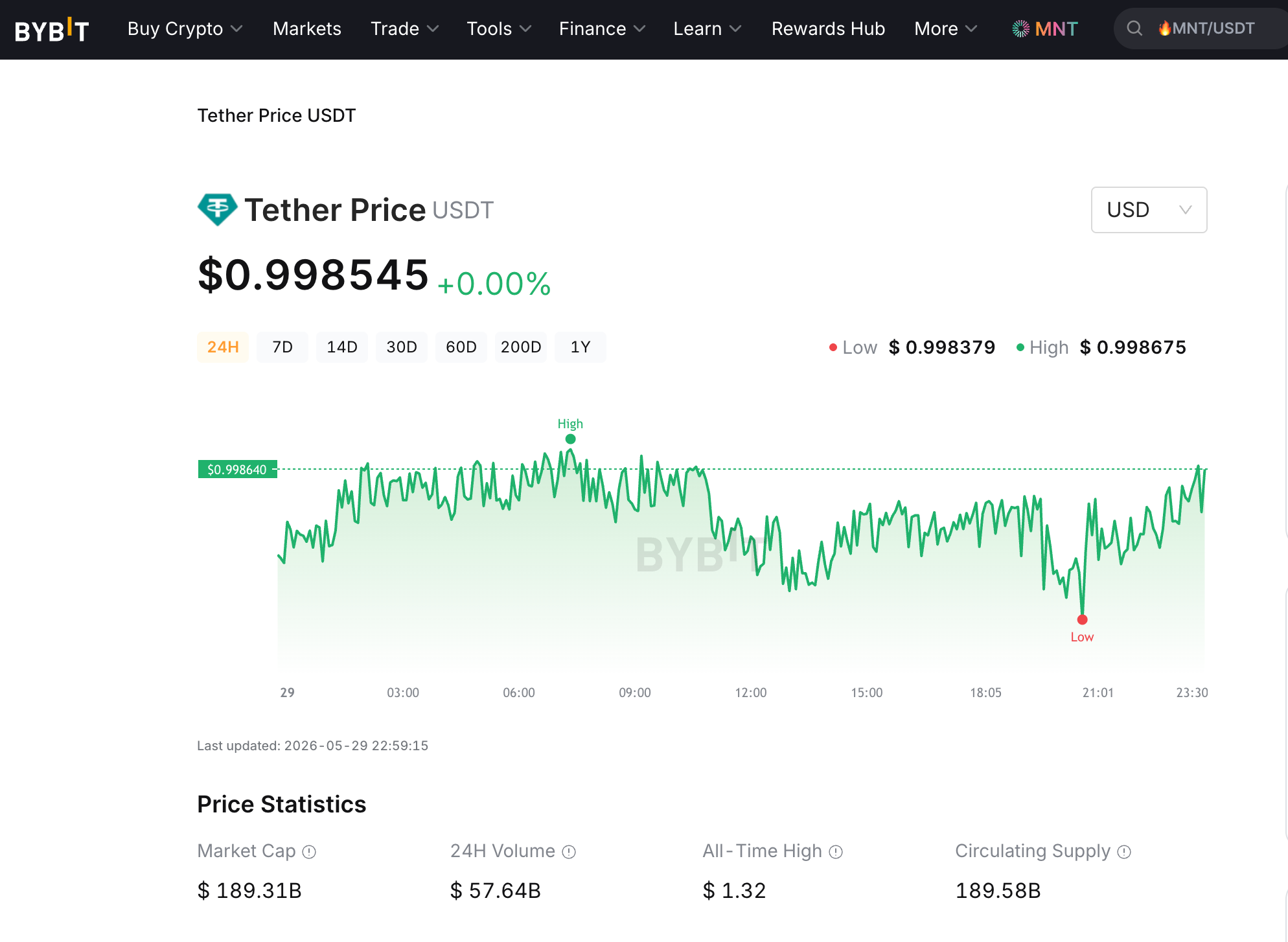
Converting crypto into USDT on Bybit Spot requires minimal steps and carries low slippage. USDT is also the primary collateral currency for Bybit TradFi and xStocks. If you’re entering RWA-adjacent products within the Bybit ecosystem, USDT is the more logical choice.
USDC
As of May 2026, USDC’s market cap is approximately $71.3 billion. It’s the preferred settlement currency for many institutional tokenized asset products. BlackRock's BUIDL money market fund, Ondo's OUSG and USDY, and Franklin Templeton's BENJI all accept or distribute in USDC. USDC is also MiCA-compliant in the EU, making it the preferred option for European institutional participants.
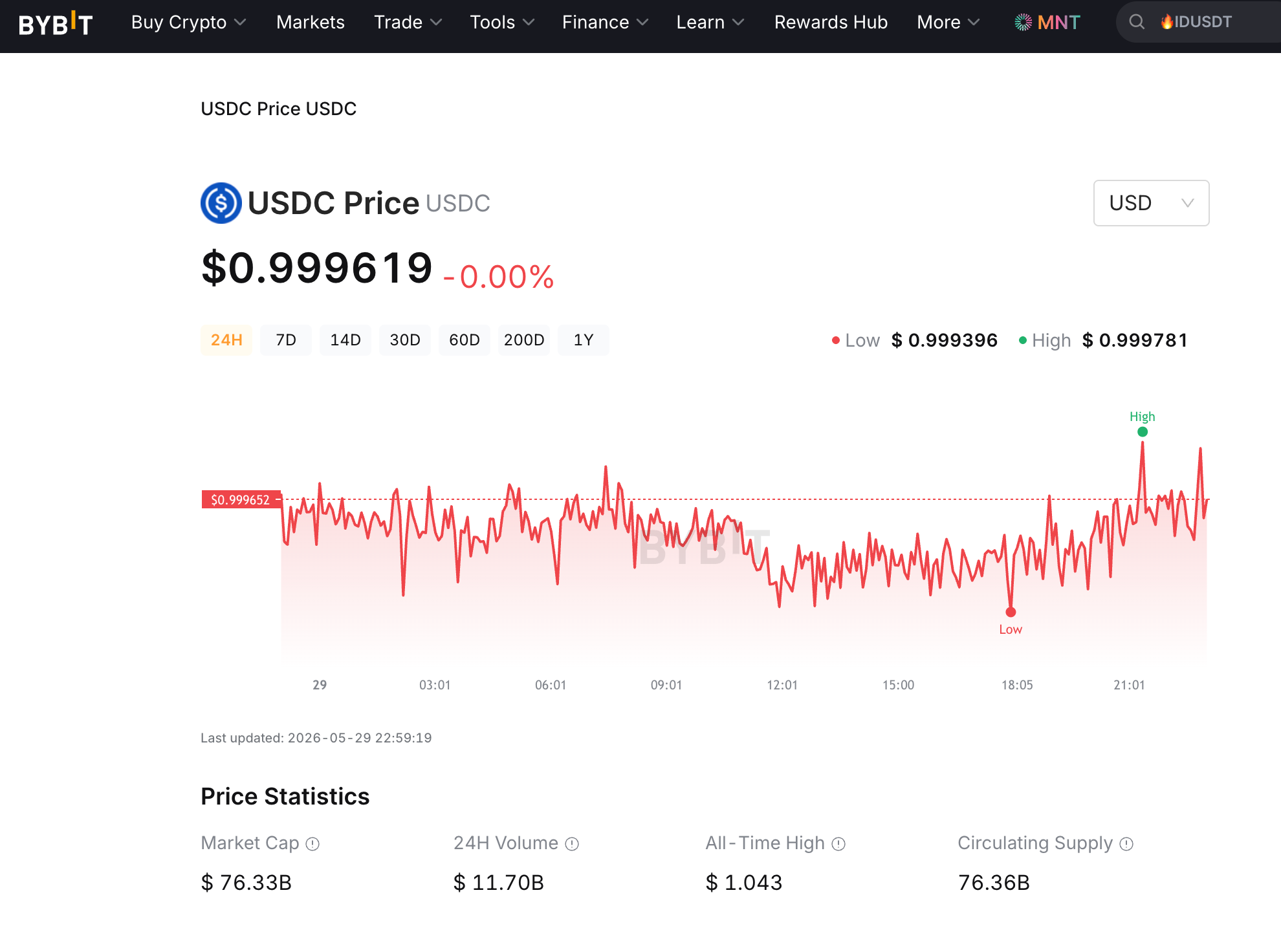
Many institutional RWA platforms specifically require USDC. If the product you’re accessing mandates USDC, you’ll need to convert before subscribing. The conversion cost is minimal — but worth accounting for in your total cost of entry.
Which one to choose
Use whichever stablecoin the RWA product requires. Check the product documentation before acquiring your position. If you’re on Bybit, and the product requires USDC, convert from USDT on Bybit Spot. The spread is typically negligible at standard sizes.
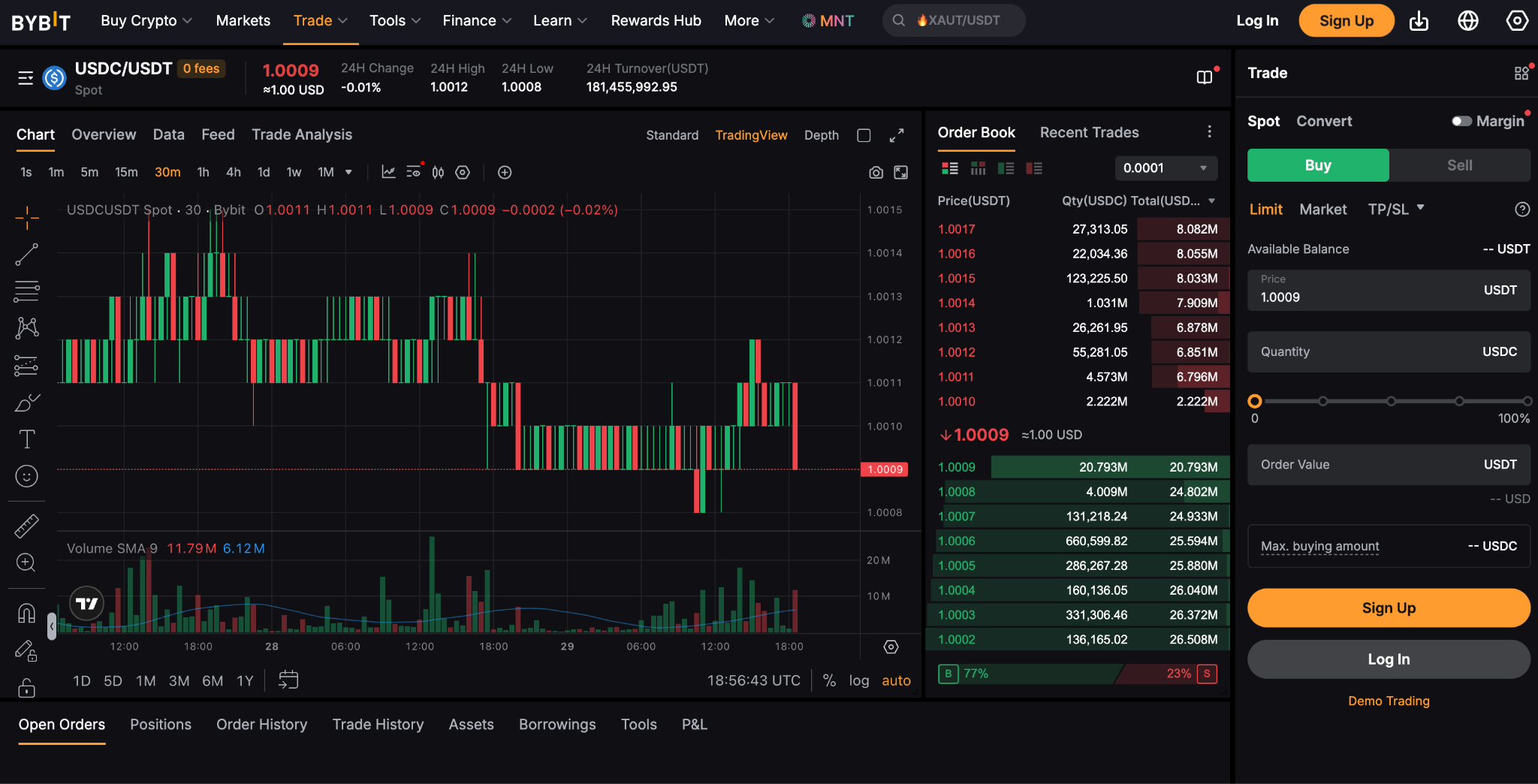
Full entry and exit workflow
The cleanest way to think about RWA trading with stablecoins is as a four-stage cycle.
Stage 1 — Acquire stablecoins
Before entering any RWA position, you need the correct stablecoin in a compatible wallet or account. With Bybit, you can acquire USDT or USDC through Spot trading or Fiat Deposit via Bybit Convert.
Also, consider the network. Many RWA products operate on the Ethereum Mainnet. Others use Arbitrum, Solana or Polygon. Moving stablecoins between networks requires bridging, which adds cost and an extra step. Acquire stablecoins on the correct network from the outset.
Stage 2 — Enter the RWA position
Once you hold the required stablecoin, enter the position through the relevant platform. The typical steps are as follows:
Complete any required KYC verification (if you haven’t already done so).
Select the RWA product and confirm your eligibility.
Approve the stablecoin spend for the smart contract or platform.
Specify the amount and confirm the transaction.
On Bybit, products such as xStocks or Bybit TradFi handle the entry process within the platform interface. For external RWA platforms, you’ll need to connect a wallet, complete product-specific onboarding and approve the on-chain transaction.
Most on-chain products settle entry near-instantly. Some apply a processing window of up to one business day before the position is fully active.
Stage 3 — Hold the position
During the holding period, your stablecoins are deployed in the RWA product. What happens next depends upon the product type:
Tokenized Treasuries: Your stablecoins back a yield-bearing token. Interest accrues daily, and is reflected in the token price (or distributed to your wallet).
Tokenized equities or equity baskets: Your capital tracks the underlying asset price. No yield distribution takes place unless dividends are passed through.
Tokenized credit: Yield accrues according to the loan's interest rate and payment schedule.
Monitor for redemption windows, lockup expiration dates and yield distribution events. Some products have minimum holding periods; exiting early may result in a penalty or forfeited yield.
Stage 4 — Exit and settle
Initiate the redemption through the same platform. Specify the amount and confirm the transaction. The platform or smart contract will return stablecoins to your wallet.
Settlement speed varies. On-chain smart contract products settle near-instantly or within minutes. Products with off-chain custodial components typically require T+1 processing. Once stablecoins return to your account, you can hold, redeploy or convert to fiat currency.
Worked example: A full round-trip
A user holds $10,000 USDC. They identify a tokenized Treasury product yielding approximately 4.5% APY. KYC is already complete. They subscribe through the platform, approving the USDC spend. Gas cost on entry is approximately $8.
Over 30 days, the position accrues yield as follows:
$10,000 × 4.5% ÷ 365 × 30 = approximately $37.
After 30 days, the user redeems. Redemption settles in one business day. They receive approximately $10,037 in USDC back. Gas cost on exit is approximately $10.
Net return after total gas of $18 is approximately $19 on a $10,000 position over 30 days. That’s a modest absolute return, but it represents yield from a government-backed instrument — and is settled on-chain without a brokerage account or institutional minimum.
The same workflow applies across asset types, so the stablecoin entry and exit mechanics don’t change, whether you’re trading tokenized equities, credit products or real estate.
Practical considerations that affect your workflow
Network selection: Verify which blockchain the product uses before acquiring stablecoins. Bridging to the wrong network adds cost and time.
Gas fees at small sizes: On a $1,000 position, $15–20 in combined gas represents 1.5%–2% friction. Note that RWA products are more cost-efficient at larger sizes.
Minimum investment thresholds: Some products require minimum subscriptions of $1,000, $10,000 or more. Verify before attempting entry.
Redemption notice periods: Certain products require advance notice before redemption. Plan exits accordingly, particularly before market-sensitive events.
KYC completion: Complete identity verification before you need to deploy capital. Delayed KYC can prevent entry during time-sensitive campaigns.
Tax treatment: Exiting an RWA position may be a taxable event in your jurisdiction. Consult appropriate tax guidance before trading.
Risk considerations
Using stablecoins as settlement currency introduces a layer of risk that sits beneath the RWA position itself.
Stablecoin depeg risk: Major fiat-backed stablecoins (USDT, USDC) have maintained their pegs through significant market stress, but algorithmic and undercollateralized alternatives have not. Use only well-established, fiat-backed stablecoins for RWA settlement.
Smart contract risk: Both entry and exit depend upon smart contract execution. Vulnerabilities or exploits can affect settlement, even for audited contracts.
Bridge risk: Bridging stablecoins across networks introduces additional counterparty risk at the bridge protocol level.
Liquidity risk on exit: Some RWA products have limited redemption capacity at any given time. In periods of high exit demand, settlement may be delayed or queued.
Platform and custody risk: The custodial structure of the RWA product determines what happens if the issuer or custodian faces operational or financial difficulty. Understand the custody model before subscribing.
The bottom line
Stablecoins are the practical mechanism for entering and exiting RWA markets. They remove conversion friction, enable 24/7 on-chain settlement and provide a predictable unit of account for dollar-denominated positions.
Stablecoins themselves do not provide yield: the yield comes from the RWA product. This distinction matters for setting expectations because the stablecoin itself is the vehicle, not the investment.
The four-stage cycle — acquire, enter, hold and exit — is consistent across most RWA products. Variables are the network, the required stablecoin, the settlement speed and the yield mechanics of the underlying product. Understand those variables — and the workflow becomes repeatable, regardless of which RWA product you’re trading.
#LearnWithBybit