


SanDisk stock outlook in 2026: How to trade SNDK on Bybit

Following its separation from Western Digital in early 2025, SanDisk Corp (SNDK) is now a standalone flash memory and storage manufacturer. SNDK's revenue is directly tied to NAND flash demand, with exposure across AI data storage infrastructure, consumer SSDs and enterprise storage. Most of these sectors have experienced sharply increased demand throughout 2025 and the first half of 2026, shaping SanDisk into one of the best market performers.
In this article, we cover SNDK's 2026 market performance, as well as the bullish and bearish factors shaping its outlook. We’ll examine what retail investors should consider before taking a position in SNDK, and how to trade it on Bybit.
Key Takeaways:
SanDisk posted a 493% YTD return through May 19, 2026, one of the most explosive stock performances of the year.
Five long-term supply deals have locked in a minimum $42 billion in contractual revenue, offering rare forward visibility in a historically cyclical industry.
Bybit's TradFi platform lets you trade SNDK via Perpetual contracts or CFDs with 24/7 market access — and SNDK is currently a boosted token in Boost Battle Season 4.
SanDisk (SNDK) market performance in 2026
Since re-listing as an independent company, SNDK has delivered one of the strongest price performances of any large-cap stock in 2026. As of the May 19, 2026 market close, the stock sits at $1,333, with a market cap of $208.45 billion, a 52-week range of $35.79–$1,600 and a YTD return of 493%. The one-year return for the storage solutions manufacturer stands at a whopping 3,218%.
Wall Street's consensus on SNDK is decidedly bullish: 20 Buy ratings, five Hold and one Sell across 26 analysts, with a median 12-month price target of $1,550, implying roughly 16% upside from current levels.
SNDK stock outlook in 2026
Bullish factors
SanDisk’s Q3 FY2026 revenue hit $5.95 billion, a 251% year-over-year surge that surpassed the company's own guidance by more than 20%. The datacenter segment experienced the sharpest acceleration with $1.5 billion in revenue, up 233% QoQ, reflecting sustained enterprise SSD demand from AI compute workloads that require high throughput and low latency. Gross margins expanded to 78.4%, up from 51.1% the prior quarter — a 27-point rise driven by a deliberate shift toward higher-value customers and an improved NAND pricing environment.
Q4 FY2026 guidance of $7.75–$8.25 billion again exceeded analyst expectations. SanDisk also signed five long-term supply partnerships with firm financial guarantees, locking in a minimum $42 billion in contractual revenue. This provides a high degree of forward cash flow certainty for the company. A $6 billion share buyback authorization followed full debt repayment, signaling management confidence in the balance sheet. NAND supply is expected to remain tight through 2027, creating a favorable environment for manufacturers to lock in premium pricing and protect their profit margins over the next couple of years.
Bearish factors
Despite its buoyant overall position, SanDisk Corp suffered a 10% quarterly revenue decline in its consumer segment for Q3 FY2026. The everyday storage market remains soft, with smartphone and PC unit demand lagging well behind the enterprise recovery. This contrast is critical, because SanDisk hasn't completely outgrown the consumer retail market. If retail hardware spending continues to decline, it could drag down total revenues despite the gargantuan AI boom.
Currently, overvaluation is the more immediate concern. SNDK hit an intraday all-time high of $1,600 on May 11, 2026, before retracing to $1,333 (as of May 19), a roughly 17% pullback that suggests momentum buyers have begun unwinding. At +462% YTD, a substantial portion of the growth narrative is already reflected in SNDK’s price, and any quarterly miss or guidance cut could trigger a correction.
Industry-specific risks are another possible bearish signal here. Potential developments, such as a drop in NAND pricing and/or waning enthusiasm for enterprise AI adoption, might directly threaten SNDK’s current surge. Moreover, intensifying competition from Chinese NAND producers operating at lower costs represents another pressure point for margins and sentiment as we approach the second half of 2026.
What retail investors need to know
SanDisk is a direct bet on AI storage demand: as enterprise AI capital expenditure grows, SanDisk's enterprise SSD portfolio is extremely well positioned to capture an outsized share of that spending. The $42 billion in locked-in contracts adds a degree of earnings predictability that’s genuinely unusual in a sector known for its violent revenue swings.
The primary risk with SNDK at the moment is that of valuation. After a nearly 500% YTD run, entering now carries real mean-reversion exposure if NAND pricing softens, or if AI infrastructure spending slows. The earliest signs of a correction might already be appearing on the horizon, with the stock retracing from its all-time high of $1,600 (intraday) on May 11 to a $1,333 close one week later. As such, SNDK is by any measure a clearly high-reward/high-risk position.
How to trade SNDK on Bybit
Bybit offers two ways to trade SNDK on its TradFi platform.
TradFi Perpetual contracts
These are USDT-denominated, USDT-settled derivatives that track SNDK's price continuously, including outside US stock market hours.
To access the SNDK TradFi Perpetual contract, follow the steps below:
Create or log in to your Bybit account on your desktop.
Alternatively, open or download the Bybit App to access TradFi Perpetuals on your mobile device.
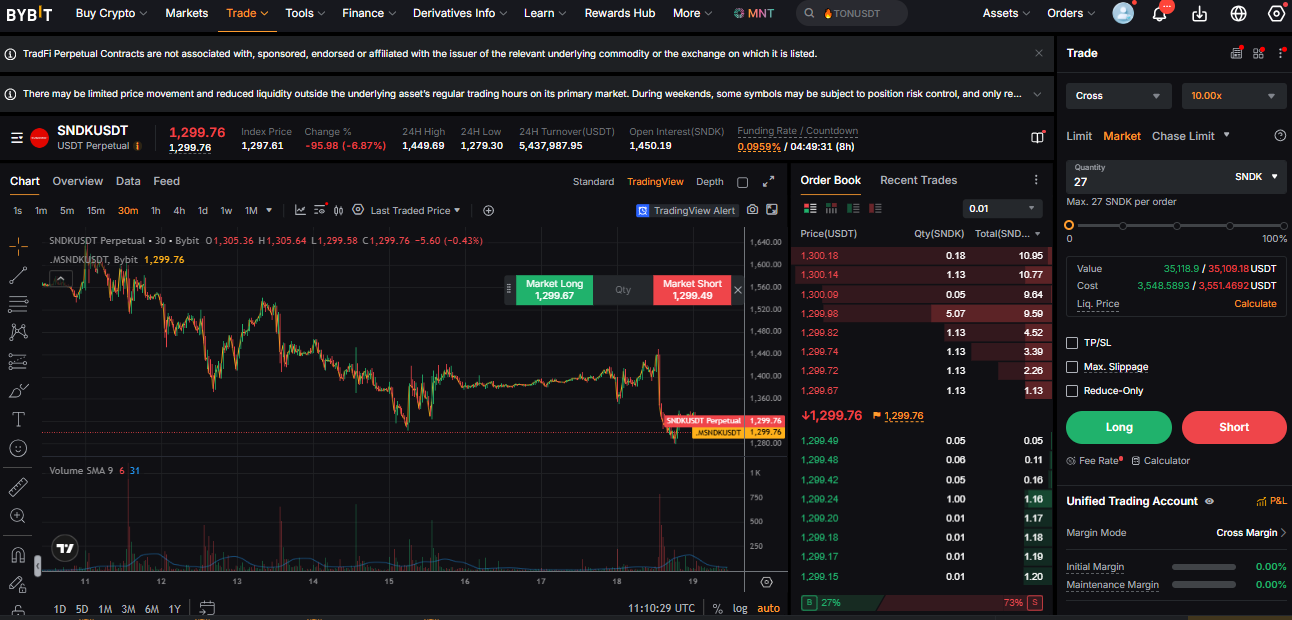
Go to Trade → Futures to access the default Perpetual trading screen.
In the search box at the top-left of the screen, type in SNDK and click on the SNDKUSDT Perpetual contract.
In the order panel on the right, specify your order details: Long to go long or Short to go short, order type (Market, Limit or more advanced types), quantity and target price (for Limit or Conditional orders). Click on Long/Short to open your position.
TradFi CFDs
Bybit also offers SNDK CFD (contract for difference) trading for verified users on TradFi. This is another derivative that lets you speculate on SNDK price movements without owning the underlying stock.
To access TradFi SNDK CFD, follow the steps below:
Create or log in to your Bybit account on your desktop.
Alternatively, open or download the Bybit App to access TradFi on your mobile device.
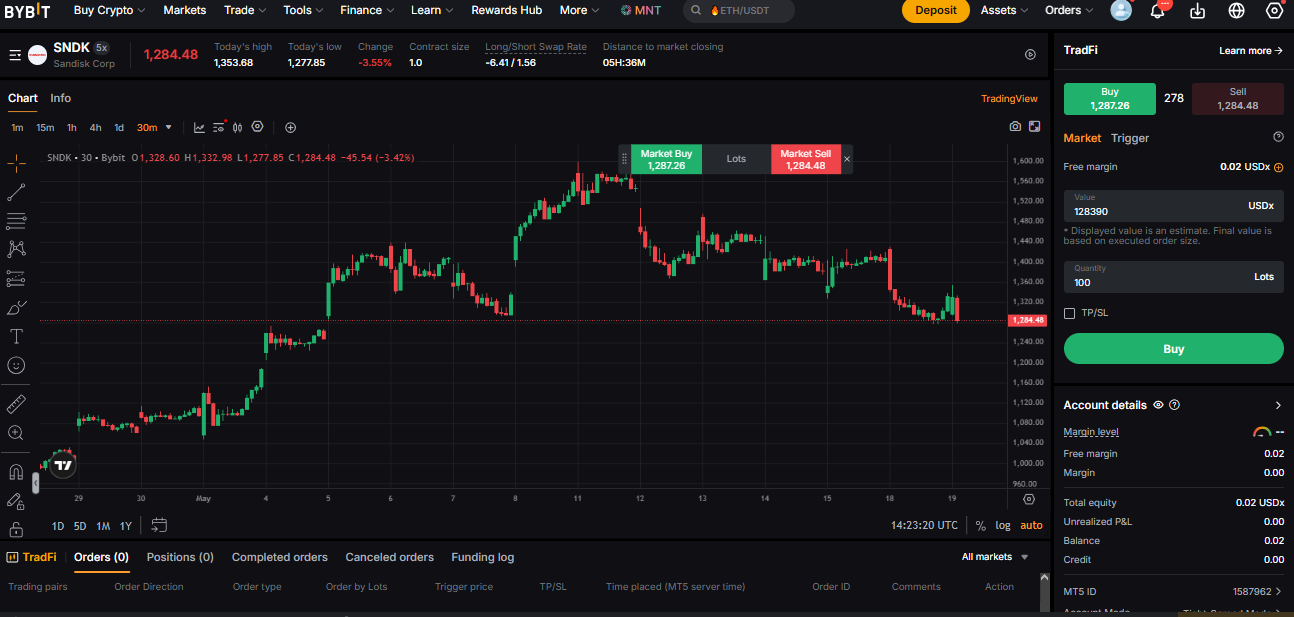
Go to Trade → TradFi.
Click on Apply to have your TradFi account approved.
Transfer USDT from your Funding Account to your TradFi account.
Navigate to Trade → TradFi → Stocks, and select SNDK.
In the order panel on the right, specify your order details: Buy or Sell, order type (Market or Trigger), quantity or value, and trigger price (for Trigger orders). Click on Buy/Sell to place your order.
Boost Battle Season 4
SNDK is a boosted token in the current Boost Battle Series 4, meaning that SNDKUSDT Perp trades count at a significantly higher volume multiplier toward prize pool rewards.
Closing thoughts
SanDisk's 2026 solid position rests on three key factors: a 251% revenue surge in Q3, gross margins approaching 80%, and $42 billion in contractually locked revenue that provides forward visibility through the cycle.
Enterprise AI storage demand and a tight NAND supply outlook through 2027 support this stock’s favorable outlook. The primary risk is that at over 3,000% in one-year returns, SNDK may be approaching overvalued territory. However, even if a structural correction is in the cards for SanDisk, its longer-term outlook looks decisively positive.
#LearnWithBybit