


Alibaba Holdings stock outlook in 2026: How to trade BABA on Bybit

Alibaba (BABA) stands as China's largest e-commerce and cloud computing conglomerate. The company operates a gargantuan ecosystem that spans core online retail platforms like Taobao and Tmall, vast cloud infrastructure through Alibaba Cloud, expansive logistics via Cainiao, digital payments and artificial intelligence. For investors seeking exposure to the Chinese technology sector and the ongoing global AI buildout, BABA presents a compelling value-and-recovery play.
This article covers the recent market performance of Alibaba, its 2026 outlook (both bullish and bearish factors) and a comprehensive guide to trading BABA on Bybit.
Key Takeaways:
Alibaba is rapidly transitioning into an AI and cloud-driven powerhouse, with AI products now making up 30% of the company's external cloud revenue.
There is a clear tension between long-term growth and short-term profits, as heavy investments in AI and quick commerce have had a temporary impact on margins.
Bybit TradFi allows users to trade BABA stock CFDs and Perpetual Contracts 24/7 using USDT as margin.
Alibaba (BABA) market performance in 2026
Market cap: $325.42 billion
YTD return: −7.95%
1Y return: +10.31%
52-week high/low: $192.67/$103.71
Analyst median 12-month price target: $187.74 (representing a potential 12-month upside of 42%)
Wall Street ratings: 46 Buy | 3 Hold/Neutral | 1 Sell (out of 50 analysts)
Understanding BABA’s current valuation requires looking at its broader recovery trajectory following its 2022 to 2024 lows. This period marked the end of the Chinese technology sector crackdown.
The intense regulatory crackdown took place between November 2020 and July 2023, resulting in a severe 79.08% fall from $304.69 in October 2020 to $63.74 on Oct 24, 2022. The stock ultimately recovered from $63.74 on Oct 24, 2022, to $135.64 as of May 20, 2026, representing impressive 112.8% growth within that specific period.
BABA stock outlook in 2026
Opposing forces are heavily driving the current valuation of Alibaba as the company balances massive AI investments against persistent macroeconomic headwinds and short-term margin pressures.
Bullish factors
Several positive catalysts are actively driving growth for Alibaba as it pivots toward next-generation technology. The cloud segment serves as a primary engine, with cloud revenue accelerating to 38% growth year-over-year in Q4 FY2026. Within this segment, AI products now make up roughly 30% of external cloud revenue. This AI revenue has delivered triple-digit growth for 11 consecutive quarters, representing a remarkable streak of sustained expansion for the technology giant.
Financially, Alibaba holds a sizeable war chest of roughly $80 billion in cash against $40 billion in debt, giving the company plenty of firepower for continued technological investment. Consumer adoption of these technologies is also expanding rapidly. The Qwen large language model (LLM) has surpassed 300 million monthly active users and is deeply embedded across all major business lines such as Taobao.
Looking ahead, management is targeting over $100 billion in combined cloud and AI external revenue within five years. Alibaba also recently launched the Zhenwu M890 AI chip and the Qwen 3.7-Max model. These releases serve as strong proof of the ability of Alibaba to innovate and successfully compete with US-based tech companies amid tight semiconductor export controls.
Bearish factors
Despite these technological advancements, significant headwinds and risks face the company in 2026. The Q4 FY2026 adjusted EBITA collapsed 84% year-over-year to just $740 million, showing that profits are currently being sacrificed for AI and tech growth. This margin compression is evident across the board, as non-GAAP net income for the full FY2026 fell 62% year-over-year.
Cash generation has also taken a hit, with free cash flow swinging to an outflow of RMB 17.3 billion in the latest quarter. Meanwhile, core e-commerce growth remains sluggish. Q4 revenue for the e-commerce segment grew just 3% year-over-year, which missed consensus estimates. The company also faces intense domestic e-commerce competition from rival platforms such as PDD Holdings, forcing Alibaba to spend heavily to retain its user base.
Broader macroeconomic and geopolitical risks remain persistent overhangs. US-China tensions and ongoing regulatory uncertainty in China continue to impact market sentiment. The turbulent tariff environment in 2025 and 2026 created by the US administration has created further instability, with tariffs fluctuating wildly and severely impacting Chinese imports.
What retail investors need to know
For the retail trader, Alibaba is currently the ultimate "show me" story. Management is spending heavily right now and asking investors to trust that the massive AI payoff will come later. While the legacy e-commerce business provides essential scale and capital, its cloud business is the real growth engine. Traders should watch AliCloud revenue growth as the key indicator of long-term success.
With a −7.95% YTD decline, BABA is operating as a distinct contrarian pick. The stock carries a higher risk profile, due to ongoing geopolitical tensions, domestic competition and severe short-term margin compression. However, it offers a potentially higher reward if its aggressive AI investments and proprietary semiconductor chips pay off in the coming years. Retail investors must weigh the short-term financial sacrifices against the long-term technological vision when evaluating this asset.
How to trade BABA on Bybit
Bybit users can easily trade BABA using USDT to access traditional financial markets without the need for fiat conversions or a separate brokerage account.
You have multiple ways to trade this asset on the platform. One option is through TradFi Perpetual Contracts. The BABAUSDT Perpetual Contract offers up to 10x leverage and 24/7 trading, allowing you to react to market news at any time. Alternatively, Bybit TradFi provides CFD trading for stocks (including BABA), indices, metals and other traditional finance assets for verified users. You can also join the ongoing Boost Battle S4 Campaign and trade boosted tokens like BABA to share a 100,000 USDT prize pool.
To start trading BABA on Bybit, use the following step-by-step guide:
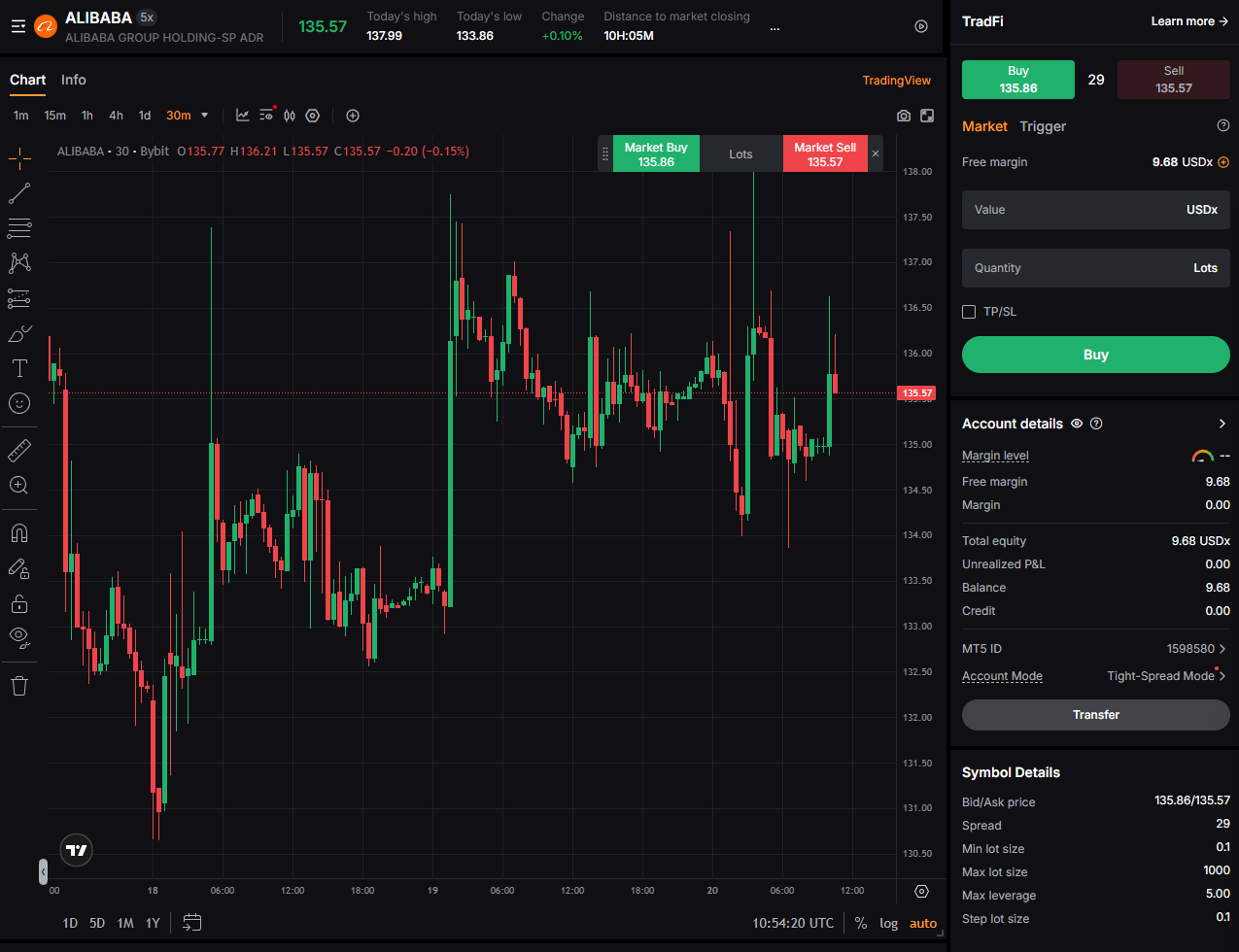
Log in to your Bybit account via the website or the App, and pass at least KYC Level 2. If you don't have a Bybit account, you can register for one here.
Transfer USDT to your TradFi Account from your Funding Account.
Head to Trade → TradFi on the top menu, and select ALIBABA from the list of Stocks.
Select whether to Buy or Sell, and choose your order quantity.
Confirm the trade to open your position by clicking on Buy or Sell.
Closing thoughts
Alibaba enters the remainder of 2026 as a tech giant that’s pivoting aggressively into AI, despite short-term margin pain and persistent geopolitical hurdles. While its transition requires heavy investment, the long-term focus on cloud infrastructure has the company well positioned for future innovation.
Explore global markets today and trade BABA on Bybit TradFi to diversify your trading portfolio.
#LearnWithBybit