


How to trade crypto options on Bybit

Options give you directional exposure to a token's price with one structural advantage over futures: your maximum loss as a buyer is capped at the premium you paid. A BTC call option that expires worthless costs you that premium and nothing more. A BTC futures position that moves against you can eat through your entire margin and trigger liquidation. That asymmetry is why options appeal to traders who want defined-risk bets, though selling options flips this dynamic entirely, exposing you to losses that can far exceed the premium received.
Bybit offers USDT-settled options on BTC and ETH, with expiration dates ranging from daily to quarterly. This guide covers how options work, what's available on the platform and how to place your first trade.
Key Takeaways:
Options let you speculate on price direction with a known maximum cost (the premium), unlike futures where losses can exceed your margin
Bybit offers USDT-settled BTC and ETH options with expirations from daily to quarterly, tradeable in Easy, Discover or Pro mode
Options are exercised automatically at 8 AM UTC on expiration day — you cannot place closing orders during settlement
What are crypto options?
An option is a contract that gives you the right, but not the obligation, to buy or sell an asset at a specific price (the strike price) before or on a set expiration date. You pay a premium upfront for this right. If the market doesn't move in your favor, the option expires worthless and you lose only that premium.
Two types exist:
Call option — profits when the underlying asset's price rises above the strike price
Put option — profits when the underlying asset's price falls below the strike price
The distinction from futures matters: a futures position can be liquidated if the market moves against you far enough. An option you've bought cannot. Your risk is fixed at entry. This is precisely why options cost a premium — you're paying for that downside cap.
Selling options reverses the risk profile entirely. When you sell (write) a call or put, you collect the premium upfront but take on potentially large losses if the market moves sharply against your position. Most beginners start by buying options rather than selling them, for exactly this reason.
How do crypto options work?
Every option contract has four components: the underlying asset (BTC or ETH on Bybit), a strike price, an expiration date and a premium. The premium is what you pay to enter the trade, and it fluctuates based on time remaining, volatility and how far the current price sits from the strike.
A worked example: BTC is trading at 65,000 USDT. You buy a call option with a 68,000 strike price, expiring in 14 days, for a premium of 800 USDT.
If BTC rises to 72,000 USDT at expiration: your profit is (72,000 − 68,000) − 800 = 3,200 USDT
If BTC stays at 65,000 USDT or falls: the option expires worthless and you lose 800 USDT — nothing more
That 800 USDT is your entire downside. Compare this to a leveraged futures position where the same adverse move could trigger liquidation and wipe your full margin.
Strike price, ITM, ATM and OTM
The relationship between the current price and the strike determines an option's "moneyness":
In the money (ITM): A call where BTC's price is already above the strike, or a put where it's below. These cost more but have intrinsic value.
At the money (ATM): Strike price is roughly equal to the current market price.
Out of the money (OTM): A call where BTC's price is below the strike. Cheaper, but needs a larger price move to become profitable.
OTM options are tempting because they're cheap, but they expire worthless far more often than ITM options. The low premium reflects low probability, not a bargain.
Which options can you trade on Bybit?
Bybit's options are all USDT-settled — profits, losses and premiums are denominated in USDT regardless of whether you're trading BTC or ETH contracts.
Underlying | Settlement | Expirations | Exercise style | Exercise time |
|---|---|---|---|---|
BTC | USDT | Daily, bi-daily, tri-daily, weekly, bi-weekly, tri-weekly, monthly, bi-monthly, quarterly | European (exercise at expiration only) | 8:00 AM UTC on expiration date |
ETH | USDT | Daily, bi-daily, tri-daily, weekly, bi-weekly, tri-weekly, monthly, bi-monthly, quarterly | European (exercise at expiration only) | 8:00 AM UTC on expiration date |
Bybit options are European-style, meaning they can only be exercised at expiration, not before. This is different from American-style options (common in traditional equity markets) where you can exercise at any point before expiry. In practice, this distinction matters less than you'd think — most traders close positions before expiration rather than exercising them.
Bybit offers three trading interfaces for options:
Easy mode — simplified view where you choose "Profit if it rises" (call) or "Profit if it drops" (put), select an expiration and amount. Best for first-time options traders.
Discover mode — curated strategies and educational overlays for traders learning to combine contracts.
Pro mode — full options chain with greeks (delta, gamma, vega, theta), granular strike selection and advanced order types. This mirrors what experienced derivatives traders expect.
How to trade crypto options on Bybit
The walkthrough below uses the Bybit mobile app. The desktop version follows the same logic: navigate to Trade → Options, select your contract and confirm the order.
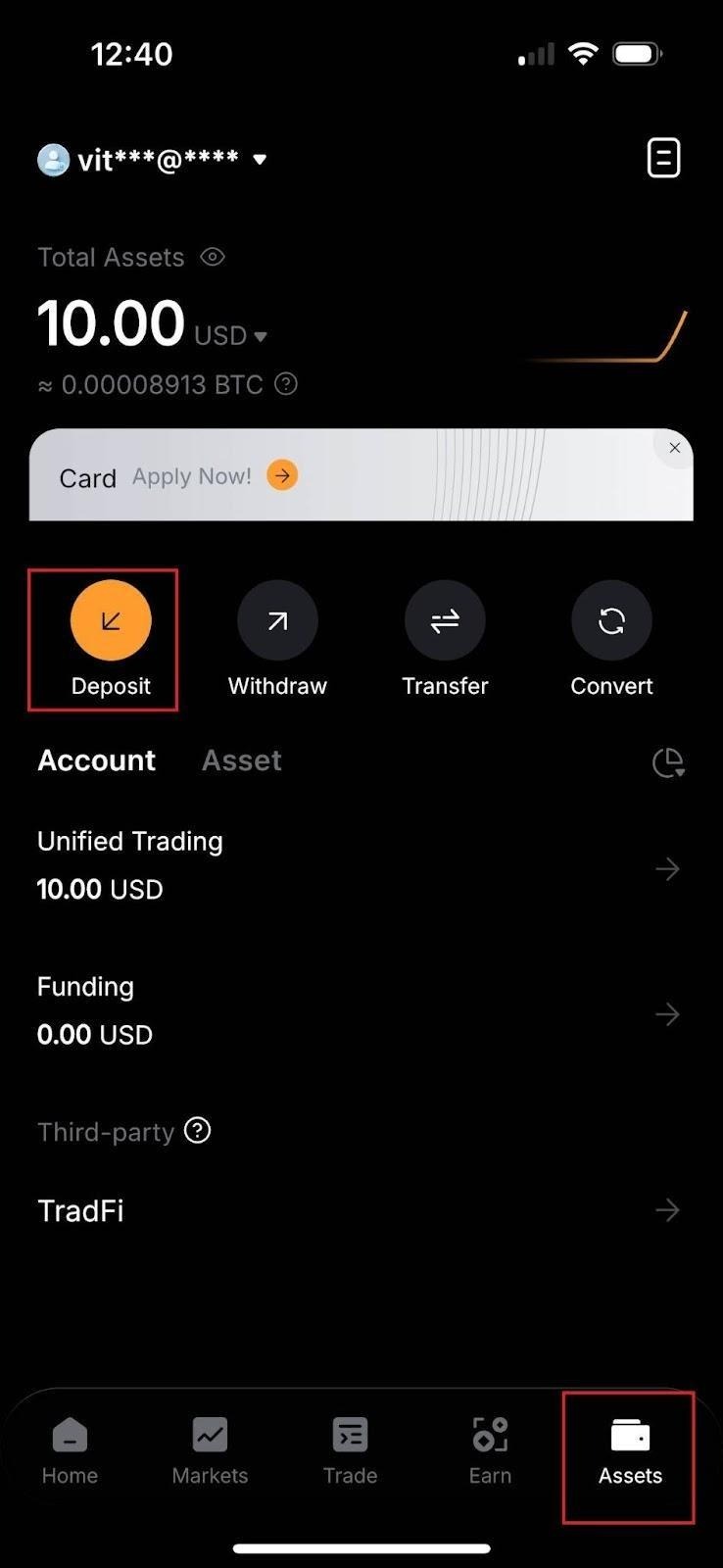
Step 1: Fund your Unified Trading Account. Options trading requires a UTA (the default for new accounts). Deposit crypto or fiat, then confirm your funds sit in the UTA rather than the Funding Account. In the Assets menu, tap USDT and verify that the Use As Collateral option is enabled.
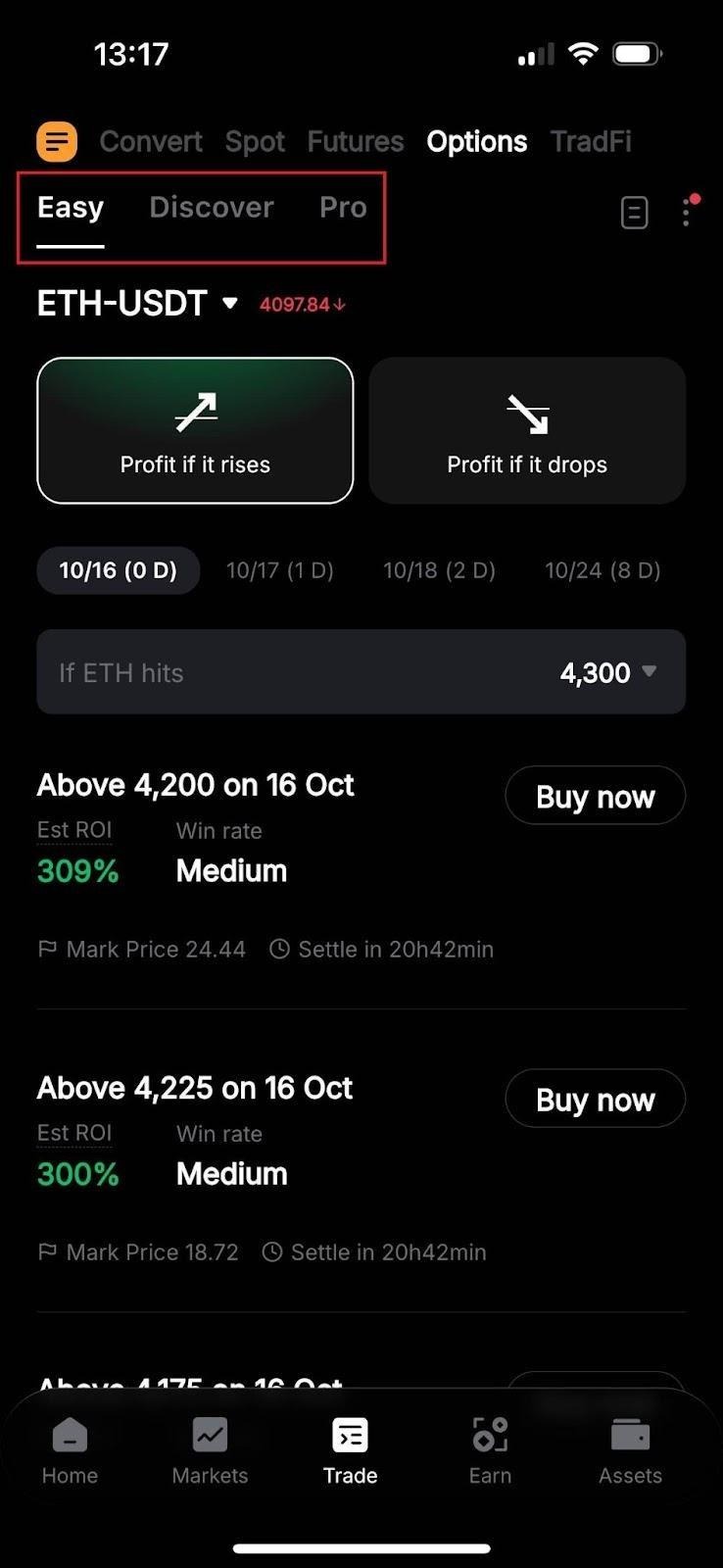
Step 2: Navigate to Options. From the bottom menu, tap Trade. Select Options from the top navigation bar. You'll land in one of the three modes (Easy, Discover or Pro) depending on your last selection.
Step 3: Choose your direction and contract (Easy mode). Select your underlying asset (BTC or ETH) and settlement currency (USDT). Then choose:
Profit if it rises — opens a call option position
Profit if it drops — opens a put option position
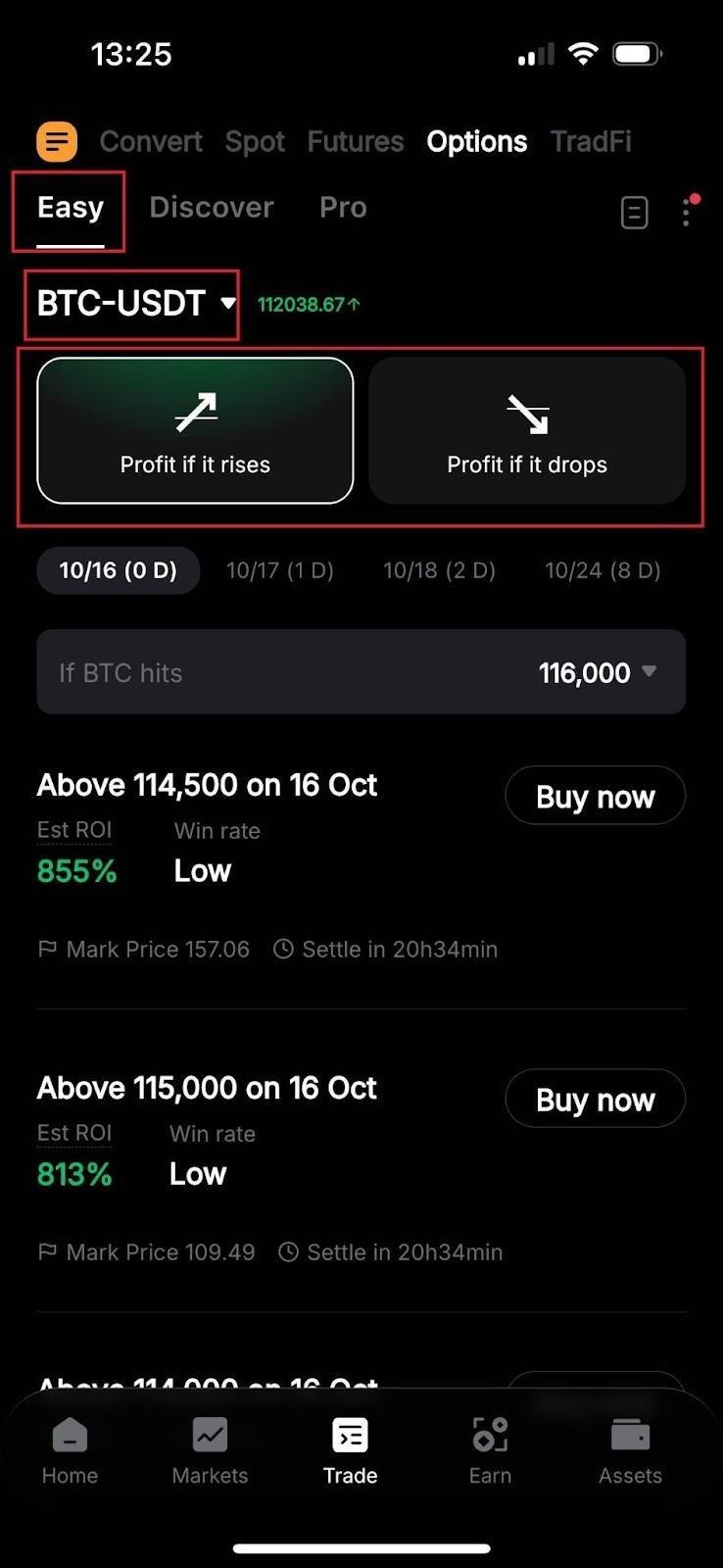
The app displays available expiration dates and strike prices filtered by your selection. Each contract shows the premium cost and basic P&L estimate.
Step 4: Select from the options chain (Pro mode). If you want more control, tap Pro at the top. The full options chain displays calls on the left, puts on the right, with strike prices in the center column. Use the expiration date selector at the top to switch between available dates.
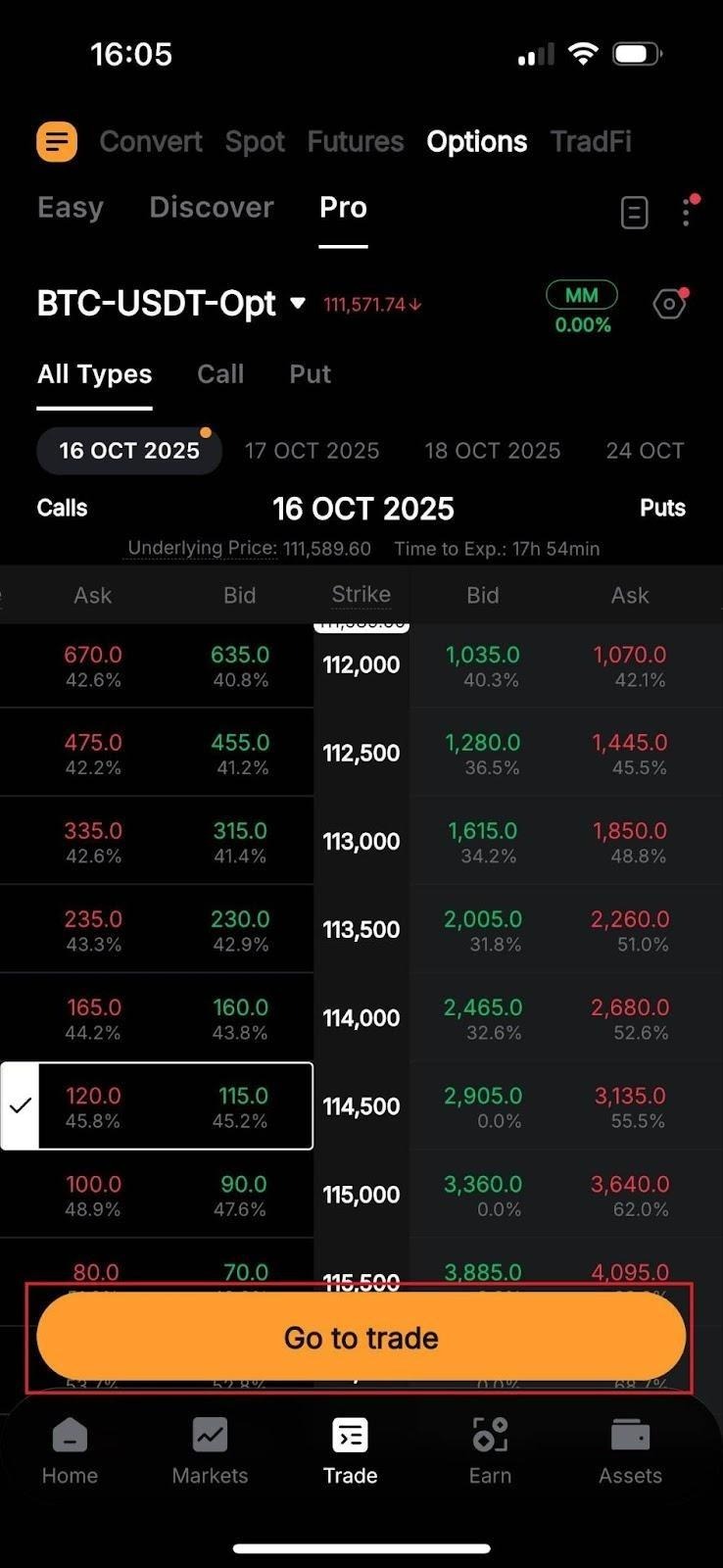
The yellow-highlighted row indicates the ATM strike. Rows above are OTM calls (cheaper, need larger moves), rows below are ITM calls (more expensive, higher probability of profit).
Step 5: Place your order. Tap a contract to open the order window. Set:
Direction: Buy or Sell
Price: Enter the premium you're willing to pay (limit order) or accept the market price
Quantity: Number of contracts
Optional: Take-profit/stop-loss triggers by ROI %, price change % or P&L amount
Review your maximum loss (the premium × quantity for buyers), then confirm.
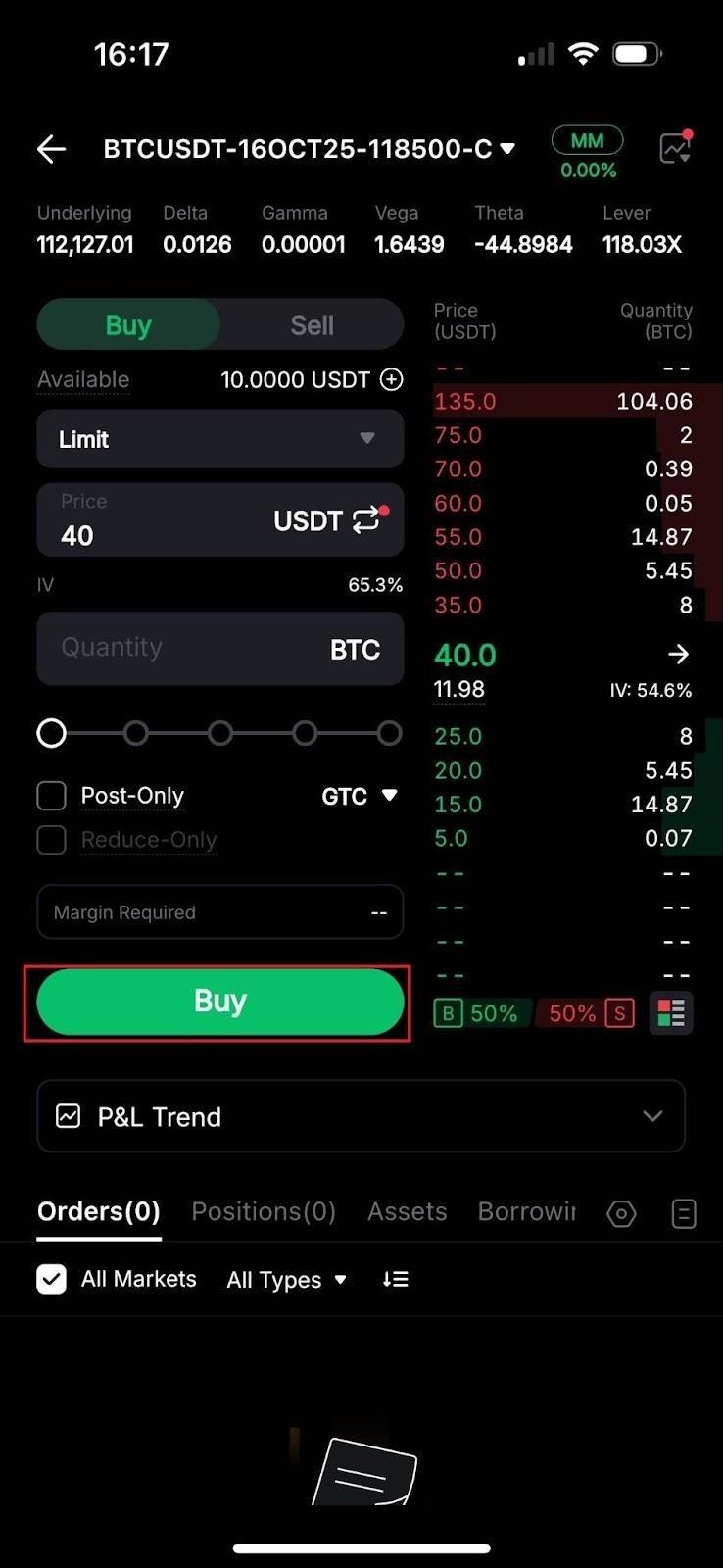
Step 6: Monitor your position. The Positions tab shows unrealized P&L, time to expiration and current mark price. You can close early by placing an opposing order, or let the contract settle automatically at expiration (8 AM UTC).
How to use Bybit's Option Strategies feature
Single calls and puts are the starting point, but options become more useful when combined into defined-risk structures. Bybit's Option Strategies feature executes multi-leg positions in a few taps, rather than requiring you to place each leg as a separate order and hope both fill at your target prices.
Step 1: Access Option Strategies. In the Bybit App, tap Trade → Options. On the Options page, tap the three-dot icon near the top-right corner and select Option Strategies.
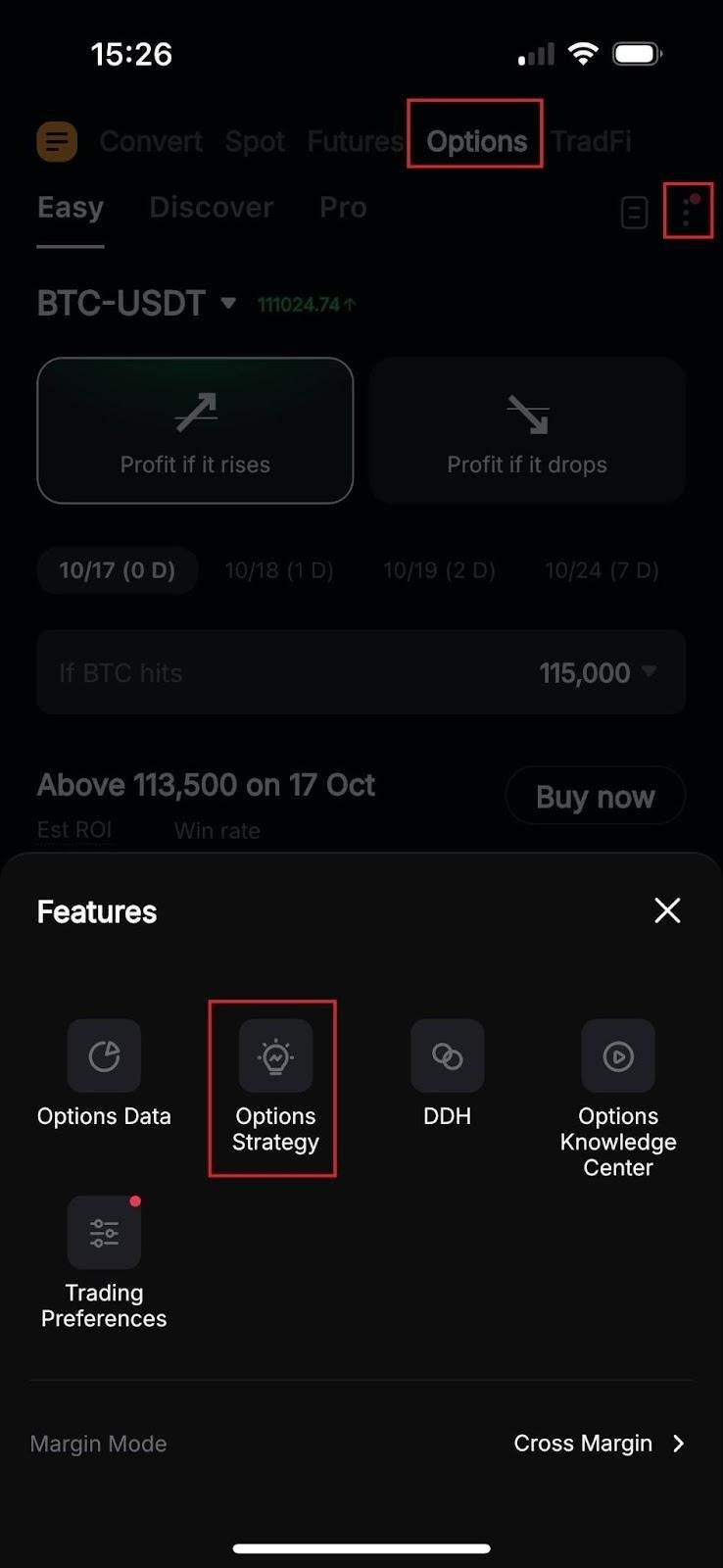
Step 2: Choose your strategy. Bybit offers four preset spread strategies, each suited to a different directional view:
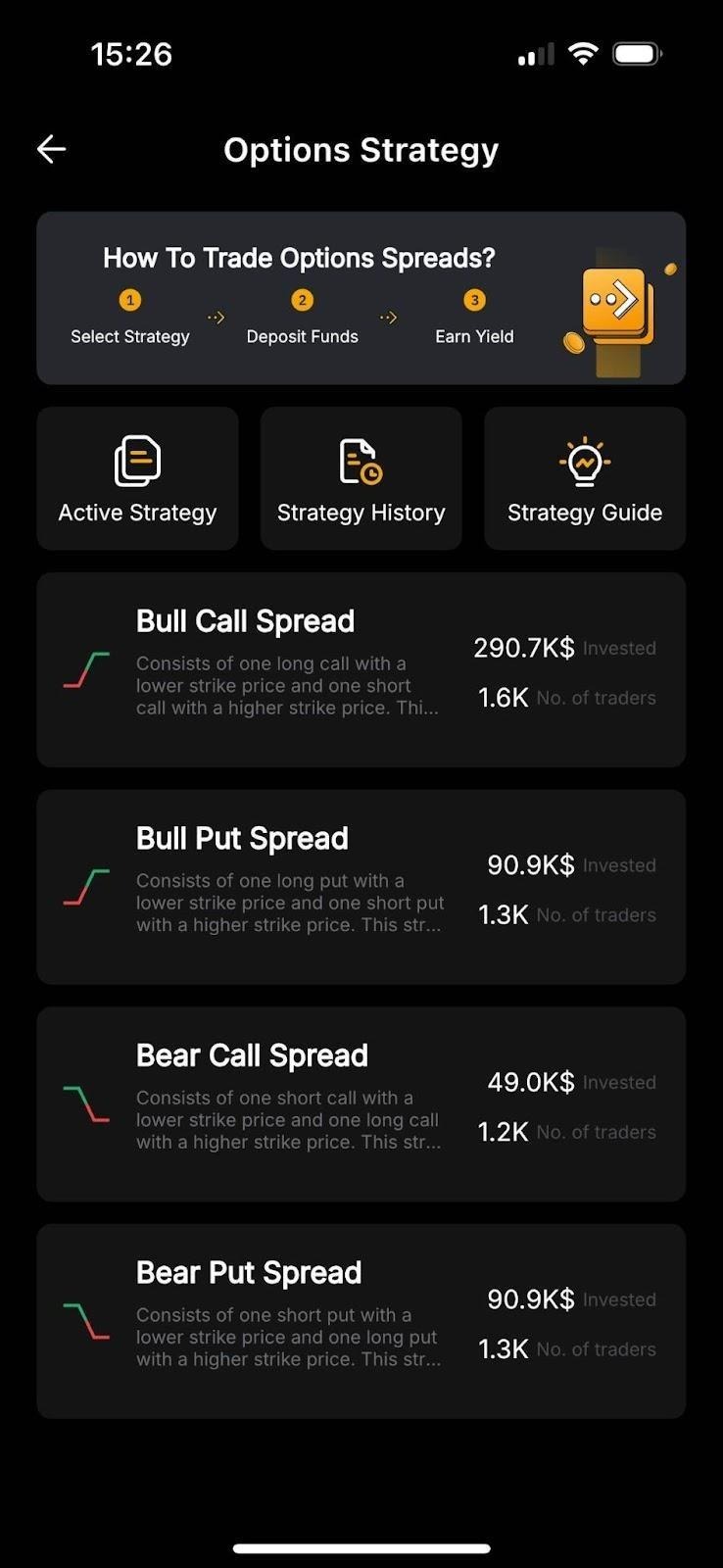
Bull Call Spread — moderately bullish. One long call at a lower strike + one short call at a higher strike. Profits if price rises moderately, with both maximum gain and maximum loss defined upfront.
Bull Put Spread — neutral to moderately bullish. One long put at a lower strike + one short put at a higher strike. Profits if price stays above the short strike.
Bear Call Spread — moderately bearish. One short call at a lower strike + one long call at a higher strike. Profits if price stays below the short strike.
Bear Put Spread — moderately bearish. One short put at a lower strike + one long put at a higher strike. Profits if price declines moderately.
Each strategy card shows an introduction, a P&L graph and key metrics including maximum profit, maximum loss and margin requirements. These are defined before you enter, which is the entire point of spreads: both sides of the risk are known at entry.
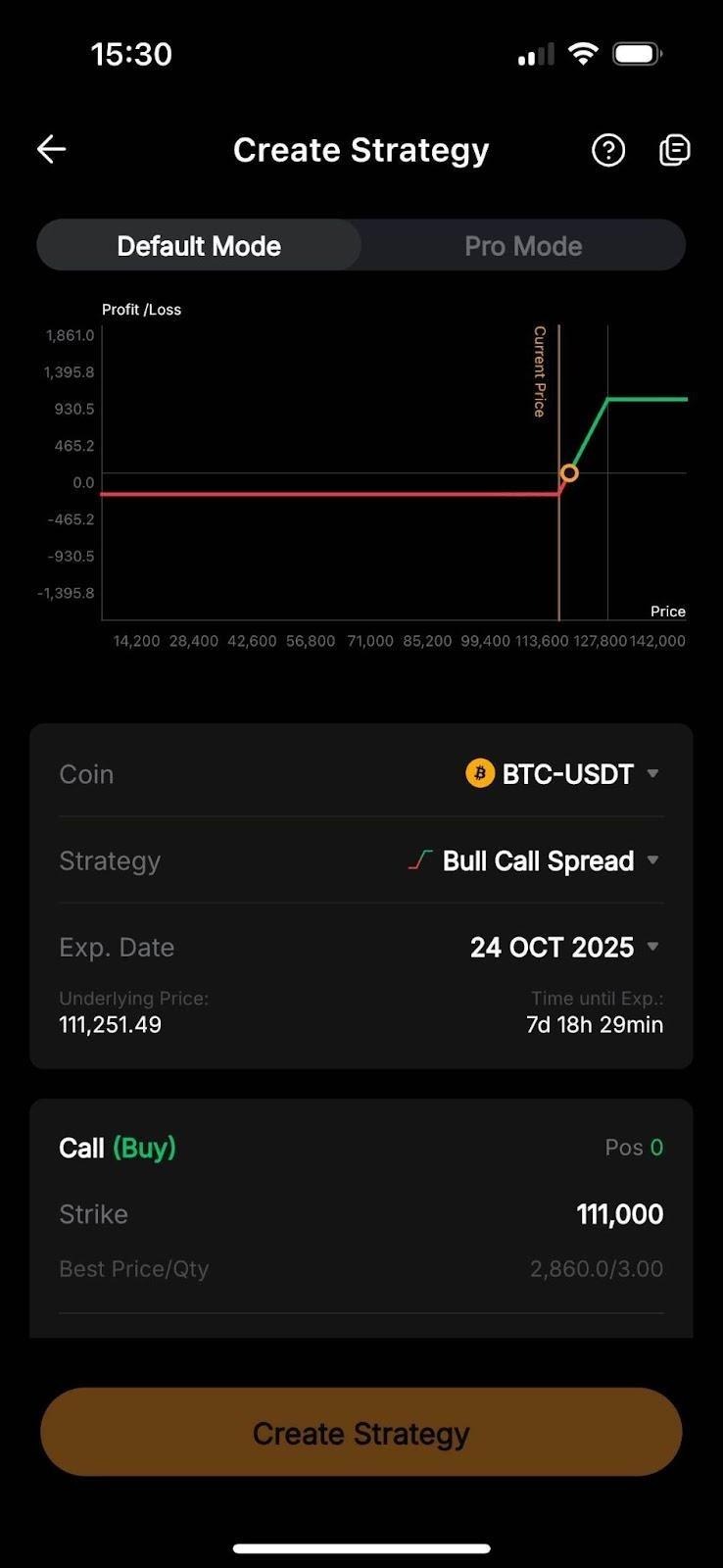
Step 3: Create your strategy. Two modes are available:
Default mode (recommended for first-time strategy users) — Bybit auto-selects the coin, strike prices and expiration date based on current market conditions. You review and confirm. Parameters cannot be customized in this mode.
Pro mode — full control over coin, strategy type, expiration date, strike prices for each leg and contract size.
Once configured, tap Create Strategy. The position executes as a market order.
Step 4: Monitor your active strategies. The Active Strategy tab shows realized cash flow, unrealized P&L and position details for each open strategy.
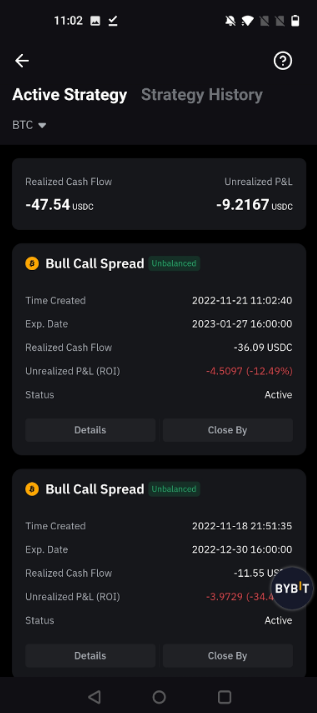
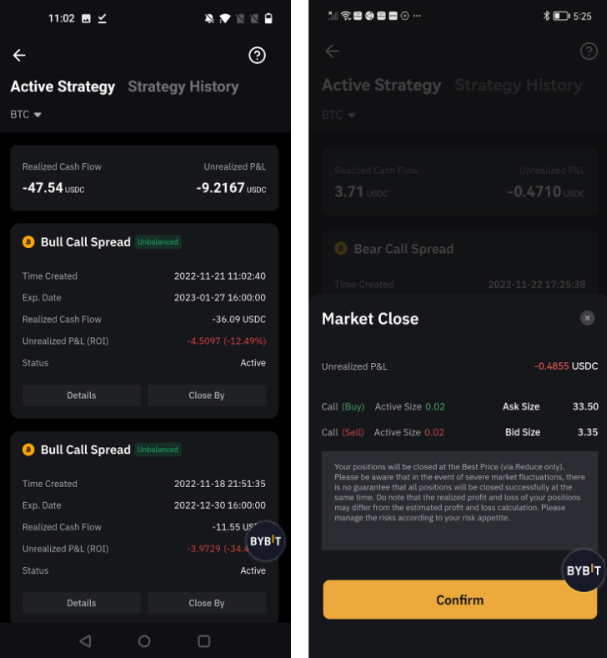
Step 5: Close your strategy. Under Active Strategy, tap Close By on the position you want to exit. Confirm the details and the strategy closes as a market order. In extreme market conditions, low liquidity may affect your ability to close at favorable prices, so monitor conditions rather than waiting until the last moment before expiration.
Fees and margin
Options trading on Bybit involves three main fee types: trading fees, delivery fees and liquidation fees. Trading fees apply when you open or close an options position, while delivery fees may apply when an option expires in the money and is automatically exercised. Liquidation fees may apply to short options if the position is liquidated due to insufficient margin.
Margin requirements also differ between buying and selling options. Buying options requires you to pay the premium upfront, and your maximum loss is limited to that premium. Selling options requires maintenance margin because potential losses can exceed the premium received.
Because options fees and margin rules vary by contract, VIP tier and market conditions, check Bybit's latest option fees schedule and options margin rules before placing a trade.
Risks of options trading
Time decay works against buyers. Every day that passes erodes an option's premium, even if the underlying price hasn't moved against you. This effect accelerates as expiration approaches. Buying short-dated OTM options means you need a large, fast move just to break even.
Selling options carries outsized risk. Writing (selling) a call or put collects premium upfront but exposes you to losses that can far exceed that premium if the market moves sharply. This is not a beginner-appropriate strategy.
Liquidity varies by strike and expiration. ATM options on BTC and ETH with popular expiration dates have tighter spreads. Far OTM or long-dated contracts may have wider bid-ask spreads, making entries and exits more expensive than the quoted premium suggests.
Complexity compounds mistakes. Multi-leg strategies (spreads, straddles) multiply the variables you need to track. Adding a leg you don't fully understand can create unexpected exposure. Start simple.
European exercise means no early exit via exercise. If your option is deep ITM and you want to realize the profit, you must sell the contract on the market rather than exercising early. Illiquid contracts may not have a buyer at fair value.
The bottom line
Options offer something futures and spot trading cannot: a known maximum loss for buyers, with uncapped upside potential. That structural advantage comes at a cost (the premium) and a time constraint (expiration). For traders who want directional exposure without liquidation risk, buying options is worth learning.
Start in Easy mode with a small position to see how premium, time decay and strike selection behave with real money on the line. Once that makes intuitive sense, Pro mode and multi-leg strategies open up. But starting with a straddle before you understand a single call is how most avoidable losses in options trading originate.
Ready to get started? Create a Bybit account and navigate to Trade → Options to explore available contracts.
Risk disclaimer: This article is for educational purposes only and does not constitute financial or investment advice. Options trading involves risk, including the potential loss of your entire premium (for buyers) or losses exceeding premium received (for sellers). Trade responsibly. |
#LearnWithBybit