


Community AMA: ZetaChain 2.0 and the Push Toward a Universal Execution Layer for AI and Web3

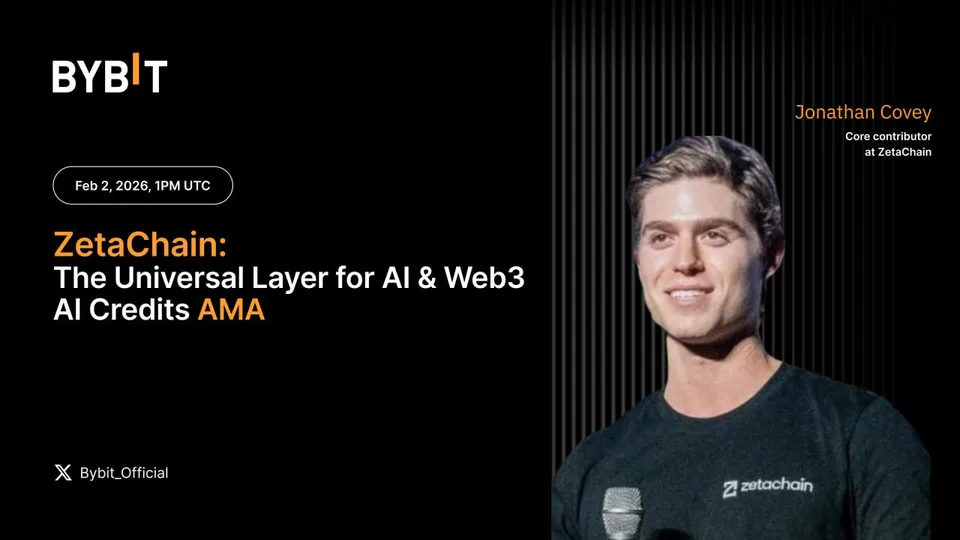
ZetaChain 2.0 and the Push Toward a Universal Execution Layer for AI and Web3
Fragmentation remains one of the biggest barriers to adoption in both Web3 and AI. Wallet switching, chain-specific apps, isolated AI models, and scattered user context continue to slow down real-world use. During a recent community AMA, Jonathan Covey, core contributor at ZetaChain, shared how ZetaChain 2.0 is designed to address these challenges by unifying blockchains and AI systems under a single execution layer.
Rather than introducing another standalone chain or AI product, ZetaChain’s approach focuses on abstraction, interoperability, and user-controlled data, with the goal of making both Web3 and AI easier to use for developers and end users alike.
From Consulting to Infrastructure: Jonathan Covey’s Background
Jonathan Covey comes from a background that spans corporate consulting, Web3 infrastructure, and product development. Before ZetaChain, he worked closely with teams focused on blockchain usability and large-scale systems, including early contributors connected to projects such as the Brave browser ecosystem.
That experience shaped his perspective on fragmentation as a fundamental issue across emerging technologies.
“I’ve always felt we could do better in terms of how people actually use these systems,” Covey shared. “ZetaChain came from the idea that interoperability shouldn’t be an afterthought.”
What ZetaChain Is Building and Why It Matters
ZetaChain is building a universal execution layer that allows applications to interact with multiple blockchains and, with version 2.0, multiple AI models, through a single deployment and user flow.
Instead of forcing users to switch wallets, bridges, or networks, ZetaChain abstracts these complexities away. For developers, this means deploying an application once while enabling it to operate across connected ecosystems.
For users, it means fewer interruptions and a simpler experience.
“From a user perspective, the idea is one transaction, one flow, without needing to download new wallets or constantly switch chains,” Covey explained.
Solving Fragmentation in Web3
Community members raised a familiar concern: why does interacting with Web3 still feel complex compared to Web2?
According to Covey, fragmentation is the core issue. Today’s Web3 applications often require users to manage multiple wallets, networks, and assets, each with its own rules and interfaces.
ZetaChain addresses this by acting as a coordination layer. Developers deploy applications using familiar EVM tools, while the protocol handles execution and interaction across connected chains behind the scenes.
“All of your code lives in one place,” Covey said. “You don’t have to redeploy or glue systems together every time you want to support another chain.”
Extending the Same Logic to AI
With ZetaChain 2.0, the protocol extends this interoperability model to AI systems.
AI today faces a similar problem: user context and data are siloed within individual providers. Switching between models often means starting over, losing memory, and duplicating workflows.
ZetaChain 2.0 introduces what Covey describes as a universal layer for AI and Web3, where AI inferences can be routed across multiple models while maintaining a single, user-owned memory hub.
“Your context is trapped inside individual AI providers today,” he said. “With ZetaChain 2.0, you own your memory and can use it across models.”
The Private Memory Layer: Ownership and Control
One of the most discussed features during the AMA was ZetaChain’s private memory layer.
This layer acts as a user-controlled hub for AI context, preferences, and interaction history. Instead of being stored by individual AI providers, memory is tied to an address on ZetaChain, giving users control over access, portability, and deletion.
“This is your AI data,” Covey emphasized. “You control it like you would control assets in a wallet.”
Developers can build applications that retrieve relevant memory context while respecting user-defined permissions. Over time, this layer is designed to support decentralized inference and validator-backed verification.
Software-First, Developer-Friendly Architecture
ZetaChain 2.0 operates entirely at the software and protocol level. It does not require specialized chips or proprietary hardware.
Validators operate globally, similar to other proof-of-stake blockchains, while AI models run on existing infrastructure such as cloud data centers.
This approach lowers the barrier for developers to build and experiment.
“Our goal is to make it easier to deploy applications without reinventing infrastructure,” Covey said. “Especially as AI-assisted development accelerates.”
Introducing Anuma: A Consumer AI Showcase
As part of its 2.0 rollout, ZetaChain introduced Anuma, the first consumer AI application built on the new infrastructure.
Anuma demonstrates AI model interoperability and persistent private memory in a real-world use case. While still in early stages, it serves as a reference point for developers exploring what cross-model AI experiences can look like.
“Anuma is meant to show what’s possible when memory, inference, and ownership come together,” Covey explained.
The developer platform is expected to open more broadly in the coming months, with additional applications already being built on the API.
Competing With or Complementing TradFi and Big Tech?
Community members also asked whether ZetaChain aims to compete with traditional finance or large technology companies.
Covey described the relationship as both cooperative and competitive. While large institutions build their own systems, many also participate as infrastructure providers.
“Composability is core to crypto,” he said. “We see traditional companies moving into blockchain, stablecoins, and digital assets. They’ll need simple ways to connect to multiple ecosystems.”
ZetaChain’s role, he suggested, is to reduce friction between decentralized systems and the traditional world.
Looking Ahead: The Next Few Years
Over the next two to three years, ZetaChain aims to evolve from a universal blockchain into a broader execution layer for crypto and AI agents.
As AI agents take on more autonomous tasks, Covey believes blockchain will play a critical role in verification, settlement, and ownership.
“All of that activity needs to be verifiable and paid out,” he said. “That’s where blockchain becomes essential again.”
Lowering the barrier for developers, improving interoperability, and protecting user data remain key priorities.
A Long-Term View on Crypto and Bitcoin
When asked about the broader market, Covey emphasized a long-term perspective.
“I’m more of a technologist than a trader,” he said. “But everything is becoming digital, and AI needs a place to thrive.”
He views Bitcoin as a foundational asset with ongoing relevance, particularly as new use cases emerge through interoperability and decentralized finance.
Final Thoughts
ZetaChain’s vision centers on simplifying complexity without sacrificing decentralization or user control. By addressing fragmentation across both Web3 and AI, the project positions itself as infrastructure rather than an isolated application.
Readers interested in learning more can explore ZetaChain’s documentation, developer resources, and updates around Anuma as the ecosystem evolves.
Thank you to everyone in the community who participated in the AMA.
As always, explore responsibly and do your own research (DYOR) before engaging with any project.
Join the Next Bybit Community AMA
Bybit Community sessions are open to members who want to stay connected with builders, traders, and innovators shaping the crypto industry.
Creating a Bybit account allows you to:
- Join upcoming live AMA sessions on X Spaces and win rewards.
- Participate in community campaigns and activities
- Connect with local and global crypto communities
- Access trading features on the platform
If you’d like to be part of the next conversation, you can create your free account and explore the Bybit Community today.