


Community AMA: How SCOR Is Turning Sports Fandom Into an On-Chain Asset

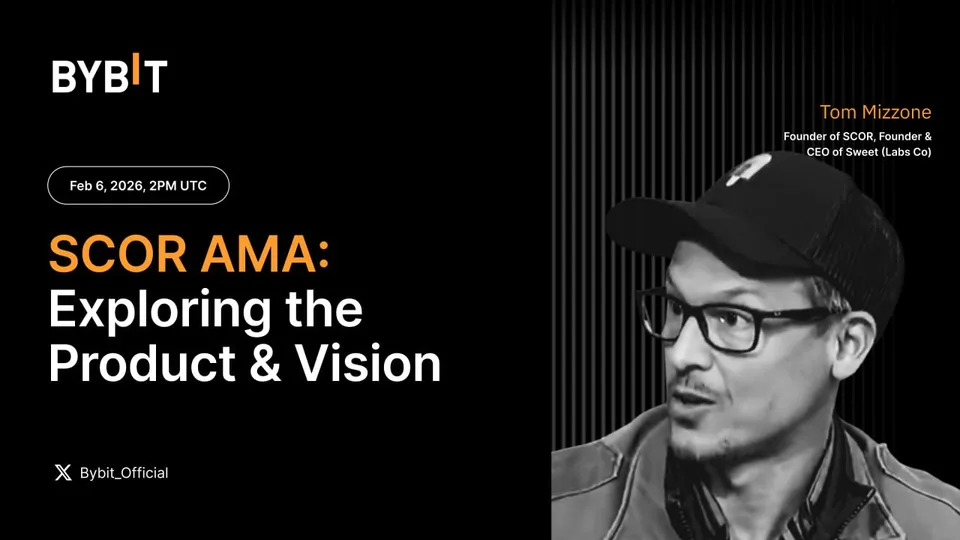
How SCOR Is Turning Sports Fandom Into an On-Chain Asset
What if being a real sports fan created something you could actually own, prove, and use across digital experiences? In a recent Bybit Community AMA, the SCOR team shared how they are building infrastructure that turns sports fandom into a verifiable on-chain asset and makes sports intellectual property programmable for the digital age.
The discussion focused on a simple but overlooked reality: fans generate enormous value for sports, yet rarely own their engagement, identity, or achievements. SCOR aims to change that by recording fan merit on-chain while giving sports brands a more flexible way to activate IP beyond slow and rigid licensing models.
Meet the speaker: Tom Mizzone, Founder of SCOR and CEO of Sweet
Tom Mizzone is the founder of SCOR and the CEO of Sweet, a Web3 company focused on sports fan engagement and IP activation. He brings decades of experience building technology and entertainment platforms, with deep exposure to professional sports through partnerships spanning multiple global leagues and brands.
SCOR, he explained, represents an evolution of Sweet’s long-term work in sports, combining blockchain infrastructure with proven fan engagement mechanics.
“We wanted to solve this fandom problem by turning fan engagement and pro sports IP into a programmable digital asset.”
The core problem: Fans create value, but don’t own their fandom
The community asked what SCOR is ultimately trying to solve. Tom described a structural imbalance affecting both fans and sports IP holders.
On the fan side, engagement is largely passive. Fans watch games, buy merchandise, and interact with content, but their loyalty, knowledge, and achievements are owned by centralized platforms. These records are not portable, verifiable, or controlled by the fan.
“The value is mostly passive. We don’t really own our status as a fan in any verifiable way. Most of that value goes to an intermediary platform.”
On the IP side, sports brands face outdated monetization models. Licensing deals are slow to negotiate, rigid in scope, and limited in how IP can be used once contracts are signed. This restricts innovation and scalability across digital platforms.
SCOR’s thesis is that blockchain can modernize both sides by creating shared infrastructure for fan identity and IP usage.
What SCOR is building and why it matters
At its core, SCOR is building a protocol that enables sports IP to be activated programmatically while allowing fans to own their engagement as an on-chain asset.
Rather than positioning itself as a single application, SCOR is designed as infrastructure that other platforms, games, and ecosystems can integrate with. Sports, according to Tom, is uniquely suited for this model due to its emotional depth and built-in global audiences.
“Sports is very unique. You’ve got built-in emotion, loyal, passionate communities. We don’t really have a cold start problem.”
Why sports instead of DeFi or generic gaming?
The community asked why SCOR chose to focus on sports instead of pursuing a broader DeFi or gaming narrative.
Tom compared the sports industry’s current moment to earlier digital shifts in music and media. Initially, industries try to protect legacy models. Eventually, they adapt to new distribution and ownership paradigms.
“Eventually you have to move from protection to saying there’s a new way the world is moving and we have to adopt that new way.”
From SCOR’s perspective, sports represents a massive, under-served market where engagement is abundant but ownership and programmability are lacking.
Product overview: accessible games with on-chain foundations
SCOR’s current ecosystem revolves around sports-based games and competitive experiences designed for both Web2 and Web3 users.
The team emphasized ease of onboarding as a priority. Rather than exposing users to blockchain complexity, SCOR abstracts the technical layer and focuses on gameplay, usability, and fairness.
“We’ve been very fixated on making the journey easy, without putting high technical barriers in front of users.”
Entry point and mechanics
Users can begin interacting with the ecosystem via fund.score.io, where they can connect a wallet and participate in games and challenges. SCOR currently supports multiple sports titles and competitive formats, including head-to-head skill-based play.
Importantly, outcomes are designed to be driven by knowledge and performance rather than chance.
SCOR token utility: how users engage today
A key community question was what users can actually do with SCOR today.
Tom outlined several utilities already live or in development:
Participating in skill-based PvP battles using SCOR
Upgrading to pro-athlete characters that provide in-game advantages
Accessing the SCOR Store for upgrades and future collectibles
Upcoming staking features that unlock higher-stakes arenas and exclusive areas
“We’re introducing staking so holders can enter higher-stakes arenas and access unique parts of the ecosystem.”
SCOR is issued as an ERC-20 token, with the team positioning the protocol as chain-agnostic over time.
SCOR ID: a fan-owned on-chain identity
Another major topic was SCOR ID, described as a fan-owned digital identity that records skills, engagement, and achievements on-chain.
Unlike traditional platforms where user data is controlled centrally, SCOR ID is designed to live with the user and remain verifiable across experiences.
“Traditional sports gaming apps own your data. With SCOR ID, your skills and achievements become an asset that you own.”
The on-chain nature of SCOR ID also enables transparent rewards and removes opaque “black box” systems where progress or benefits can be altered off-platform.
Differentiation and long-term sustainability
The community raised concerns about the longevity of Web3 fan platforms. Tom highlighted several differentiators:
Sweet’s multi-year operating history in sports engagement
Existing partnerships with major sports IP holders
A focus on fun, social, and rewarding gameplay fundamentals
A protocol-first approach rather than a single standalone app
“Users stay when it’s easy, fun, social, and worth their time.”
What’s coming next
Looking ahead, the SCOR roadmap includes:
Expanded integrations with external sports ecosystems
More social and head-to-head gameplay formats
Staking mechanisms tied to higher engagement tiers
Sports collectibles and memorabilia with in-app utility
Reactivating dormant sports NFTs across chains by attaching them to SCOR’s ecosystem
These initiatives reflect a strategy centered on real utility and gradual adoption rather than speculative narratives.
Exploring SCOR
Users interested in exploring the ecosystem can start at fund.score.io, where onboarding and gameplay experiences are available today. Additional updates are shared through the project’s official channels.
Thank you to the community for participating in the AMA and contributing thoughtful questions. For those interested in how Web3 infrastructure can reshape sports fandom, SCOR presents a focused attempt to bridge fan passion with on-chain ownership.
Encourage readers to explore responsibly and always DYOR.
Join the Next Bybit Community AMA
Bybit Community sessions are open to members who want to stay connected with builders, traders, and innovators shaping the crypto industry.
Creating a Bybit account allows you to:
- Join upcoming live AMA sessions on X Spaces and win rewards.
- Participate in community campaigns and activities
- Connect with local and global crypto communities
- Access trading features on the platform
If you’d like to be part of the next conversation, you can create your free account and explore the Bybit Community today.