


Bybit Options Weekly Review: May 6–May 11

Opening Snapshot | The Week in One Line
Last week's Long Strangle strategy was directionally right but unlucky — BTC sat in the corridor between both breakevens all week. However, recently the market delivered a deeper signal: a rising wedge on the technical chart, persistently negative funding rates, and DVOL grinding down to 37–41 — a historically extreme low. Three indicators pointing at the same conclusion: the derivatives market is brewing something, but price has not yet confirmed what. Remember: BTC remains 36% below its all-time high. The market is still trading inside a bear market range. No strategy recommendation this week. We are watching. |
I. Weekly Market Recap
BTC grinded sideways above $80k all week, posting a modest +0.5% gain that obscured the significance of Consensus Miami's regulatory signals. XAUT surprised to the upside with +2.1%, breaking the simple "risk-on = gold off" narrative.
Weekly Price Action (Bybit Platform Data, updated May 11):
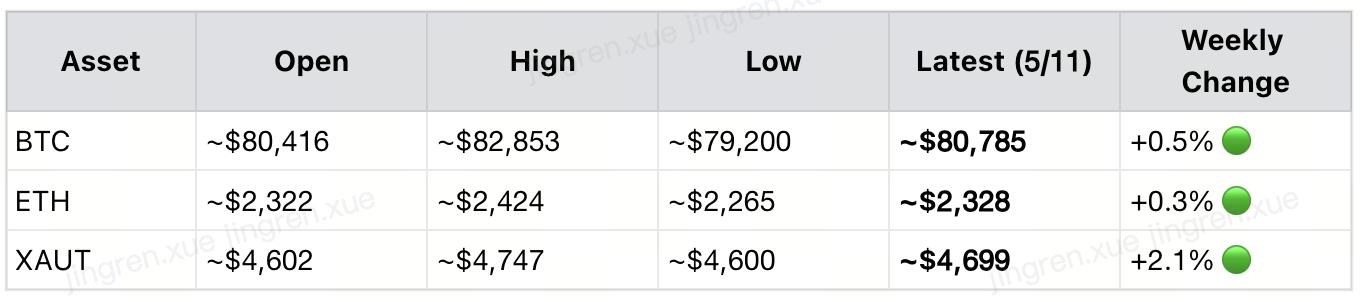
⚠️ Important narrative correction: Bybit data shows XAUT rose +2.1% this week, not the decline previously estimated. XAUT benefits from a sharp increase in trading volume and sustained institutional inflows, demonstrating a unique advantage combining both safe-haven and yield-generating attributes, with effective support at the $4,500 level. BTC and gold rising in tandem suggests institutions may be simultaneously building crypto exposure and gold hedges — not a simple risk-on rotation. Since the Iran war began, gold has been moving largely in tandem with riskier assets (e.g. cryptos, FX, etc.) in light of inflation risks (i.e. higher oil prices --> greater inflation risks --> higher central bank rates --> less appeal for gold)
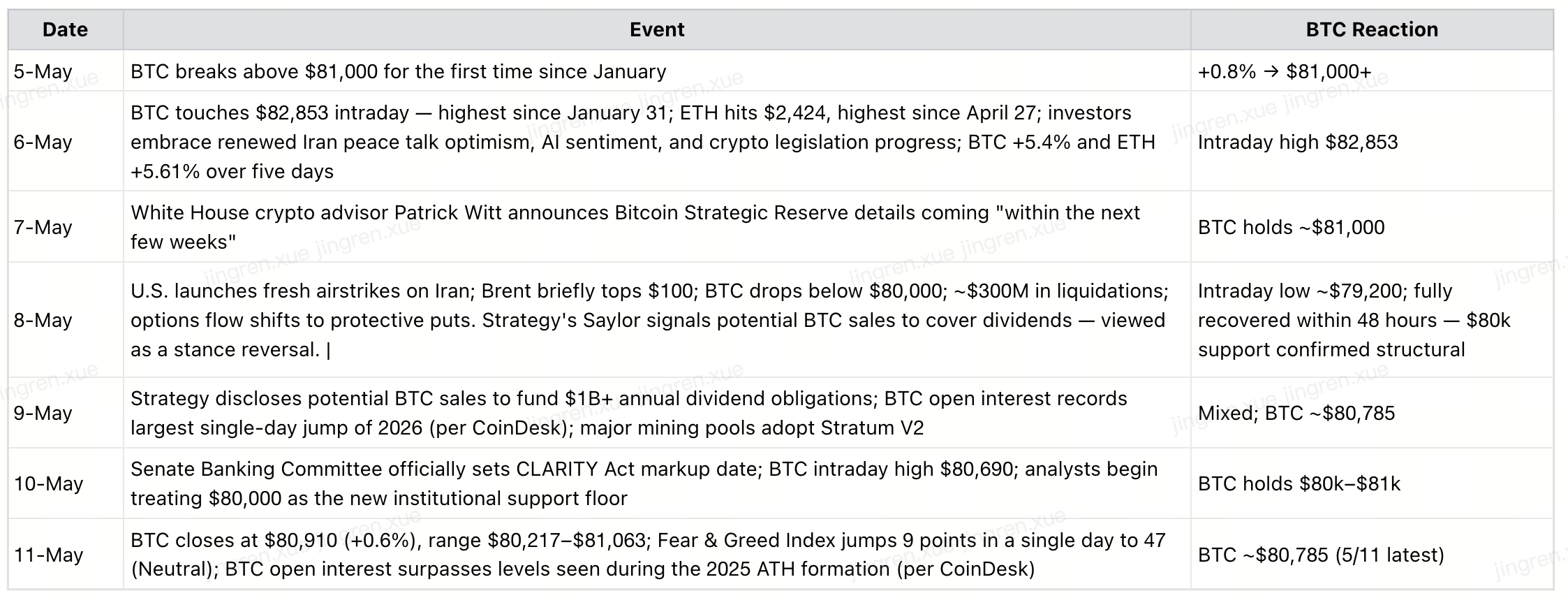
Event Timeline:
II. Options Market Key Data
Last Week's Long Strangle — Honest Post-Mortem:

📌 Lesson: Near-the-money strangles have almost zero tolerance for range-bound action. BTC's ~3% intraweek range without breaking either breakeven level is the near-the-money strangle's worst-case scenario. The thesis on vol being underpriced was correct; the strike selection and structure were not.
Current Options Snapshot:

III. Deep Dive | Three Signals, One Conclusion
This week the market delivered three signals that, individually, are each inconclusive. Together, they demand serious attention.
Signal One: Technical — Rising Wedge
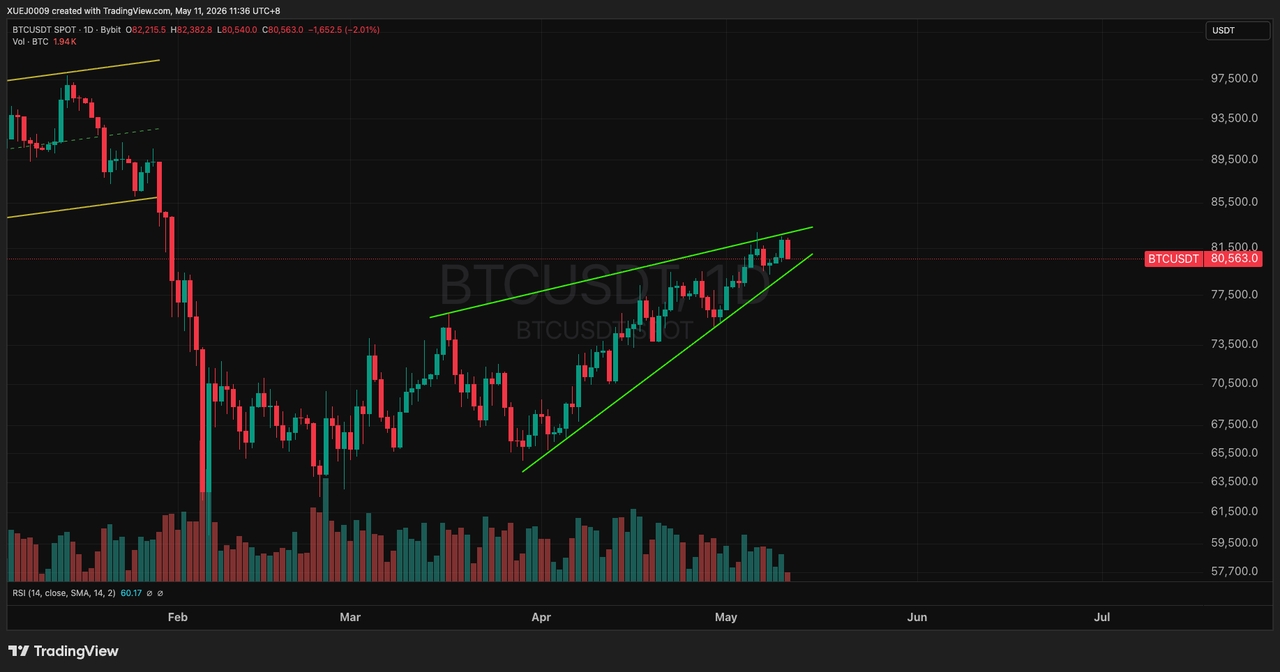
Analysts have flagged a rising wedge formation on BTC's chart — price advancing within a narrowing ascending channel, with both the highs and lows rising but the two boundaries converging. This is a classic momentum exhaustion pattern: price continues higher but each successive advance requires more energy from a thinning pool of buyers, and the structure typically resolves with a downside break. If triggered by a macro catalyst — particularly a hotter-than-expected inflation print or a Fed statement pushing rate cuts further out — BTC could technically decline toward $70,000. This is not a fringe tail risk; it is a structurally grounded downside scenario with a clear macro catalyst.
The key implication of the rising wedge: every dollar BTC gains above $80k is being bought with progressively thinner volume support against a narrowing ceiling.
Signal Two: Flow — Funding Persistently Negative, Spot Demand Weak
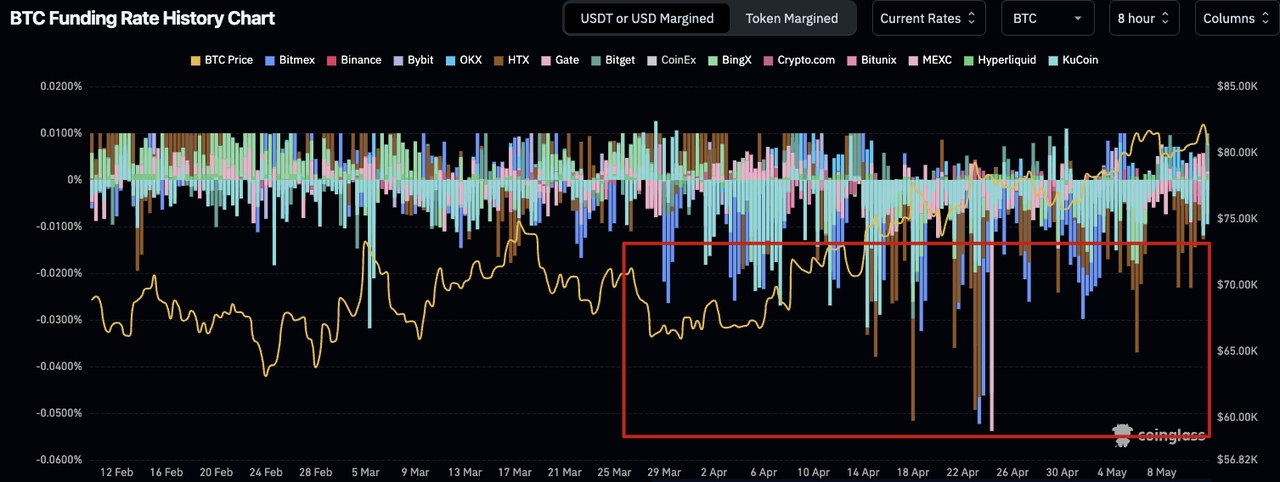
Bitcoin's open interest has expanded to levels exceeding those recorded during BTC's 2025 all-time high formation — but this leverage buildup occurred with funding rates remaining broadly negative for weeks (per CoinDesk). The leverage accumulation was not a crowd of aggressive longs paying premiums.
What persistently negative funding rates actually tell us:
Genuine spot buying demand is insufficient: If real bullish conviction were strong, longs would pay a premium to hold (positive funding). Persistent negative funding means the market does not believe in $80k+ price levels — bulls are being carried by short squeeze mechanics, not organic demand
Fragile structure: Heavy short positioning + price near resistance = a structure that can spike violently upward on short squeezes, but has no organic demand to sustain any rally that follows
The market is still inside a bear market range: At ~$80,785, BTC remains approximately 36% below its all-time high of $126,198. This is a technical recovery from the $65,000 low — not a bull market. Recovery and bull market are two fundamentally different conditions
Signal Three: Volatility — DVOL 37–41, a Historically Extreme Reading
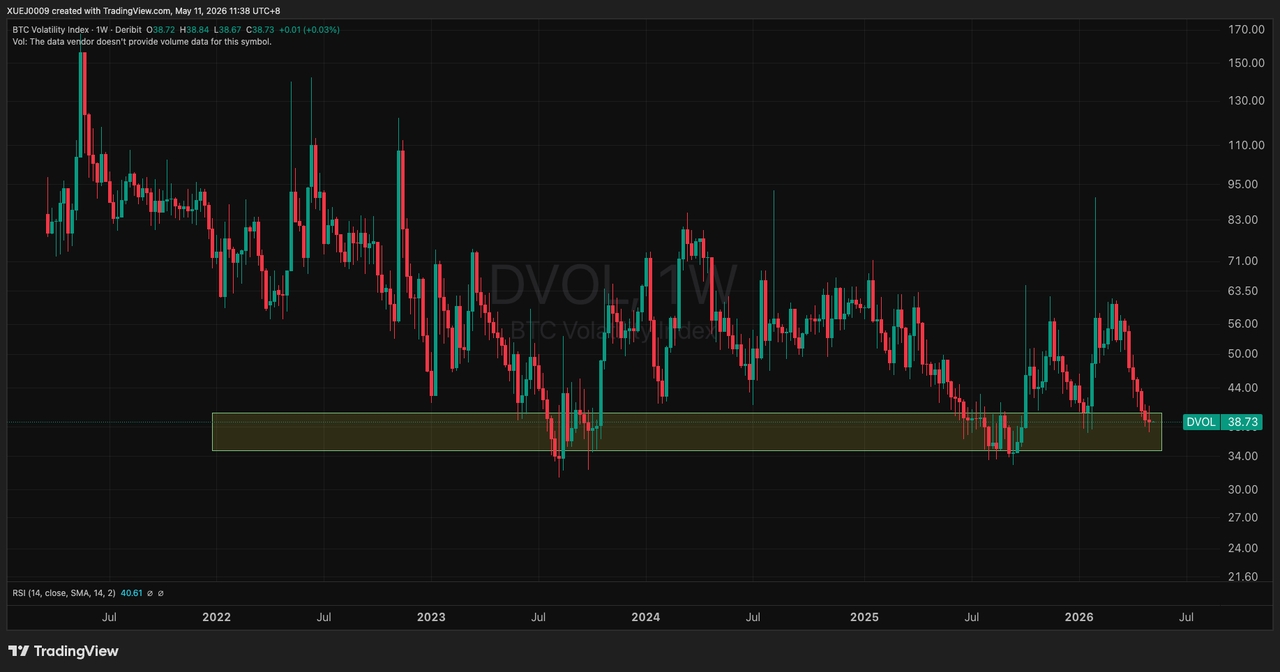
What DVOL at 38 means in BTC's historical context:
Even during 2024's calmest range-bound periods, DVOL rarely stayed below 42% for extended stretches
Every prior instance of DVOL reaching an extreme low was followed by a significant directional expansion — direction uncertain, but magnitude almost never disappointing
Low volatility is historically a precursor to a large move, not a steady state. The current quiet feels less like stability and more like a coiled spring at maximum compression
The combined conclusion of all three signals:
The derivatives market is brewing something. But price has not yet confirmed what. Technical structure favors downside resolution. Spot demand is insufficient to sustain the rally on its own. Volatility is at a historical floor. These three conditions together mean the next large move may be significantly larger than any single indicator suggests — but the direction remains unconfirmed. In this environment, forced trading is expensive. Patience is the correct position. |
IV. Macro Background
CLARITY Act — The Week's Most Important Regulatory Development
On May 10, the Senate Banking Committee officially set a markup date for the CLARITY Act. This market structure bill is viewed as the "final boss" of crypto regulation, aimed at providing the definitive legal certainty needed to fully integrate digital assets into U.S. financial infrastructure. Market reaction was positive, with analysts treating $80,000 as the new institutional support floor.
The CLARITY Act passed the House 294-134 last summer but has been stalled in the Senate Banking Committee. Polymarket gives the bill 47% odds of being signed into law this year. XRP is the asset with the most to gain from the bill — analysts project XRP ETF inflows could scale to $3–5B by year-end if it passes.
Kevin Warsh — The Fed's New Era Begins May 15
Warsh cleared committee confirmation 13-11 on April 29; the full Senate vote is expected the week of May 11, with his official start date on May 15. J.P. Morgan expects Warsh to push for rate cuts, with his argument being that AI productivity gains give the Fed room to ease without reigniting inflation. If Warsh signals any openness to cuts in his early speeches, crypto could move meaningfully higher.
Strategy's Dividend Overhang
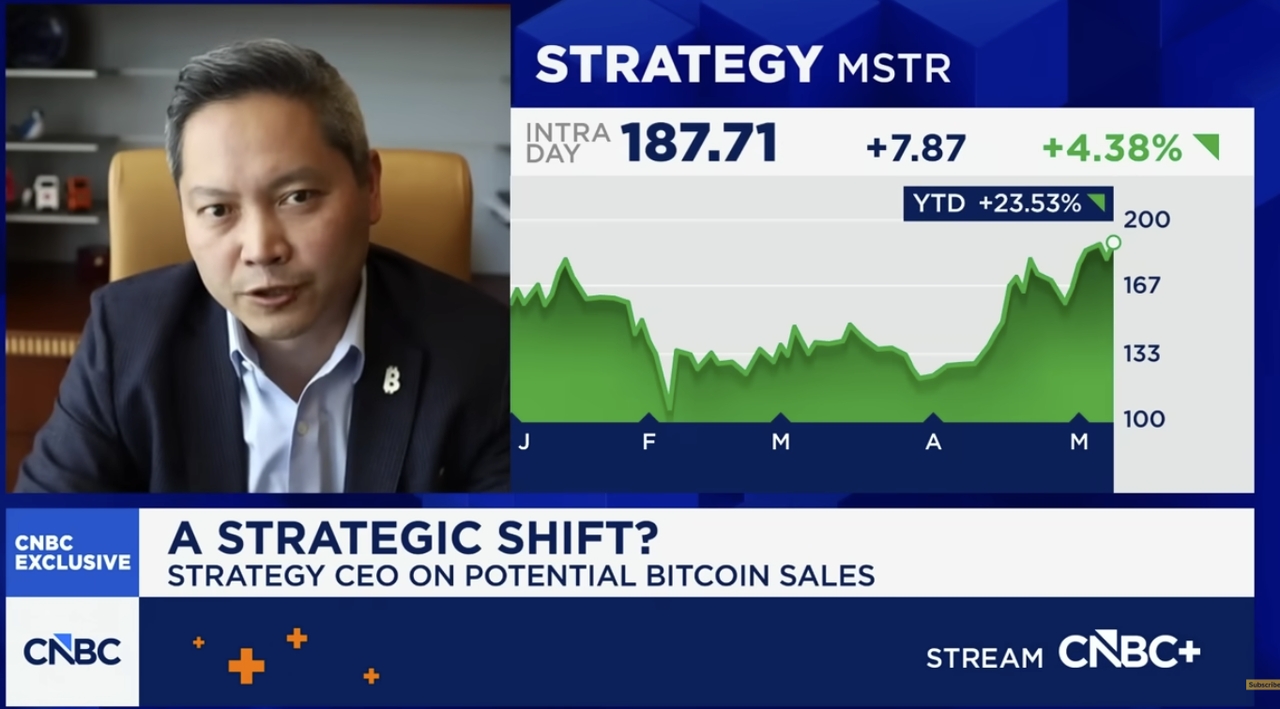
Strategy (holding 818,334 BTC) is considering selling portions of its treasury to cover preferred stock dividends, with annual obligations exceeding $1 billion. CEO Phong Le stated sales would only occur if they increase Bitcoin holdings per share. This is the first credible corporate supply overhang of this cycle — monitor SEC 8-K filings for any actual sales.
CME Bitcoin Volatility Futures — June 1
CME Group plans to launch Bitcoin volatility futures on June 1, pending regulatory approval, giving institutions a direct way to trade BTC price swing magnitude through regulated futures markets. If launched successfully, this could be a structural variable that accelerates the end of the current low-vol regime — and changes DVOL dynamics meaningfully in Q2's second half.
V. Outlook for Next Week (May 12–18)
CLARITY Act (5/14), Warsh takes office (5/15), ETH Glamsterdam positioning window — three catalysts in four days. But the technical and flow-side structural pressures remain intact.

Three Scenarios:

VI. Strategy Recommendation: No Trade This Week
We are not recommending any options strategy this week. Here is why.
Reason One: Sellers — DVOL 37–41 compresses premium to historic lows
At DVOL 37%, the premium collected from selling options is minimal. The same capital at the same risk generates far less return than it did a month ago when DVOL was 50%+. Tying up margin for thin premium in an uncertain directional environment is an unfavorable risk/reward trade.
Reason Two: Buyers — Low DVOL does not guarantee profitability
Last week's Long Strangle proved it: even buying vol at historically cheap levels loses when BTC refuses to move past either breakeven. Low implied vol reduces entry cost but cannot change the market's willingness to stay range-bound. Cheap vol + sideways market = still a losing trade.
Reason Three: Directional — Structure is genuinely unclear
Rising wedge (technical) + persistently negative funding (weak spot demand) + DVOL at historic floor (market pricing calm) — these three together mean neither an obvious directional long nor short presents a compelling asymmetric opportunity at current levels.
The most important thing to watch — when DVOL recovers above 45%:
A move in DVOL from the current 38% back above 45% is the key trigger for reassessing seller strategies. The following events could drive that recovery:
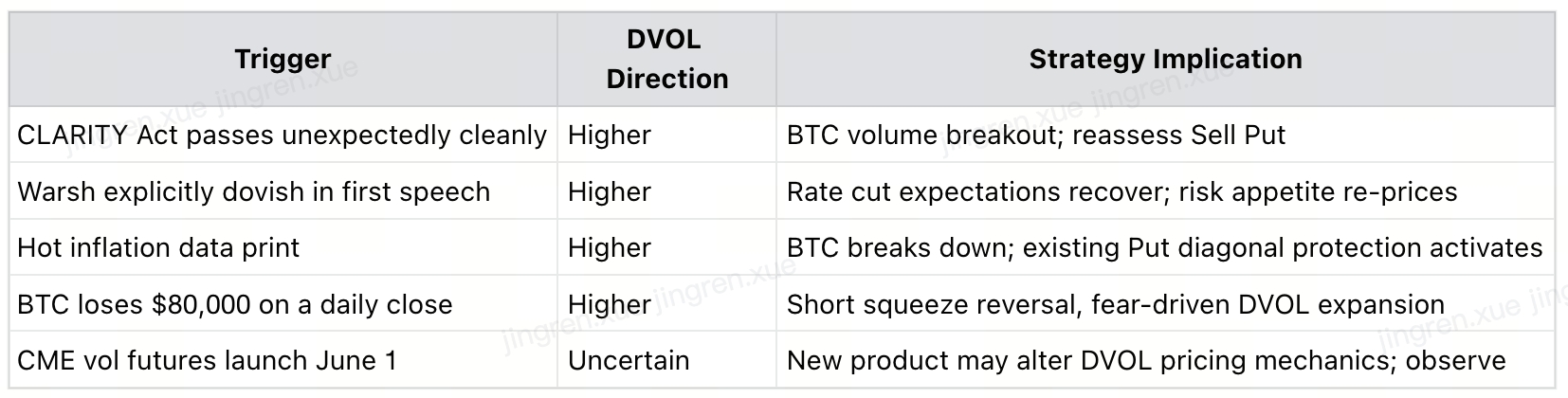
Conclusion: Waiting is the correct position. DVOL at 38 is historically rare for Bitcoin — this level of quiet does not last. The next window where DVOL recovers meaningfully is when the next entry opportunity appears. Forcing trades into 38 vol is treating luck as a strategy. |
Weekly Summary:
Rising wedge on the technical chart: Price advancing in a narrowing channel, momentum exhausting — every dollar above $80k is bought with progressively thinner support against a converging ceiling.
Funding persistently negative, spot demand insufficient: BTC open interest has surpassed 2025 ATH formation levels (per CoinDesk), but this leverage expansion occurred with funding rates broadly negative — the buildup is short positioning, not long conviction. Structure is fragile.
DVOL 37–41, historically extreme: ETH EVIV similarly at its lowest since January 31. Vol at 38 is among the rarest readings in BTC's history — low volatility precedes large moves, not steady states. The direction of the next move is what remains unconfirmed.
Three signals, one conclusion: The derivatives market is brewing something. Price has not yet confirmed what. Upside is structurally pressured. The market remains in a bear market range (−36% from ATH).
CLARITY Act markup officially scheduled; Warsh takes over May 15 — the two catalysts that will likely determine which direction BTC breaks from the current range.No strategy recommendation this week. Watch DVOL direction, CLARITY Act outcome, Warsh's first signal. Wait for the market to answer the question — trading into 38 vol without a clear setup is not a strategy, it is speculation.