


Bybit Options Weekly Review: Jun 16–Jun 22

TL;DR
|
I. The Most Important Thing This Week: Warsh Tore Up the Fed's 14-Year Communication Playbook
This was not an ordinary FOMC meeting. It was the most fundamental break in Fed communication style in over a decade.
Warsh directly dismantled the Fed's traditional 14-year communication framework, abruptly eliminating forward guidance without prior warning and leading the boycott of the dot plot — becoming the first Fed Chair since the dot plot's inception in late 2011 to refuse to submit a personal rate projection. He stated bluntly that "forward guidance doesn't suit the current economic environment," explicitly saying "I cannot give you any forward guidance on what we're going to do next."
What does this shift mean for markets?

Analysts described it this way: the old Fed statement was a roadmap; the new one is a weather report — it tells you what's happening right now and says nothing about tomorrow. For a crypto market that trades heavily on macro expectations and rate-cut hope, removing forward guidance is like pulling the rug out from under the most popular trade thesis of the past 18 months.
The dot plot details — this is where the real shock lives:
The dot plot showed 9 of 18 officials now projecting at least one rate hike before year-end 2026, with 6 projecting two — a complete reversal from March when zero officials saw hikes. The median year-end rate projection jumped from 3.4% to 3.8%, and the Fed simultaneously raised its 2026 PCE inflation forecast from 2.7% to 3.6%.
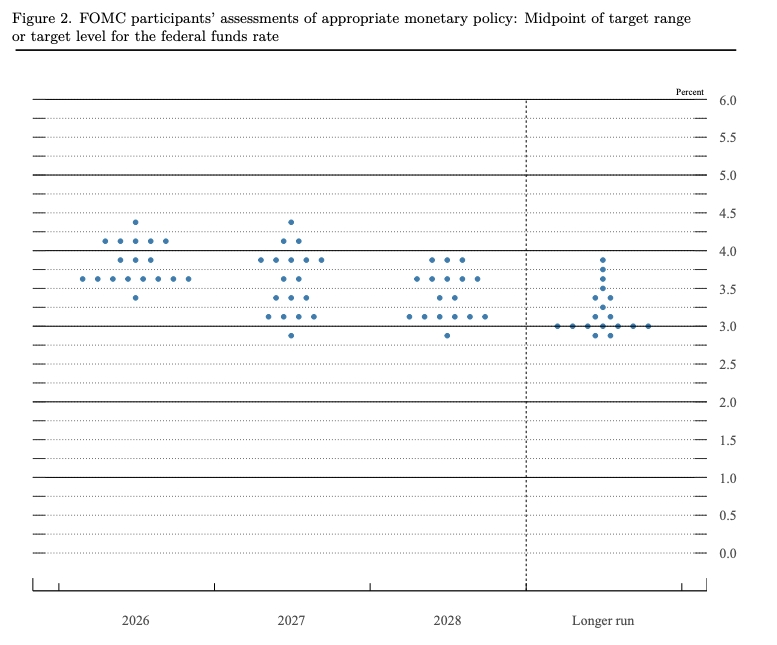
In plain terms: the Fed flipped its narrative from "maybe cuts this year" to "maybe hikes this year" in a single quarter.
Five new task forces announced:
Warsh announced the formation of five task forces to study: policy communication (Standard Implementation Plan reform), balance sheet review, data sourcing and methodology, AI's impact on productivity and employment, and the inflation-driver framework. The inflation task force itself is a signal — Warsh is questioning the Fed's current analytical framework, not just the policy settings.
READ MORE (published June 18th): 5 key takeaways from the “new” Fed
II. Weekly Market Recap
Price Action (Bybit Platform Data, updated June 22):

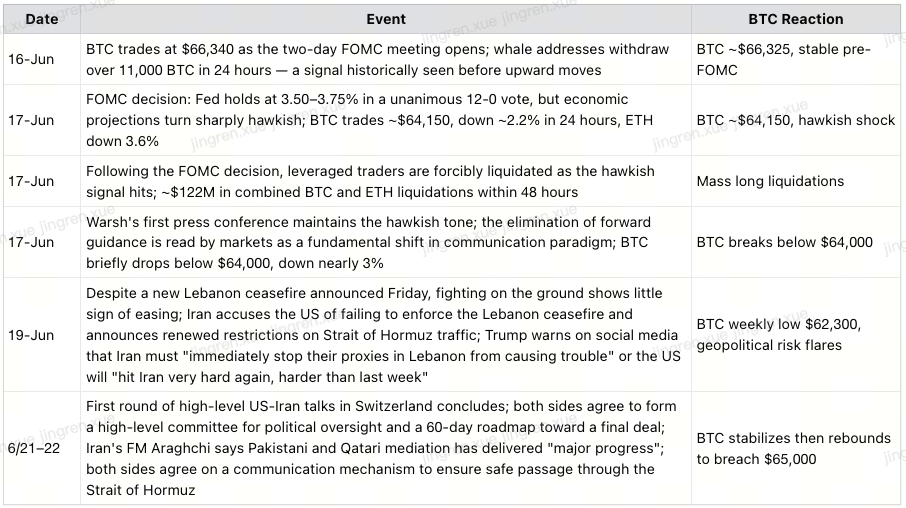
This week saw a classic "FOMC shock + geopolitical whiplash" double-stack: BTC briefly broke below $65,000 ahead of the FOMC meeting, bounced to $66,400, but once the Fed confirmed no rate cut and Warsh signaled hawkish, BTC slid again, hitting a weekly low of $62,300.
Event Timeline:
III. US-Iran Situation: Far From "Geopolitical Risk Resolved"
The first round of Switzerland talks produced a 60-day roadmap, but the situation is far more fragile than it appears:
Trump's hardline stance: Over the weekend he threatened on social media to "hit Iran very hard again, harder than last week" if Iran doesn't immediately rein in its Lebanon proxies — and told Fox News he'd seize the Strait of Hormuz outright if Iran closed it
Iran's countermove: Accused the US of failing to honor its Lebanon ceasefire commitment and announced renewed restrictions on strait traffic — only 5 vessels crossed on Sunday, down sharply from 26 the day prior
Tense negotiating room: Disputed reports emerged that the Iranian delegation walked out (later denied by US officials) — a telling sign of how volatile the process remains
The real implication for crypto markets:
The geopolitical risk premium is far from eliminated — it briefly reignited this week amid strait disruptions and Trump's rhetoric. This is not a steadily resolving process; it's a high-risk standoff that can deteriorate sharply in any given week. Lebanon — the one variable neither Washington nor Tehran fully controls — remains the most critical thread to watch over the coming 60 days.
IV. Strategy and the STRC Depeg Scare: The Key Differences from Terra/Luna
This is the topic most prone to panic-driven misjudgment this week — it deserves careful clarification.
Strategy's flagship financing instrument STRC (a preferred share with an 11.5% annualized dividend, functionally similar to high-yield debt) has depegged sharply, briefly falling to $83.26. The root of market concern: Strategy's disclosure of its first BTC sale since 2022 (32 BTC, late May) raised fears the company might be forced into larger BTC sales to meet its dividend obligations — even though buying has since resumed and expanded.
STRC ≠ Terra/Luna: Three Fundamental Differences
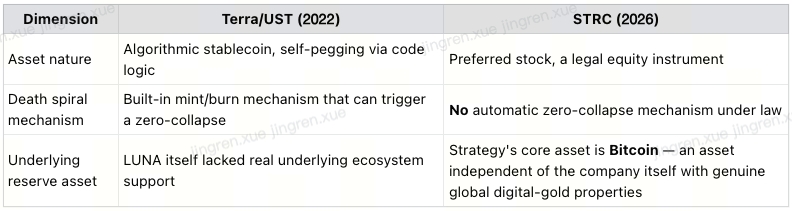
Even in the most extreme scenario — Strategy being forced to liquidate and sell BTC — the enormous demand from US spot Bitcoin ETFs, which absorbed roughly 400,000 BTC even during a six-month bear stretch, means the market has sufficient liquidity to digest a short-term "flash" decline and recover quickly. Longer term, this could even push the crypto market toward a healthier, more diversified credit structure — "de-Strategy-ifying" excessive reliance on a single whale's sentiment.
VI. Outlook for Next Week (June 23–29)
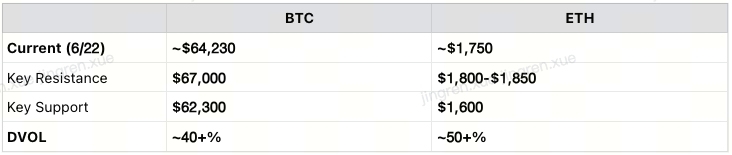
Key technical judgment: Reclaiming and holding $65,000 means the hawkish shock has been digested, with recovery continuing toward $66,000–$68,000 resistance. Losing $62,000 means liquidity headwinds are winning, and the market will seek deeper support.
Key data to watch next week:
① June 25 (Thursday), 8:30 AM ET — US May PCE, consensus 3.4% year-on-year. This is the first major macro data point since FOMC and will test whether upside inflation risks are materializing — a meaningful beat would reinforce fears of "rising inflation + Fed rate hikes" simultaneously. ② Ongoing US-Iran/Lebanon developments — Not a fixed-date release but an event-driven risk: the status of the Lebanon deconfliction mechanism, whether Israel withdraws, and whether fighting resumes. Any material progress or deterioration could rapidly reprice the geopolitical risk premium. Together these form next week's most important decision window: PCE tests the macro side, Lebanon tests the geopolitical side — either one resolving clearly would shift the current "wait" stance. |
Three Scenarios:
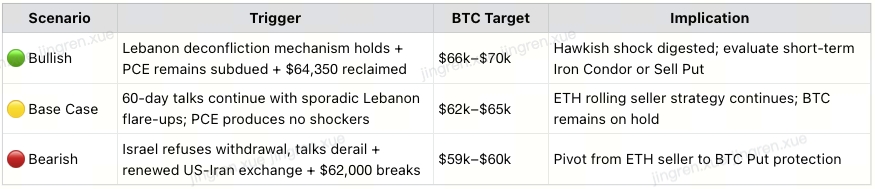
VI. This Week's Strategy: Roll Short-Dated ETH Puts/Calls
This is the only specific strategy recommendation this week — designed exclusively for ETH.
BTC remains on hold.
The core logic in one sentence:
ETH DVOL currently sits around 50+%, notably higher than BTC's ~40+%; with no fresh fundamental shock event in sight and $1,500 support unlikely to break in the near term, this mismatch between "elevated implied vol" and "muted realized vol" means the premium collected from selling options likely exceeds the actual price movement risk being underwritten. |
Why ETH and not BTC:
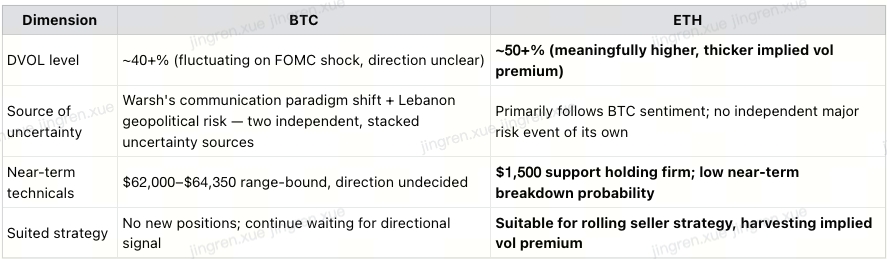
Specific Trade Parameters:
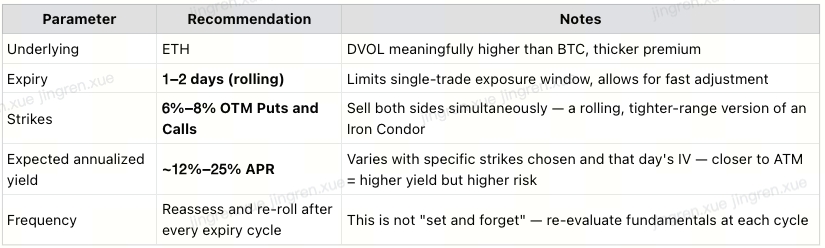
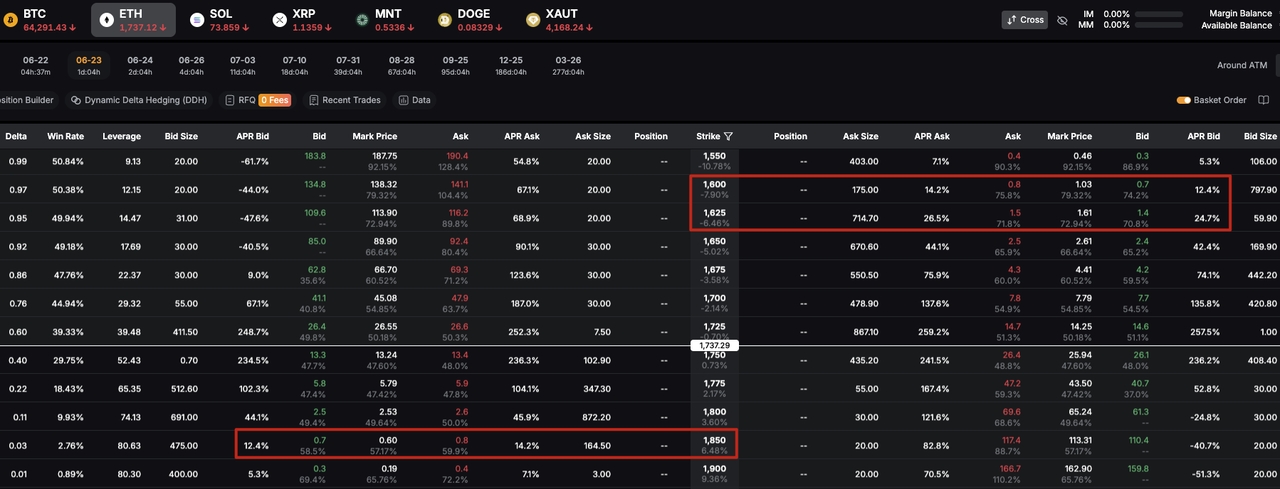
screenshot of 06-23 ETH option chain
The nature of this strategy:
This is not a directional bet — it's harvesting a volatility premium. The logic rests on three pillars:
No fresh fundamental shock expected — this past week's known risks (FOMC hawkish shock, Lebanon situation) have already been priced in by the market; the probability of an equally large new shock within the next 1–2 days is comparatively limited
$1,500 technical support is holding firm — ETH's support level is unlikely to break to the downside in the near term, keeping Put-leg assignment risk manageable
DVOL at 50+% is itself elevated — even accounting for genuine ETH volatility, current implied vol is "overpriced," giving sellers a statistical edge
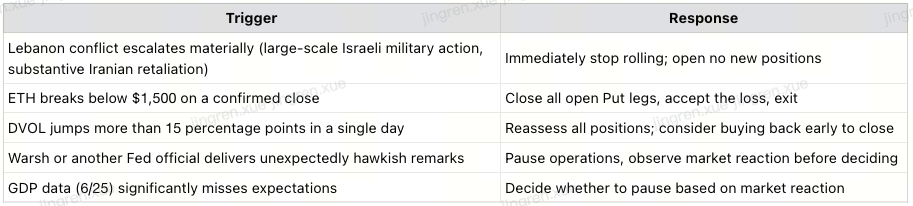
The most important discipline of this strategy: be ready to exit at any moment
The biggest risk in a rolling seller strategy isn't losing money on any single trade — it's still being in the trade when a risk event actually fires. This week's report repeatedly flags two unresolved uncertainty sources — Warsh's communication paradigm shift and Lebanon's fragility — and either one turning sharply negative could push ETH's move well beyond the 6%–8% OTM buffer within hours. |
Specific Exit Triggers:
Position Sizing:
Keep each rolling position within 10% of account NAV — this is a yield-harvesting strategy, not a core position
Avoid stacking too many overlapping expiries at once; keep it simple and controllable
At every re-evaluation point, ask explicitly: "If I weren't already holding this position, would I open it right now?" — if the answer is no, don't blindly roll it forward
⚠️ This strategy is for informational purposes only and does not constitute financial advice. Seller-side option strategies carry tail risk — a single black-swan event can produce losses exceeding the premium collected. Actual strikes, premiums, and APR estimates depend on live quotes at time of entry. |
Weekly Summary:
Warsh's first post-FOMC press conference as Fed Chair fundamentally rewrote the Fed's 14-year communication paradigm: forward guidance eliminated, the statement shrunk to 114 words, and Warsh himself refused to submit a dot plot projection.
Dot plot turns sharply hawkish: 9 of 18 officials project at least one rate hike this year, 6 project two; the 2026 PCE forecast jumped from 2.7% to 3.6%.
US-Iran talks remain on a knife's edge — far from "geopolitical risk resolved": the first round in Switzerland produced a 60-day roadmap toward a final deal, but Trump threatened to "hit Iran harder" over the weekend and Iran briefly restricted Strait of Hormuz traffic again. Lebanon is viewed as the decisive factor for the talks' success, and Israel is not a direct party — the most fragile thread to watch over the coming 60 days.
STRC's depeg should be understood rationally — its mechanics are entirely different from Terra/Luna. Preferred shares have no death-spiral mechanism, and enormous spot ETF demand provides a liquidity buffer even in the worst-case scenario.
This week's strategy: roll 1–2 day, 6%–8% OTM ETH Puts/Calls, targeting 12%–23% annualized yield. This exploits the implied vol mismatch between ETH (50+%) and BTC (40+%), harvesting premium while no fresh fundamental shock is expected and $1,500 support holds short-term — but the discipline is non-negotiable: be ready to exit immediately if Lebanon or Warsh deliver any surprise.
BTC remains in "wait" mode. Reclaiming $64k, a real breakthrough in Lebanon's deconfliction mechanism, or a break below $62,000 — any of these will finally clarify direction.