


Bybit Options Weekly Review: April 15–21

Week of April 15–21, 2026
I. Weekly Market Recap
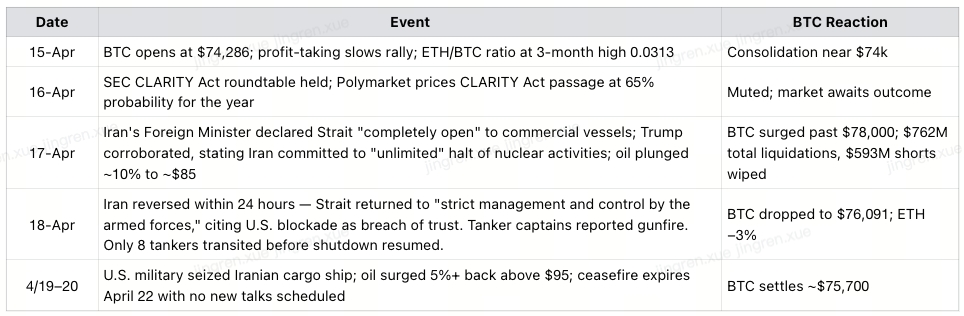
This past week delivered another headline-dominated whipsaw — BTC briefly broke $78,000 on a surprise Hormuz reopening announcement, only to surrender most of those gains within 24 hours as Iran reversed course. The net result: a modest +4.7% weekly gain that masked intraweek volatility of over 5%.
Price Action:
BTC: Week opened ~$74,286 (4/15) → registered an intraday high of $78,336 on April 17 as Brent crude fell 12.95% to $86.52 on Iran's Hormuz reopening announcement → slid to $75,000–$76,000 by Saturday as Iran re-closed the Strait within 24 hours → settling ~$76,600 by April 21
ETH: Preserved a 5.2% weekly gain despite a 3% weekend pullback to ~$2,365. XRP outperformed all majors with a 6.4% weekly advance.
Net weekly change: BTC +4.7% | ETH +5.2% | XRP +6.4% (best performer)
The ETH/BTC ratio rose to ~0.0313 — a three-month high — supported by an 82% quarterly jump in new Ethereum users, record transaction volumes, and stablecoin supply reaching an all-time high of $180 billion on Ethereum.
Event Timeline:
II. Options Market Key Data
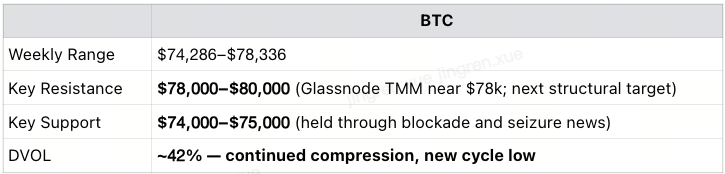
Weekly Expiry (4/17) — Hormuz Whipsaw, Vol Stays Compressed:
Post-Hormuz Options Dynamics:
The Hormuz open/re-close whipsaw triggered $762M in total liquidations — the largest single-day event since March 4. Short positions accounted for $593M, with BTC shorts representing $381M of that total.
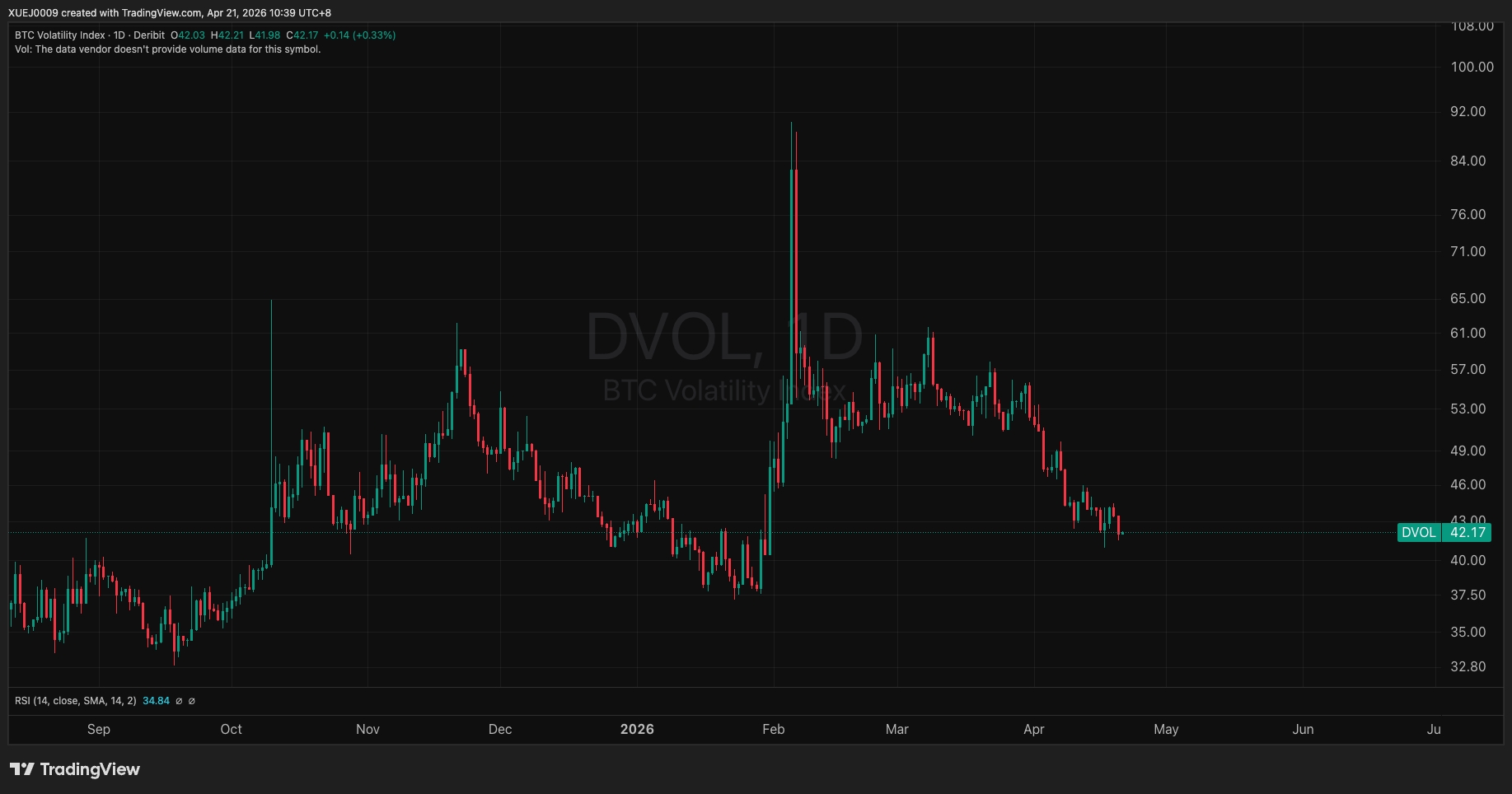
DVOL compressed further to ~42% — a new low since February — despite the intraweek $78k spike. The market is pricing the Hormuz headlines as range-confirming rather than breakout-driving. Lower IV means reduced net credit on short legs, but wing protection is also cheaper.
Polymarket's April 30 Hormuz normalization odds crashed 41 percentage points to 28% after Iran fired on tankers; the May 31 contract holds at 69%, suggesting traders see longer-term resolution as more probable than near-term stabilization.
ETF Flows — Strongest Week Since January:
Bitcoin ETF weekly net inflows hit nearly $1B — the highest since mid-January and the third consecutive week of positive flows. BlackRock's IBIT led with $906M, while Morgan Stanley's MSBT recorded $71M in its first full week.
Total crypto ETP assets rose to $151.2B (up ~$10B week-over-week). Ethereum ETFs pulled in $179M for the week, with BlackRock's ETHA alone attracting $76M in a single day.
BTC briefly touched $78,000 on strong ETF demand before retreating to ~$75,200 on Monday amid renewed U.S.-Iran geopolitical tensions.
III. Macro Background
U.S.–Iran War (Week 8, Days 50–56):
Iran's Foreign Minister declared the Strait "completely open" on April 17, triggering the sharpest oil reversal of the year. The IMO could not confirm the arrangement met freedom-of-navigation standards; shipping firms awaited legal and safety clarity before resuming normal passage.
Within 24 hours, Iranian forces reasserted control, citing the U.S. blockade as a "breach of trust." Tanker operators received Iranian radio communications to halt passage; one supertanker captain reported hearing gunfire and reversed direction. Only 8 tankers transited before the crackdown resumed.
Iran's state news agency confirmed on April 19 that Tehran sees "no plans" for further negotiations. Ceasefire expires April 22 with no replacement framework in place and Trump warning the U.S. is prepared to target Iranian civilian infrastructure if a deal is not reached.
Federal Reserve & Macro:
Jerome Powell chairs his final FOMC meeting on April 28–29 before Kevin Warsh tentatively takes over on May 15. Any dovish surprise from Powell's last meeting could push risk assets higher — but with inflation above 3% and oil still elevated, the base case remains rates on hold.
Despite 46 consecutive days of extreme fear sentiment, whale wallets accumulated 270,000 BTC over the past 30 days — the largest sustained buying spree since 2013 — while exchange reserves hit their lowest level since December 2017 at 2.21 million BTC.
The White House confirmed on April 18 that the Trump administration plans to unveil a formal Bitcoin Strategic Reserve strategy within the next two months, utilizing ~200,000 BTC seized in government enforcement actions — the first official recognition of BTC as a national reserve asset.
IV. Outlook for Next Week (April 22–28)
The ceasefire expires April 22. Powell's last FOMC is April 28–29. The two biggest macro events of Q2 land back-to-back.
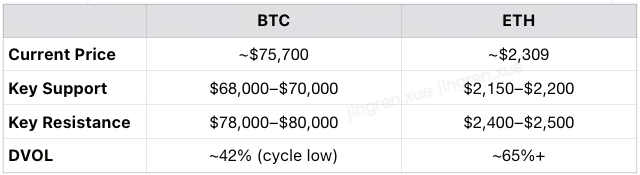
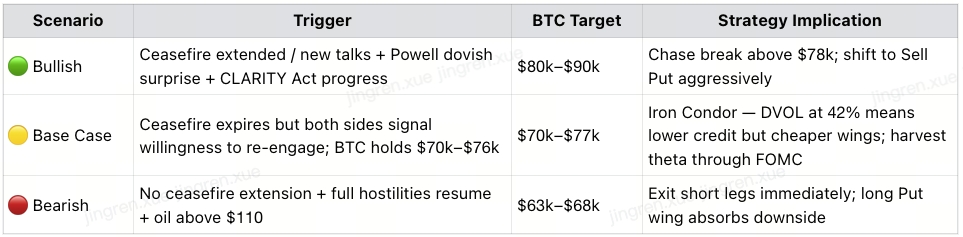
⚠️ $68,000 is the last line of defense before the ceasefire expires April 22. Bitcoin has held above it through both the Islamabad talks collapse and the blockade announcement — suggesting the market has already priced in near-term bad news. But if oil climbs past $110, analysts project BTC could fall to $65,000.
Key structural signal: DVOL at ~42% is the lowest reading since before the Iran war began. Historically, prolonged IV compression ahead of known binary events precedes sharp directional moves in either direction. The April 22–29 window is precisely that setup.
Three Scenarios:
V. Trading Strategy Recommendations
✅ Strategy — Iron Condor (4/24 or 5/2 expiry) — Strikes Adjusted for $75.7k Base
Rationale: DVOL has compressed further to ~42% — now at its lowest level since before the Iran war began. This is a double-edged development: net premium on the short legs is reduced, but wing protection is also cheaper, improving the risk/reward ratio of the full four-leg structure. With BTC range-locked between $68k and $80k and three binary catalysts arriving in succession (ceasefire expiry 4/22, CLARITY Act markup, FOMC 4/28–29), a defined-risk structure remains the optimal fit over a naked strangle.

P&L Profile (illustrative only — actual strikes and premiums depend on live IV at entry. This is not financial advice.)
Max profit: Net premium — BTC expires within inner strikes through expiry
Max loss: Wing width minus net premium — fully capped both sides
Note: At DVOL ~42%, net credit will be lower than prior weeks — size accordingly
Strategy Update vs. Last Week:
Last week's Iron Condor (inner strikes ~$67k–$68k / $76k): the $78k intraday spike on 4/17 tested the upper wing but BTC failed to hold above — structure survived
This week: shift Call wing up to $78k–$80k zone reflecting higher BTC base; Put floor up to $68k–$70k
DVOL compression to 42% is the key change — lower premium means reduce position size by a further ~20% vs. last week to maintain consistent risk/reward
Risk Warnings:
Ceasefire expires April 22 without extension = rapid reversal toward $65k–$68k; exit short Put immediately, let long Put ride
Ceasefire extended + dovish Powell + CLARITY Act = BTC clears $78k on volume; Call side faces assignment risk — set stop
Three catalysts interact: if ceasefire extends and oil drops toward $90, rate cut expectations improve going into FOMC and crypto gets a macro tailwind at the same time CLARITY Act could add a crypto-specific catalyst. If all three resolve favorably in sequence, analysts project a move toward $80k by end of April — but that requires a lot to go right simultaneously. Keep total sizing at ~40–50% of peak until April 22 resolves.
Weekly Summary:
BTC whipsawed between $74k and $78,336 as the Hormuz open/re-close cycle triggered $762M in liquidations ($593M shorts) — the sharpest single-day squeeze since March.
DVOL compressed to ~42% — a new cycle low — despite intraweek volatility. The market is treating Hormuz headlines as range-confirming, not breakout-driving. This is the most important options signal of the week.
Spot BTC ETFs recorded ~$1B in weekly inflows — strongest since January. Strategy bought $2.54B in BTC; Bitmine bought $230M in ETH — institutional accumulation is accelerating even as retail sentiment remains fearful.
White House confirmed a formal Bitcoin Strategic Reserve strategy is coming within two months — the first official recognition of BTC as a national reserve asset.
Hormuz remains effectively closed: only 8 tankers transited before shutdown resumed. Ceasefire clock expires April 22 with no framework in place.
Options playbook: DVOL at 42% makes Iron Condor the right structure — cheaper wings offset lower short leg credit. Reduce size to 40–50% of peak and treat the April 22–29 binary window as the cycle's next major inflection point.