27 Feb 2026: What's New in DeFi?

1) Coinbase has rolled out tokenised stock trading to all US users, allowing customers to trade stocks and ETFs 24/5.
Alongside, Coinbase has partnered with Yahoo Finance to enable users to move directly from researching an asset on Yahoo Finance to executing a trade on Coinbase, while also providing integrated tools within Yahoo Finance for asset discovery and tracking.
----------
2) Meta is reportedly planning to integrate stablecoin payments into its apps later this year, aiming to start in the early part of the second half of 2026, according to people familiar with the plans.
The idea is to partner with a third-party vendor to run dollar-pegged token payments and launch a new wallet, rather than building the full stack internally.
----------
3) In a post on X on Tuesday, Aave claimed that Aave Horizon is now the largest market for real-world-asset (RWA)-backed loans on Ethereum, and said it’s the only RWA market offering instant, 24/7 liquidity while still meeting issuer compliance requirements.
----------
4) The Ethereum Foundation has begun staking part of its treasury, following the Treasury Policy it announced in June 2025.
The initiative starts with a 2,016 ETH deposit and targets around 70,000 ETH staked in total, with rewards flowing back into the EF treasury.
----------
5) Ethereum digital asset treasury Bitmine Immersion Technologies (NYSE: BMNR) announced its latest acquisition of 51,162 ETH over the past week.
This brings its crypto, total cash, and “moonshots” holdings to $9.6B, including 4,422,659 ETH valued at $1,958 per ETH, representing 3.66% of the total ETH supply (over 73% toward its “Alchemy of 5%” goal), 193 BTC, $691M in cash, a $200M stake in Beast Industries, and a $17M stake in Eightco Holdings.
As of February 22, 2026, Bitmine has staked 3,040,483 ETH worth $6.0B, generating $171M in annualized staking revenue, and is on track to launch its MAVAN staking solution in Q1 2026.
----------
6) The Financial Times reports that the Trump-led “Board of Peace” is considering a US dollar-pegged stablecoin intended to help people in Gaza make digital payments, citing five people familiar with the early discussions.
----------
7) Tether has announced it will discontinue support for CNH₮, citing low demand and limited sustained community adoption relative to its other stablecoin products.
The transition will happen in two stages: new CNH₮ issuance will stop immediately (no more tokens will be minted), and redemptions will remain available for one year, after which Tether will end redemption support, with a reminder notice to follow closer to the deadline.
----------
8) Nasdaq-listed bitcoin miner, Bitdeer Technologies (BTDR), has sold its entire bitcoin holding after selling its remaining 943 BT3C in a single week. The company also sold the 189.8 BTC it mined during the same period.
The move follows a $325M convertible notes offering and a $43.5M equity raise, suggesting the liquidation may be aimed at boosting cash as it expands data centers and pivots toward AI.
----------
9) CME Group has announced the launch of 24/7 trading for cryptocurrency futures and options beginning Friday, May 29, at 4:00 pm CT, subject to regulatory review.
Trading will run continuously on CME Globex, with a minimum two-hour maintenance window each weekend, and any positions traded from Friday evening through Sunday evening will be dated and processed on the next business day for clearing, settlement, and regulatory reporting.
----------
10) As digital asset treasury companies come under the spotlight, Metaplanet CEO Simon Gerovich has posted a statement on X, rejecting claims from “anonymous accounts” that the firm misled investors about its Bitcoin purchases, derivatives strategy, and BTC-backed borrowing disclosures.
He said all major transactions were announced promptly, arguing critics are misreading financial statements and misunderstanding accounting-driven losses.
----------
11) OpenAI and Paradigm have partnered to launch EVMbench, a new benchmark designed to evaluate how effectively AI agents can identify, exploit, and fix critical smart contract vulnerabilities.
EVMbench draws on 120 curated vulnerabilities from 40 audits, including sponsored open-code audit competitions and security reviews for Tempo, the Layer 1 blockchain co-developed by Paradigm and Stripe, and tests AI agents’ capability modes like vulnerability detection, contract modification, exploit mitigation, and end-to-end fund-draining attacks in a sandboxed blockchain environment.
----------
12) Coinbase has expanded its onchain lending product, powered by DeFi protocol Morpho, to let eligible U.S. customers use XRP, Dogecoin, Cardano, and Litecoin as collateral to borrow up to $100,000 in USDC without selling their crypto.
This is an expansion to their previous offering, which only allowed BTC and ETH as collateral, allowing loans of up to $5M and $1M, respectively.
----------
13) The Hyper Foundation is unstaking and allocating 1M HYPE tokens to help launch the Hyperliquid Policy Center (HPC), a nonprofit focused on research and advocacy for decentralized finance in the US.
The goal is to give the Hyperliquid community a presence in Washington and push for clearer, more workable regulations for DeFi, particularly around perpetual derivatives and decentralized markets via research, policy engagement, and direct outreach to lawmakers, serving as a resource for informed policymaking.
----------
14) XRPL has activated the XLS-81 “Permissioned DEX” amendment yesterday, introducing members-only, on-ledger trading venues built on the same mechanics as the network’s native DEX.
The key change is access control, which is now a “permissioned domain” that allows the venue operator to define which approved entities can place orders and which can fill them, enabling participation to be linked to KYC/AML and other compliance requirements.
The feature is designed for regulated institutions, such as banks and brokers, that want on-chain settlement and liquidity but cannot interact with fully open DeFi markets.
----------
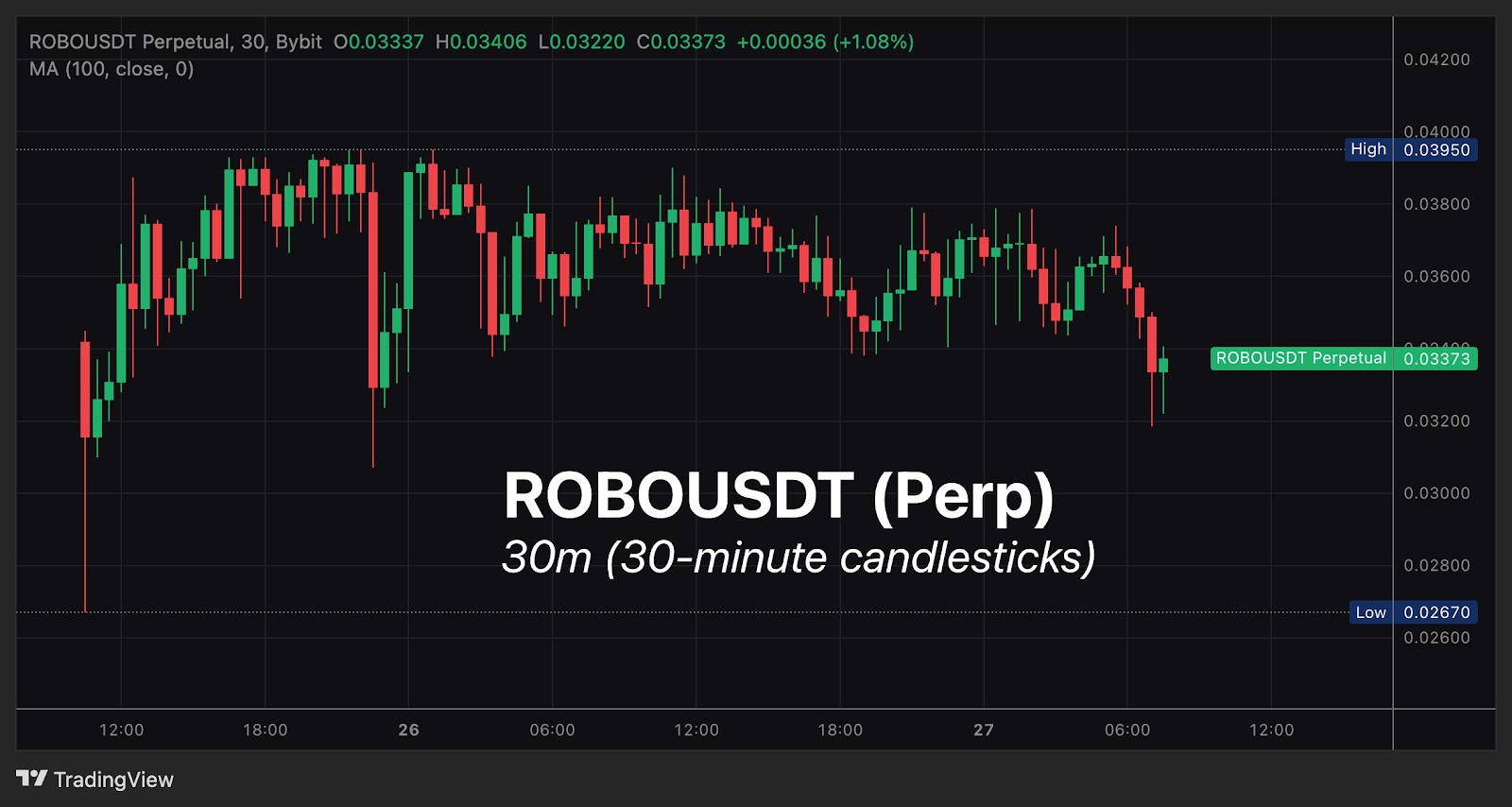
The Latest Listings - ROBOUSDT
The ROBO token is the native cryptocurrency of the Fabric Foundation, an initiative established by OpenMind.
The project describes itself as infrastructure for coordinating intelligent machines and robotics in a way that can be shared across many participants, with rules that are transparent and enforceable. The underlying premise, as stated in its public materials, is that as autonomous systems become economically active in the real world, coordination problems expand into identity, permissions, accountability, settlement, and incentive alignment between humans, organisations, and machines.
Fabric is designed as a blockchain network. It relies on an on-chain ledger and smart-contract rules so participants can share the same system of record for coordination and settlement without a single central operator. In practical terms, the chain is meant to be where network state is recorded and where economic activity is settled, so that permissions, transactions, and incentive flows are all handled in one consistent framework.
On the technical side, the architecture is described as a base layer that provides settlement and security, with the option to run more specialised execution environments on top of it, framed as robot sub-networks in an L2-style model. The idea is that robotics-related activity can run in environments tailored to those needs, while still anchoring outcomes to a common settlement layer.
Within that design, ROBO is positioned as the economic unit of the network. It is intended to be used for fees and settlement, and it is also tied to incentive mechanisms such as staking, delegation, and bond-like structures that are meant to coordinate participants and align behaviour over time.
The main differences compared to other tokens that are close to the AI narrative are that Fabric places the emphasis more directly on machines acting in the physical world, which naturally shifts attention toward settlement, accountability, and governance around actions that have real-world consequences. It also sits close to DePIN and the broader “machine economy” theme, where blockchains are used to coordinate real-world devices and services with token incentives. The difference here is that the focus is not mainly on getting device data on-chain, but on setting up a wider set of rules and payments for how autonomous machines interact and get coordinated, potentially across several environments that still settle back to the same base layer.
Bybit announced that ROBOUSDT is listed on Perpetual Pre-Market Trading from 25 Feb 2026.