


19 June 2026: What’s New in DeFi?

1) CME Group sued the CFTC and its Chairman Michael Selig on Thursday (June 18), alleging the regulator bypassed Congress and broke the law by approving crypto perpetual futures contracts for rival platform Kalshi.
CME argues thata crypto perp futures should be classified as a swap under stricter oversight, not a futures contract.
The lawsuit, filed in Washington D.C., is widely viewed as a competitive fight, with CME - the world's largest futures exchange - using the courts to block an upstart rival from capturing a fast-growing, 24/7 crypto derivatives market.
----------
2) A bipartisan group of senior Senate and House lawmakers — Tim Scott, Elizabeth Warren, French Hill and Maxine Waters — has agreed on an updated version of the 21st Century ROAD to Housing Act, giving the legislation bicameral momentum and a clearer path through Congress.
While the bill is primarily focused on housing affordability and supply, it also includes language that would prevent the Federal Reserve from issuing a CBDC, or any substantially similar digital asset, until the end of 2030, reflecting continued political resistance to a U.S. digital dollar.
----------
3) A coalition of national gaming, tribal, state and labor organizations urged the U.S. Senate to include language in crypto market structure legislation that explicitly bans event contracts tied to sports and casino-style gaming.
The groups argued that sports-related prediction markets have expanded gambling nationwide without state or tribal authorisation, allowing some users as young as 18 to place bets and marketing gambling products as “investments.”
----------
4) BlackRock has filed a Form 8-A for its proposed iShares Bitcoin Premium Income ETF (BITA), a key regulatory step that typically signals a fund is nearing launch.
The filing follows BlackRock’s recent fourth amendment to the ETF registration, which “typically means launch in one week” according to Bloomberg ETF analyst Eric Balchunas.
The form set a 0.65% sponsor fee and outlined a strategy of generating yield by selling call options primarily against IBIT, the firm’s spot bitcoin ETF. Balchunas added that if he had to bet, “next Thursday BITA goes live.”
----------
5) Citigroup is launching a blockchain-based platform for wealthy and institutional clients to trade tokenised shares of private companies, with the rollout initially limited to foreign investors, according to The Wall Street Journal.
The platform is aimed at giving clients exposure to large private companies, as investor demand builds around names such as SpaceX, Anthropic and other late-stage private firms.
----------
6) French bitcoin treasury firm Capital B is preparing to launch a digital credit instrument for European investors, modeled on Strategy’s STRC and Strive’s SATA, announced at a speech at BTC Prague.
The Paris-listed company plans to use its bitcoin treasury as the underlying asset for a yield-focused product designed around Europe’s regulatory and tax environment. Capital B currently holds 3,139 BTC and aims to reach 15,000 BTC by the end of 2027.
Board director Alexandre Laizet said the instrument could target double-digit yields while keeping volatility below double digits, arguing that bitcoin treasury companies can support such products through the long-term appreciation of their BTC holdings.
----------
7) China’s digital yuan international operation centre, managed by the People’s Bank of China, has signed direct participant agreements with 26 financial institutions in Shanghai to expand cross-border e-CNY payment services.
The agreements allow institutions to join Cross-border e-CNY Transfer Services (CBETS), a settlement platform designed to support round-the-clock digital payment links with foreign central banks and overseas financial institutions.
----------
8) Bitmine Immersion Technologies, the largest public Ethereum treasury company, said its holdings reached 5.62M ETH, equal to 4.66% of the total ETH supply, after acquiring 76,881 ETH over the past week.
The company reported $10.4B in crypto, cash, marketable securities and “moonshot” holdings, including 204 BTC, $502M in cash and marketable securities, a $180M stake in Beast Industries and an $88M stake in Eightco Holdings.
Bitmine said 4.72M ETH, or more than 83% of its ETH holdings, are staked, with projected annualized staking revenues of about $226M, while its 9.50% Series A Perpetual Preferred Stock is expected to begin trading on the NYSE under BMNP on June 16.
----------
9) Avalanche Treasury Co., an AVAX-focused treasury company, began trading on Nasdaq under the ticker AVAT on June 11, following the completion of its $675M SPAC merger that was first announced in October 2025. Shares closed down 40% on their first day of trading.
The company plans to deploy capital across the Avalanche ecosystem and has previously outlined ambitions to acquire more than $1B worth of AVAX, while investing in areas including Avalanche validator infrastructure, protocol development and enterprise partnerships.
----------
10) TON blockchain's native token, Toncoin ($TON), has been rebranded to $GRAM, with a new name, ticker and logo. The TON blockchain and network remain unchanged.
All TON holdings convert 1:1 to GRAM automatically, with no swap, migration or action required from holders.
----------
11) LG Electronics, the South Korean consumer electronics giant, revealed plans on June 11 to launch a blockchain-based advertising network built with Arbitrum.
The platform is designed to place and track digital advertisements onchain through a shared database of ad inventory and user interactions, allowing advertisers and publishers to buy, sell and monitor ad placements using the same transparent record of campaign performance and user engagement.
----------
12) MNX, a decentralised futures exchange being built on MegaETH, raised $6.4M in a pre-seed round at a $40M valuation to develop trading markets focused on the AI economy, including AI company valuations, compute infrastructure, and prediction markets.
The platform plans to launch on mainnet later this summer and will use MegaETH’s low-latency infrastructure, while targeting traders seeking exposure to prediction markets on AI model benchmarks, product launches, company performance and geopolitical developments alongside futures and perpetual contracts designed for AI-related assets.
----------
13) Figure Technology Solutions, a blockchain-based capital markets platform, has agreed to acquire real estate lending platform Kiavi in a $717M transaction, with a joint venture between Figure and Sixth Street purchasing Kiavi’s balance sheet assets.
The deal is expected to add more than $7B in annual first-lien loan volume to Figure’s marketplace and bring residential transition loans and rental-property lending products onto its tokenised infrastructure, which the company says represents a roughly $200B annual addressable origination opportunity.
----------
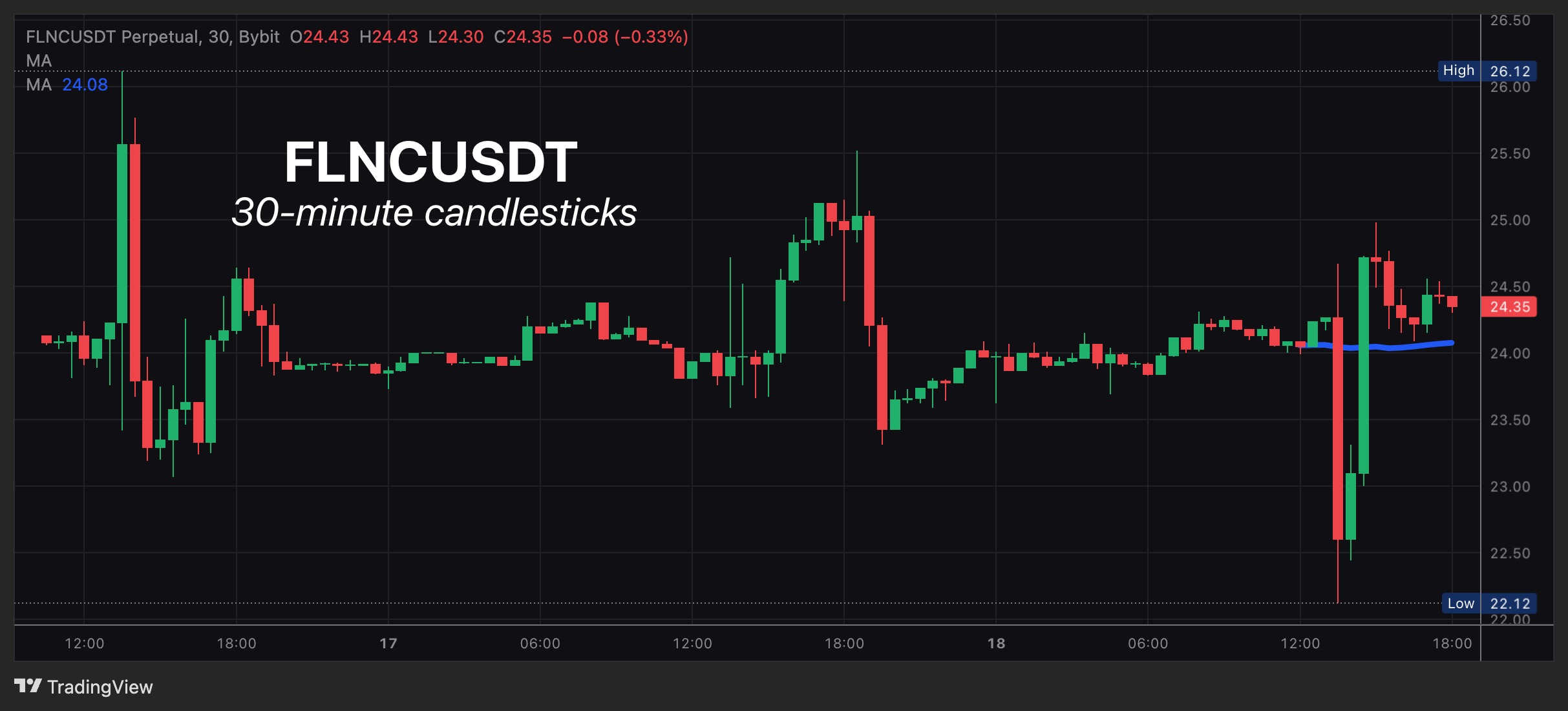
The Latest Listings - FLNCUSDT
Fluence Energy, Inc. (Nasdaq: FLNC) is a publicly listed energy storage and grid technology company.
The company provides large-scale battery energy storage systems, software, and related services for utilities, renewable energy developers, independent power producers, and large electricity users.
In simple terms, Fluence helps electricity grids store power, manage renewable generation, and improve reliability as the energy system becomes more dependent on intermittent sources such as solar and wind.
The company’s core business is utility-scale battery energy storage.
Its systems are designed to absorb electricity when supply is high or prices are low, then release that electricity when demand rises, renewable generation drops, or the grid needs support.
This makes storage increasingly important as power markets add more renewables and face higher volatility in supply and demand. Fluence’s products are used for applications such as renewable energy integration, grid stability, peak demand management, capacity support, and energy trading.
Fluence is not only a hardware supplier.
One of its more distinctive features is that it combines battery storage systems, operational services, and software.
Its software platforms help asset owners optimize how batteries and renewable assets operate in power markets, while its services business supports projects after installation.
This matters because the economics of battery storage depend not only on the physical asset, but also on how effectively it is operated, maintained, and monetised over time.
A key part of Fluence’s positioning is that it sits at the intersection of several major energy themes:
- renewables growth
- grid reliability
- electrification
- and rising power demand from data centres and AI infrastructure.
As electricity systems become more strained, storage is becoming a critical tool for balancing the grid.
Fluence is therefore exposed to a structural growth market rather than a short-term energy trend.
The company’s unique details are its:
- public-market exposure to grid-scale storage
- Siemens/AES heritage
- integrated hardware-plus-software model
- global project footprint
There are relatively few public companies that give investors direct exposure to utility-scale battery storage as a core business.
That makes FLNC notable for investors, partners, and customers looking at the energy transition and the infrastructure required to support it.
The importance of Fluence is that battery storage is becoming essential infrastructure. Renewable power cannot scale efficiently without storage, because solar and wind output do not always match electricity demand. Storage helps bridge that gap, improves grid resilience, and can reduce reliance on fossil-fuel peaker plants.
DISCLAIMER:
This article is provided for general information and reflects the author’s views only. It does not constitute investment advice, nor an offer or solicitation to buy or sell any financial instruments or digital assets. Your ability to access or use any products or services mentioned may be subject to the laws and regulatory requirements of your jurisdiction.