


12 June 2026: What's New in DeFi?

1) Strategy purchased a further 1,550 BTC ($101.3M) last week, days after disclosing its first bitcoin sale since 2022.
Separately, shareholders approved a change to the dividend schedule on its STRC preferred stock, moving from monthly to semi-monthly (twice-monthly) payments from the end of June.
Strategy said the more frequent distributions are intended to improve liquidity and reduce price volatility in the preferred stock.
----------
2) Bitmine Immersion Technologies, the largest corporate holder of ETH, said its treasury grew by 126,971 ETH over the past week to 5.54M ETH — around 4.59% of Ethereum’s total supply — with total crypto, cash and other holdings valued at $9.6B.
Chairman Tom Lee said the firm accelerated purchases into recent market weakness and reiterated its goal of controlling 5% of ETH supply in 2026.
Bitmine said more than 4.7M ETH of its holdings are currently staked, generating an estimated $230M in annualised staking revenue.
----------
3) SOL Strategies (Nasdaq: STKE), a Solana-focused treasury company, sold 65,001 SOL to repay roughly C$5.75M of debt as part of an active treasury and risk-management programme.
The firm framed the sale as a deliberate move to de-lever and clean up its balance sheet during a period of market volatility, allowing management to focus on its core operating businesses (including managing staking validators and providing infrastructure for the Solana blockchain).
----------
4) Morpho, an onchain lending protocol, raised $175M in a round co-led by a16z crypto, Paradigm and Ribbit Capital, with additional participation from Apollo, Circle's venture arm and VanEck.
According to the protocol, it is the largest funding round in DeFi to date, valuing Morpho at around $2B.
The capital will go toward deepening integrations and building infrastructure for programmable credit products.
Morpho's open credit network now holds more than $11B in deposits and is used by firms including Coinbase, Kraken, Binance, Galaxy and Anchorage Digital.
----------
5) Jupiter has launched Forecast, which it describes as Solana's first fully native prediction market.
Rather than routing all trades through a single liquidity pool, Forecast lets multiple proprietary automated market makers post competing quotes, matching users with the best available price at any given moment.
It is being integrated into Jupiter's existing Jup Predict product, starting with short-dated 15-minute crypto markets, and the team has said it will continue to support Polymarket's markets alongside it.
----------
6) The SEC published a draft of its 2026–2030 Strategic Plan, formally naming digital assets, capital formation and technological modernisation among its core priorities.
Under Chairman Paul Atkins, the agency signaled a shift away from regulation-by-enforcement toward a “clear and practical”, principles-based framework, citing tokenised offerings and on-chain infrastructure as areas where it wants to enable compliant capital formation.
The draft also flags clearer jurisdictional boundaries with the CFTC and is open for public comment through 2 July 2026.
----------
7) Grayscale filed an S-1 application for a spot ETF tracking Canton Coin (CC), the native token of the Canton Network, with the fund proposed to list on NYSE Arca. The trust would hold CC directly.
The filing follows Grayscale’s recent run of single-asset product launches and notes meaningful concentration risk, disclosing that the 100 largest wallets control roughly 89% of CC’s circulating supply.
----------
8) Japan’s Financial Services Agency formally recognised qualifying foreign-issued stablecoins as electronic payment instruments under its revised Payment Services Act framework, effective 1 June.
Trust-type stablecoins issued abroad can now operate in Japan — and are excluded from securities treatment — provided issuers meet licensing, collateral and audit requirements.
----------
9) The Hong Kong Monetary Authority established a Tokenised Bond Expert Group, bringing together banks, law firms, technology providers and market-infrastructure participants to help develop and scale the city’s tokenised bond market.
The group’s first discussions focused on how Hong Kong’s existing legal and regulatory framework applies to tokenised bond issuance and trading, with feedback set to inform a broader review of the jurisdiction’s tokenisation rules.
The move builds on earlier HKMA initiatives, including the world’s first tokenised government green bond in 2023.
----------
10) The UK’s Financial Conduct Authority proposed allowing authorised investment funds, including UCITS and most retail-focused funds, to allocate up to 10% of assets to crypto exchange-traded notes (ETNs).
Qualifying funds would be able to hold crypto ETNs listed on recognised UK and international exchanges, with the 10% cap intended to limit risk.
The FCA stressed that it is not currently considering allowing authorised funds to hold crypto assets directly, pending further development of the UK’s broader crypto regulatory framework.
----------
11) Decentralised lending protocol Aave is weighing a new risk-management framework proposed by LlamaRisk, introducing standardised assessments for asset, bridge and blockchain risks alongside automated monitoring tools across the protocol.
The proposal follows April’s $292M KelpDAO rsETH bridge exploit, which spilled into Aave after stolen assets were deposited as collateral and used to borrow funds, raising concerns about bad debt and cross-protocol contagion.
Founder Stani Kulechov said the framework would set a new risk standard across Aave V3, V4 and Horizon, adding that assets failing to meet the updated requirements could be removed from the protocol in the coming weeks.
----------
12) Visa is working with stablecoin infrastructure provider Brale on a proof of concept to test institutional settlement using SBC, a US-dollar-backed stablecoin, on the Canton Network.
The pilot will assess whether Canton’s privacy-focused architecture can support institutional payment settlement while limiting the visibility of sensitive transaction data, as Visa continues to expand its stablecoin settlement infrastructure.
----------
13) Goldman Sachs partnered with Apex Group and Archax - alongside LRC Group and Ownera — to launch a blockchain-native tokenised real estate fund.
Built on Goldman’s GS DAP platform within a regulated Luxembourg structure, the fund aims to bring fractional ownership and improved liquidity to traditionally illiquid real estate.
Apex acts as the fund’s manager and administrator, while Archax serves as custodian for the digital securities and the initial distribution partner.
----------
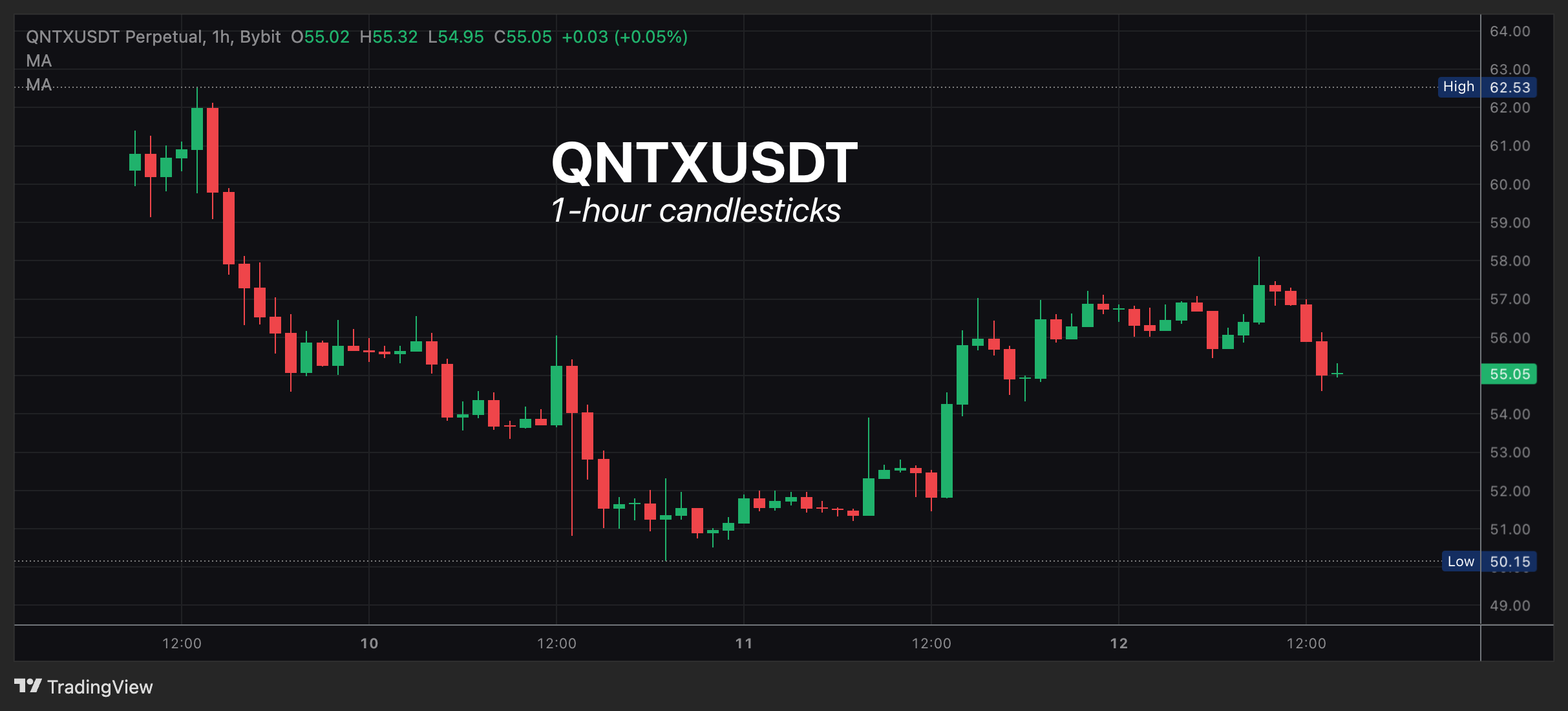
The Latest Listings - QNTXUSDT
Quantinuum is a full-stack quantum computing company that recently became publicly traded, listing on the Nasdaq under the ticker QNT after one of the largest-ever IPOs in the quantum sector.
The company was formed in 2021 through the merger of Honeywell’s quantum computing division and Cambridge Quantum, combining trapped-ion hardware with quantum software and algorithms. Honeywell remains its largest shareholder.
Quantinuum is described as “full-stack” because it builds across the entire quantum computing chain.
This means it develops both the physical quantum hardware — the systems that perform quantum calculations — and the software, error-correction techniques and algorithms that run on top of it.
Rather than specialising in one layer, the company works across the whole stack, from the underlying machines to the applications built on them.
This is significantly important with quantum computing emerging as one of the next major frontiers in advanced computing.
Quantum computers process information in a fundamentally different way to traditional computers, using the properties of quantum mechanics to tackle certain problems that are extremely difficult for conventional machines.
Quantinuum’s relevance comes from its position as one of the most established names in the field, with hardware based on trapped-ion technology and a customer and research base that already includes large enterprises and institutions such as Airbus, BMW Group, JPMorgan, Amgen and national research bodies.
Its public listing also places it within a broader market theme.
As with artificial intelligence, investors have increasingly looked for ways to gain exposure to the companies building the foundational infrastructure of the next computing era.
Quantinuum’s IPO gives market participants a direct, listed way to access the quantum computing sector, which until recently was largely confined to private firms and corporate research divisions.
At the same time, the company operates in an early-stage, capital-intensive industry.
Quantum computing remains in a developmental phase, commercial revenues are still modest relative to investment, and the company reported a significant net loss in its most recent financial year. As a result, it carries meaningful execution risk alongside its long-term potential.
For market participants, Quantinuum is notable as a newly public, pure-play quantum computing company, offering exposure to one of the most closely watched emerging themes in advanced technology.
DISCLAIMER:
This article is provided for general information and reflects the author's views only. It does not constitute investment advice, nor an offer or solicitation to buy or sell any financial instruments or digital assets. Your ability to access or use any products or services mentioned may be subject to the laws and regulatory requirements of your jurisdiction.