


1 May 2026: What's New in DeFi?

1) Western Union, one of the world's largest money transfer and remittance companies, is preparing to launch its Solana-based U.S. dollar-backed stablecoin, USDPT, next month.
The company said during its 24 April earnings call that USDPT will initially be used for onchain settlement with agent partners, rather than as a consumer-facing token, positioning it as a faster alternative to traditional settlement rails such as SWIFT.
Alongside USDPT, the company is launching its Digital Asset Network to connect crypto wallets with Western Union's retail infrastructure, while a planned USD Stable Card would allow consumers in dozens of markets to hold dollar-denominated stablecoin value and spend globally.
----------
2) Data shows that Bitmine has staked an additional 112,656 ETH this week, worth around $260M, lifting its total staked holdings to 3,814,245 ETH, or roughly 75% of its total ETH supply.
The latest increase follows last week's announcement that Bitmine had staked approximately $320M worth of ETH, taking its staked ether position to around 3.5M ETH, valued at more than $8B.
----------
3) Pump.fun has burned approximately $370M worth of PUMP tokens (~36% of circulating supply) and introduced a programmatic buyback-and-burn mechanism funded by 50% of future net revenue.
The buyback system is executed via smart contracts that automatically repurchase tokens from the open market and permanently remove them from circulation over a one-year period.
----------
4) Ondo Finance has partnered with Broadridge to integrate proxy voting into tokenized equities and ETFs, using a Web3-enabled extension of Broadridge's ProxyVote infrastructure that supports wallet-based authentication and on-chain verification of investor actions.
The system enables holders of 250+ tokenized securities to access issuer communications, prospectuses, and regulatory disclosures, while linking blockchain-based ownership records with traditional shareholder voting workflows and corporate action systems.
The integration effectively bridges on-chain tokenized assets with off-chain market infrastructure, allowing real-time trading (24/7) while maintaining compliance with governance, reporting, and investor participation standards used in traditional capital markets.
----------
5) 3F, a vault protocol built on Morpho, has raised $4M to develop leveraged exposure products for tokenized real-world assets.
The funding includes a pre-seed and seed round, with the latter led by Maven 11 and participation from F-Prime, GSR, Susquehanna Crypto, Gate Ventures, and others.
The capital will support product development ahead of a private beta and a broader launch expected in Q2. 3F is designed to simplify leveraged RWA strategies that are currently operationally complex.
Instead of manually looping positions by buying an asset, posting it as collateral, borrowing stablecoins, and repeating the process, users will be able to select a supported RWA and leverage factor through a one-click interface.
----------
6) Lido Labs has proposed that the Lido DAO allocate up to 2,500 stETH, worth roughly $5.8M, to support a recovery package following the recent Kelp exploit.
The proposed contribution is intended to help reduce the shortfall in Kelp's rsETH backing, which emerged after the LayerZero-related exploit.
Lido said the incident has created wider stress across DeFi venues, including pressure on market rates, lending markets, vaults, and looping strategies linked to rsETH and stETH liquidity.
----------
7) Litecoin suffered a major chain change after attackers exploited a zero-day vulnerability linked to its MimbleWimble Extension Block privacy layer.
According to the Litecoin Foundation, the vulnerability allowed mining nodes running older software to validate an invalid MWEB transaction, enabling coins to be improperly pegged out of the privacy extension and routed to third-party decentralised exchanges.
The incident reportedly affected blocks 3,095,930 to 3,095,943, creating a more than three-hour window during which attackers attempted double-spends against cross-chain swap protocols that had accepted transactions later removed from Litecoin's main transaction history.
The network ultimately reverted 13 blocks, removing the invalid MWEB-related transactions from the canonical Litecoin chain.
The Litecoin Foundation said valid transactions from the period were unaffected and that the vulnerability has now been patched.
----------
8) Syndicate, an Ethereum-based infrastructure platform for building rollups and sequencers, has detected an exploit linked to a compromise of its Commons cross-chain bridge, where an attacker acquired ~18.5M SYND tokens and liquidated them for approximately $330K.
The team is conducting on-chain tracing and working with security firms to investigate the bridge vulnerability, while assessing remediation measures and confirming it has sufficient token reserves to compensate affected users.
----------
9) Telegram's blockchain strategy is expanding into AI-driven on-chain execution, as TON Tech launches agents capable of carrying out transactions and DeFi activity on behalf of users.
At launch, these agents can carry out transfers, swaps, staking, automated trading within pre-set budgets, and basic portfolio management.
----------
10) Paradigm-backed Succinct Labs has launched ZCAM, an iPhone camera app designed to verify the authenticity of photos and videos at the point of capture, as stated in their official statement.
The app aims to address the growing challenge of AI-generated and manipulated media by shifting authentication away from post-hoc detection and toward cryptographic proof created at capture.
ZCAM signs photos and videos on-device, using Apple's Secure Enclave and App Attest service to link each piece of media to the device and application that captured it.
----------
11) Metaplanet is issuing roughly $50M in zero-interest bonds to fund further bitcoin purchases, according to their post on X.
The bonds were fully subscribed by EVO Fund and mark Metaplanet's 20th ordinary bond issuance.
The company has been steadily accumulating bitcoin since April 2024 and holds 40,177 BTC as of 31 March 2026, after adding 5,075 BTC in the first quarter.
----------
12) KBank, the South Korean internet-only bank that serves as the sole banking partner for crypto exchange Upbit, announced on Monday that it has entered into a strategic partnership with Ripple to test onchain cross-border remittances.
The proof-of-concept will assess whether Ripple's blockchain infrastructure can improve the speed, cost and transparency of international transfers.
The first phase has already verified a wallet-based remittance system, while the second phase will test the stability of onchain transfers in a virtual environment, including routes to markets such as the UAE and Thailand.
----------
13) Uzbekistan has introduced a presidential decree establishing "Besqala Mining Valley," a special mining zone in Karakalpakstan aimed at scaling Bitcoin and crypto mining through structured regulation, tax incentives, and large-scale use of renewable energy sources.
The framework allows licensed legal entities to conduct mining operations using solar, hydrogen, and grid electricity, with requirements for separate metering, onshore registration, and mandatory conversion or repatriation of mined crypto proceeds via regulated exchanges or bank accounts.
The policy includes tax exemptions on mining income until 2035, differentiated electricity pricing (including higher tariffs for grid usage), strict compliance and KYC rules, and infrastructure development plans leveraging underutilised energy assets, positioning the zone as a state-backed hub for industrial-scale BTC mining and energy optimisation.
----------
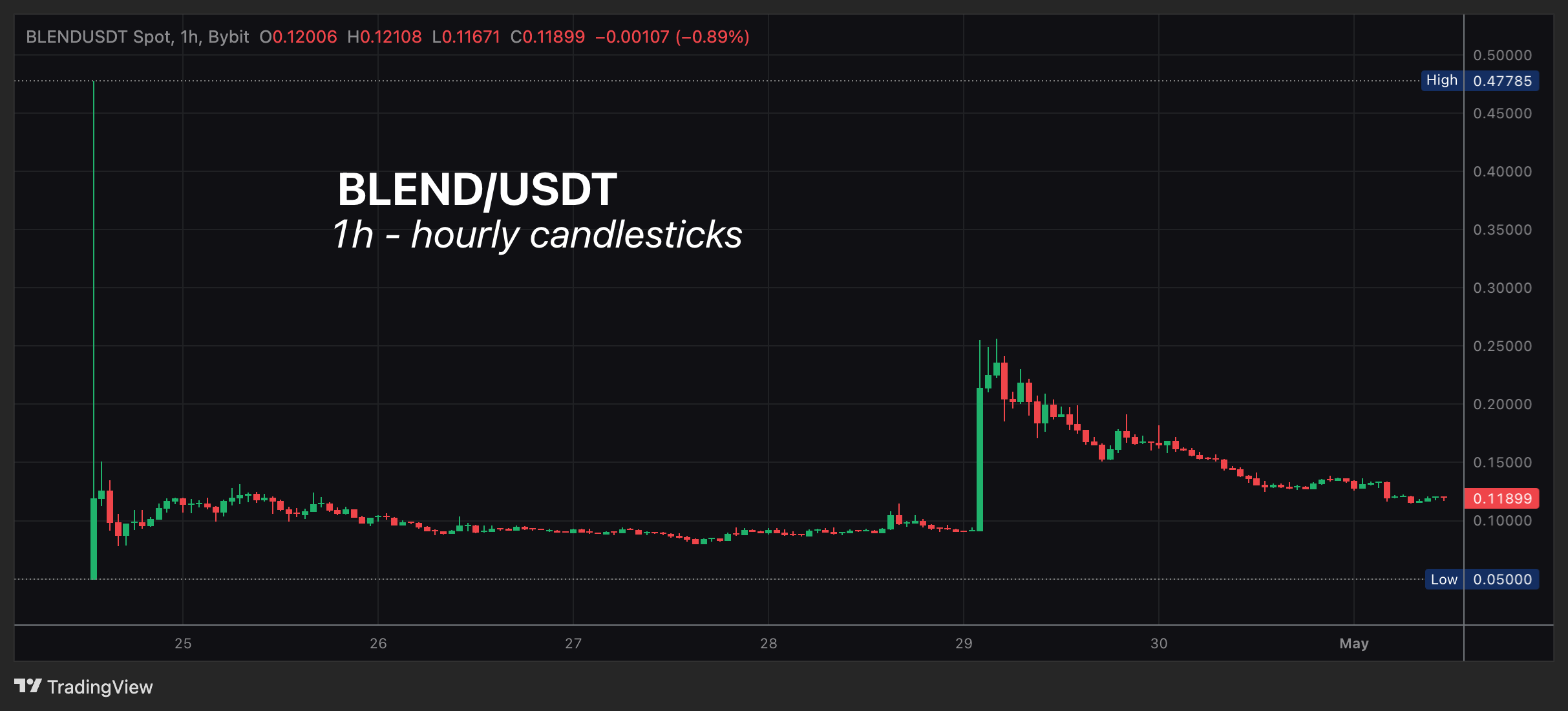
The Latest Listings - BLEND
Fluent Network is an Ethereum-based Layer 2 built around the idea of "blended execution".
Instead of supporting only Ethereum's EVM, Fluent is designed to bring together multiple execution environments — including the EVM, Solana's SVM and Wasm — within a single L2. Its native token is BLEND.
The aim is to make cross-ecosystem development easier.
Today, developers usually have to build around the specific tools, languages and constraints of one blockchain environment: Ethereum applications run on the EVM, Solana applications use the SVM, and some newer blockchain systems rely on Wasm.
Fluent wants to reduce these boundaries by allowing developers to use familiar tooling while building applications that can interact across environments.
The technical layer behind this is rWasm, Fluent's main execution environment.
Rather than forcing all smart contracts into an EVM-compatible format, rWasm is intended to help run and connect code from different virtual machines. This is what underpins Fluent's claim to offer blended execution, to provide broader compatibility rather than simply cheaper or faster Ethereum transactions.
This makes Fluent different from a standard Ethereum L2.
Most L2s focus primarily on scaling Ethereum-style applications through lower fees, faster settlement and higher throughput. Fluent is trying to make the execution layer itself more flexible, potentially enabling applications that combine Ethereum-style smart contracts, Solana-style execution and Wasm-based logic without requiring developers to rebuild everything for one environment.
BLEND is the native token of Fluent Network and is expected to sit at the centre of its economic design. Within the ecosystem, BLEND is intended to support network incentives, ecosystem participation and liquidity formation as Fluent attempts to attract developers and applications to its blended execution model.
Bybit listed BLEND on the Spot trading platform on Apr 24, 2026.
DISCLAIMER:
This article is provided for general information and reflects the author's views only. It does not constitute investment advice, nor an offer or solicitation to buy or sell any financial instruments or digital assets. Your ability to access or use any products or services mentioned may be subject to the laws and regulatory requirements of your jurisdiction.