


Indian Rupee hits new record low! What's next?


In the initial Jan 13th edition of this article, we cited Nomura Bank's prediction of USDINR reaching 92 in Q1 2026.
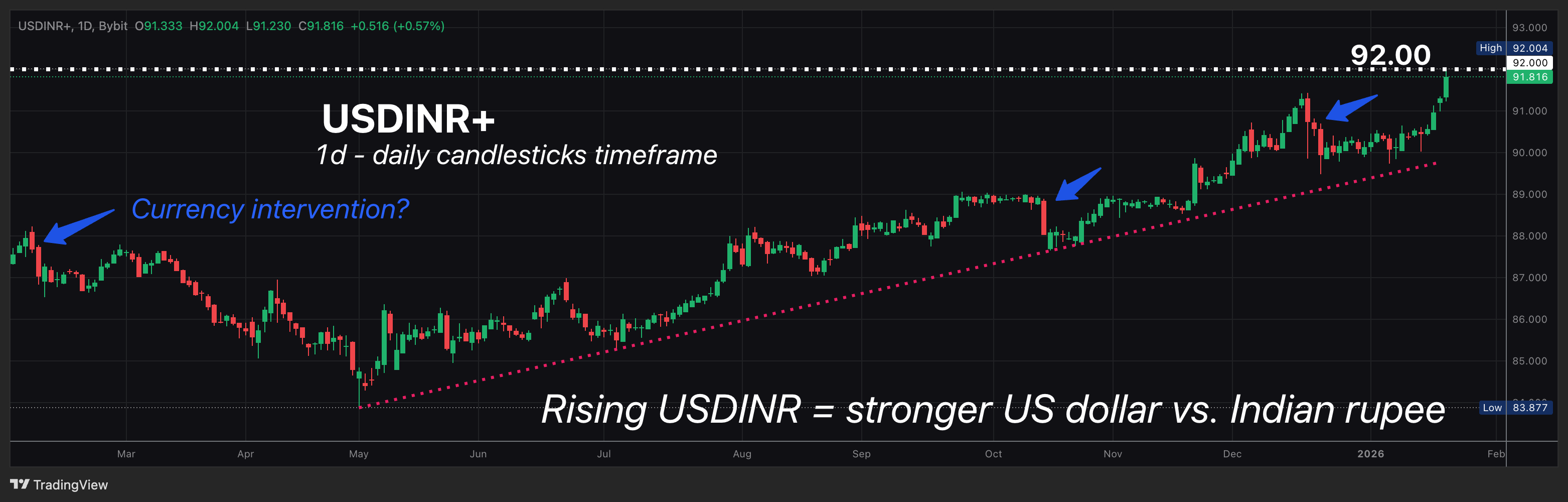
That forecast has already been hit a week later, by January 21st!
[Updated: Wednesday, January 21, 2026]
The Indian Rupee (INR) is starting off the new year on the back foot, weakening some 2% against the US dollar so far in 2026.
While it's still early days in the new year, the INR will be looking for some relief from its longer-term trend:
- INR was Asia's worst-performing currency in 2025, weakening 4.9% against the US dollar in 2025.
- INR has now weakened against the US dollar for 8 consecutive years
- INR has posted annual declines vs. USD in 14 of the past 15 years
NOTE: When USDINR moves higher, the US dollar is getting stronger against the Indian Rupee / INR is weakening against USD.
3 reasons why INR is weakening:
1) US tariffs hurt Indian economy, and currency
The Indian economy has been feeling the brunt of US President Donald Trump's trade tariffs of 50% - the highest rate across Asia.
To be clear, the Indian government expects its economy to grow about 7.4% (or 357 trillion rupees/4 trillion US dollars) this financial year ending March 2026, making it the fastest-growing major economy in the world!
However, such economic resilience hasn't been reflected in the INR's performance.
Instead, the weaker INR is likely helping the economy, especially its exports of textiles, gems, jewellery, and leather.
Still, it hasn't escaped the market's attention that ...
India remains one of the few major economies that has yet to secure a trade agreement with the US administration.
2) Foreign funds exiting India's stock markets
Foreign investors have pulled out US$ 2.7 billion from Indian equities so far in 2026, adding to the US$ 19 billion of outflows for all of last year.
Although the Nifty 50 - India's benchmark stock index - climbed 5.2% in USD terms last year, it clearly underperformed its major Asian peers' annual performance in 2025:
- South Korea's KOSPI benchmark index rose 81%
- Hong Kong's Hang Seng index rose 32%
- Singapore's Straits Times Index rose 29%
- China's Shanghai Composite Index rose 26.5%
- Japan's Nikkei 225 benchmark index rose 20%
The Nifty 50 index is also down 3.7% so far in 2026 in USD terms (as of Jan 21, 2026).
3) India's central bank offering limited support for its currency, so far.
The Reserve Bank of India (RBI) appears to have occasionally intervened by selling US dollars to help support the Rupee, with notable episodes likely in February, October, and December last year (see chart above).
Although the RBI has one of the biggest foreign-exchange reserves in the world - close to US$ 700 billion - the central bank appears to have used it sparingly thus far, with INR now hitting a record low of 92 on Jan 16th, surpassing the previous record low of 91.434 on Dec 17th.
Where to next for USDINR+?
According to Bloomberg's FX model, the Indian Rupee could weaken by:
- over 2% more by March 2026 (78.6% chance of USDINR trading between 90.15 - 94.20)
- over 4% more by end-June 2026 (75.5% chance of USDINR trading between 89.84 - 95.93 by mid-year)
- over 7% by end-2026 (76.5% chance of USDINR trading between 89.52 - 98.7 by year-end 2026)
NOTE: % figures above measured from USDINR's current record high of 92.00 on Jan 21st, 2026.
In the Jan 13th edition of this article, we cited Nomura Bank's prediction of USDINR reaching 92 in Q1 2026. That forecast has already been hit a week later, by January 21st.
Rupee may underperform despite expected USD weakness in 2026
Broadly, the US dollar is expected to weaken over the course of the year.
Downward pressures on the "buck" will likely gather momentum especially if the US Federal Reserve can proceed with more rate cuts than anticipated.
Markets may persist with the "sell America" narrative in light of escalating risks surrounding the:
- Fed's independence
- Greenland crisis
- US Treasuries being weaponized
However, the Indian Rupee may continue to underperform, unless a US-India trade deal is sealed in the near future, which in turn could brighten India's economic prospects while alleviating market sentiment to help the INR recover meaningfully.