


What is a Spot Grid Bot, and how does it work?

Crypto markets run 24/7, which means that price movements don't pause while you sleep. Missing hours in a volatile pair may mean lost opportunities. Grid bots help close this gap.
The underlying logic of these bots mirrors the oldest trading principle: buy low, sell high, repeat. A grid bot formalizes this into an automated cycle, placing layered buy and sell orders at fixed intervals so that every price oscillation within a defined range results in a realized trade — with no prediction or manual tracking required.
Bybit's Spot Grid Bot applies this system within a price range you define, executing continuously without active management. Profit comes from the spread between each completed buy-sell pair — not from correctly calling the market direction. This distinction is what makes the strategy viable for traders who can't monitor charts around the clock.
Key Takeaways:
Bybit's Spot Grid Bot automates buy-low/sell-high execution within a defined price range, generating profit from volatility without active monitoring or directional guesses.
The bot pairs core grid mechanics with advanced features, such as Trailing Up, Trailing Stop and real-time parameter adjustment. This combination gives you meaningful control over risk and range coverage without interrupting your running strategy.
What is spot grid trading?
Spot grid trading divides the price range of a trading pair into fixed levels called grid levels. It then places alternating buy and sell limit orders at those levels. Limit orders are instructions to buy or sell at a specified price or better.
When the price falls to a defined grid level, the bot automatically makes a buy order. When the price rises to the next grid level above, it sells — and the difference between those two prices, minus fees, is your realized grid profit. This process repeats every time the asset’s price crosses a defined grid level.
This strategy performs best under two conditions:
sideways markets, in which prices move within a band with no clear trend
volatile markets, in which frequent reversals create repeated opportunities
In strongly directional markets, a price may break out of the range. The bot then waits, placing no new orders until the price returns to the range.
One important distinction separates spot grid trading from its futures-based equivalents: there is no liquidation risk. The bot operates entirely within the spot market, meaning that your exposure is limited to allocated capital with no leverage or margin requirements. This makes the spot grid strategy function more like a yield mechanism on a held asset, rather than a risky directional trade.
How Bybit's Spot Grid Bot works
Consider the following trading scenario:
A Spot Grid Bot configured with a lower price of 55,000 USDT, an upper price of 95,000 USDT and nine grid levels with equally spaced intervals of 5,000 USDT. This creates the following price points: 55,000, 60,000, 65,000, 70,000, 75,000, 80,000, 85,000, 90,000 and 95,000 USDT. With BTC near 75,000 USDT at launch, the bot sets buy orders below the current price and sell orders above it.
If BTC’s price drops to 70,000 USDT, that buy order fills. The bot then immediately places a sell order at 75,000 USDT. When BTC recovers to that level, the sell order executes — completing one grid cycle, and realizing a grid profit. In a volatile market, that process can repeat across multiple grid levels without any manual intervention.
When the price moves outside the configured range, the bot pauses. No new orders are placed above 95,000 USDT or below 55,000 USDT. You can wait for the price to return within the range, at which point the strategy automatically resumes. Alternatively, you can terminate the bot and redeploy your funds.
Funds are routed directly from your Bybit Funding Account. When the bot is created, the system automatically transfers the required amount.
Setting up your Spot Grid Bot
Bybit offers two bot creation paths: AI Strategy and Manual.
AI Strategy generates parameters from historical performance data for the selected pair. Range, grid count and investment are prepopulated for one-click setup, making it the lower-risk starting point for beginners.
Manual gives you direct control over every variable — trading pair, upper and lower price bounds, number of grids (2–200) and total investment amount.
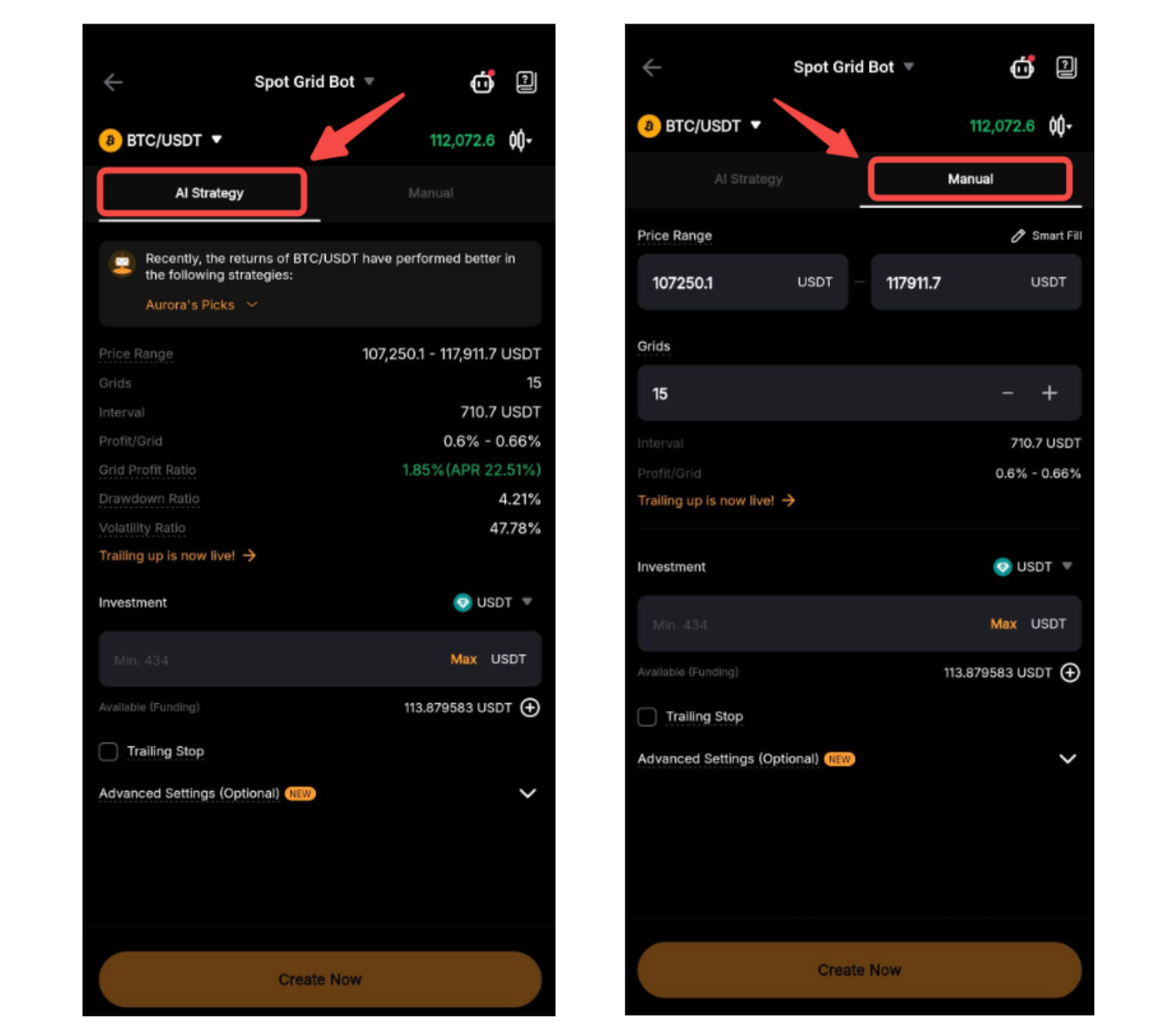
Key parameters work in relation to each other. The price range defines the bot's operating window, and the grid count determines how finely it's divided. The total investment is distributed across the resulting order levels.
Entry price (available under Advanced Settings) delays bot activation until the market hits your chosen level. It must be between 30% and 100% of the current market price. Take profit (TP) and stop loss (SL) can be configured to terminate the bot automatically at defined thresholds.
Key features
Trailing Up shifts the grid range upward when market price exceeds the upper limit by one interval. It cancels the lowest buy order, and repositions it at the previous upper boundary. With each successive breakout, this process repeats, letting you capture gains beyond your original range instead of sitting idle.
Trailing Up works only if there are at least five grids and enough balance to place new, higher orders. This available balance can include accumulated grid profits and released funds from canceled orders. If the balance is too low, the bot stops shifting the grid upward, and pauses new orders until the price returns to range. Since this feature may lead to high-price buys during market reversals, using it together with Trailing Stop can help manage risk more effectively.
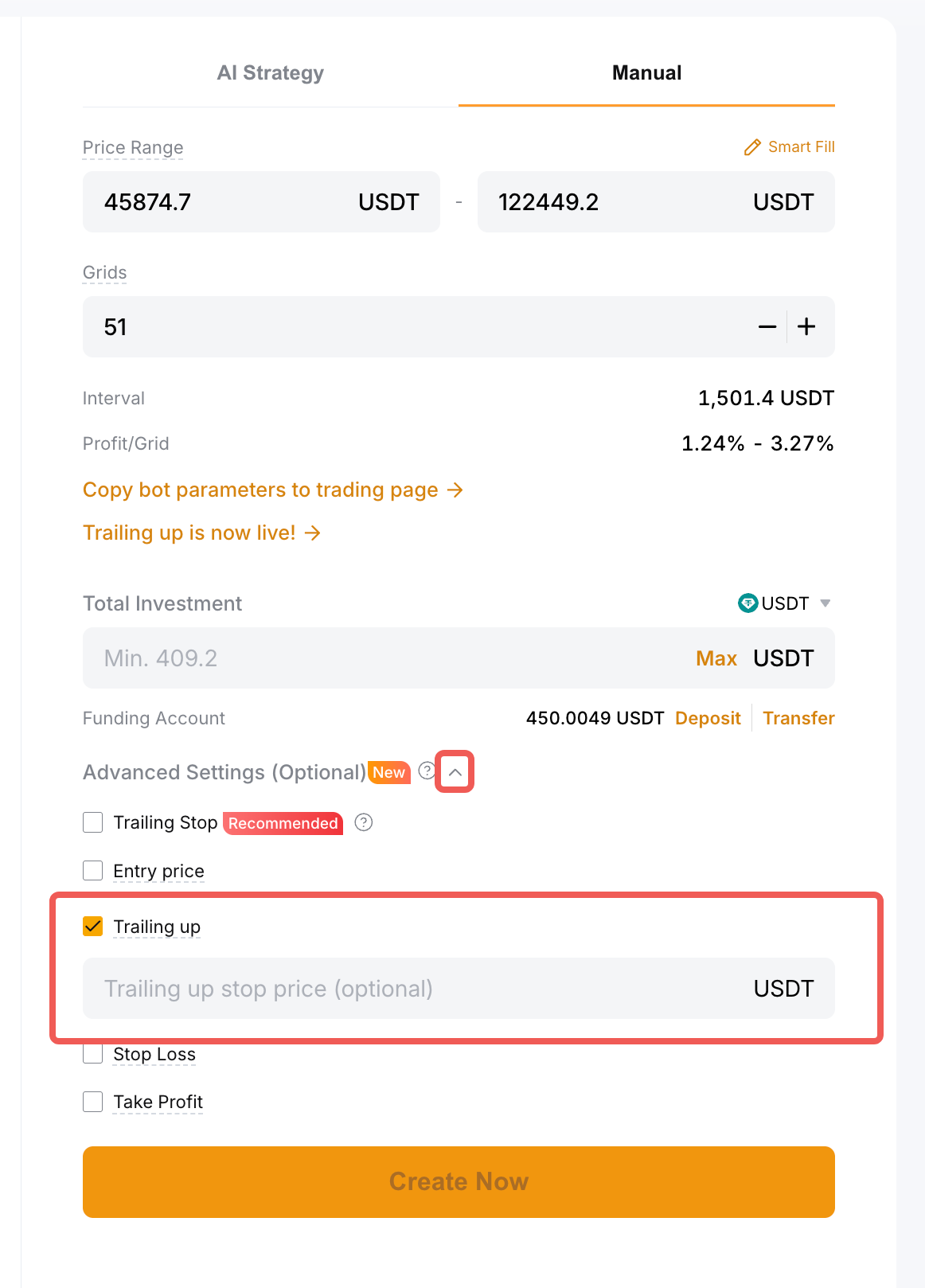
Trailing Stop tracks your account's highest equity, and will close the bot if your equity declines by a certain percentage from that peak — thus helping to protect your profits when the market reverses.
Dynamic order mechanism supports Trailing Up by canceling the order farthest from the current price when there aren’t enough funds to place a new, higher-level order. This automatically helps free up funds.
Real-time parameter adjustment lets you modify price range, grid count and TP/SL on a running bot. Please note that modifying either the range or grid count resets existing TP/SL settings.
Profit withdrawal lets you withdraw your realized grid profits without terminating your strategy, provided that your initial investment amount remains allocated inside the bot at all times.
Understanding your P&L
Three key figures appear on your bot details page. The distinction between them matters at the time of termination.
Grid Profit is the cumulative realized profit from completed buy-sell pairs. It’s always positive while the bot is cycling — which is why it can overstate actual performance.
Total P&L is the overall outcome — grid profit plus the unrealized P&L from base token value changes, expressed as current token equity minus total investment.
Current P&L includes any grid profits you’ve already withdrawn. It gives you the full performance of the strategy since its start.
When the base token’s price drops sharply, its declining value can outpace accumulated grid profit, producing a negative Total P&L despite positive grid profit. This isn't a system error; it reflects the structural reality of holding base tokens in a spot strategy.
At termination, Total P&L is the only figure that reflects your actual net outcome.
Supported pairs, fees and limits
Bybit mainly supports four quote currencies for Spot Grid Bot: Tether (USDT), USDC (USDC), Bitcoin (BTC) and Dai (DAI). These currencies cover some of the most traded spot pairs. The full pair list updates regularly via Bybit's trading bot announcements.
Fees are straightforward, and standard Bybit Spot trading rates apply (charged only on filled orders). No bot creation fee or subscription cost exists beyond the per-trade rate.
You can run up to 50 Spot Grid Bots simultaneously. Individual know your customer (KYC) verification at the Standard or Business Identity Verification level is required before creating a bot.
Tips for an effective grid strategy
Range width and grid count, the two levers that define strategy behavior, pull in opposite directions. A wider range captures more potential movement, but thins capital across more levels. Meanwhile, a tighter range concentrates capital and increases fill frequency, but the bot pauses more often when price temporarily moves out of range.
More grids produce finer intervals and more frequent fills, but may result in smaller profits per trade. Be sure to take this into account, as such smaller profits may not adequately cover the trading fees. Push the grid count too high relative to the range width, and it may begin to consume the bulk of your earnings.
TP/SL and a configured Trailing Stop can help you contain downside risks from deteriorating trends. Grid bots profit from oscillation, rather than from defined trends: when a pair enters a sustained directional move, redeploying into a range-bound pair outperforms holding a misconfigured grid through a breakout.
Last but not least, always track your Total P&L, not just grid profit alone. This will give you an accurate read on your bot’s actual performance.
Closing thoughts
Bybit’s Spot Grid Bot turns volatility into a repeatable execution mechanism that works to your advantage. Every oscillation within your defined range is a potential completed pair,allowing gains to accumulate across a market that never closes.
The Spot Grid Bot suits traders who want systematic automated execution without constant market monitoring, and those who don't want to wait around for strong directional movements in order to deploy their capital productively. The strategy requires a reasonable expectation that price will continue oscillating within a defined band — not a prediction about where it will go next.
In terms of the main execution mode, AI Strategy is the more productive entry point for most traders, particularly those who are just beginning. This is because system-generated parameters reflect historical pair behavior, and give you a calibrated baseline before you need to manually adjust anything. Once the fill frequency and per-cycle dynamics become more intuitive, switching to the Manual configuration becomes the natural next step.
#LearnWithBybit