


Bybit TradFi Perpetual contracts: Derivatives trading for traditional markets

Traditional financial markets close, but the news cycle doesn’t. A Fed rate decision, an earnings report about Asian trading or a geopolitical event over the weekend can move gold, oil or equity prices before any brokerage is open. Bybit TradFi Perpetual contracts address that gap, giving traders 24/7 price exposure to traditional assets, settled in USDT from a single Bybit account.
Key Takeaways:
TradFi Perpetual contracts are USDT-settled derivatives that track traditional assets — gold, silver, crude oil and major equities. Trading is available 24/7, even when an underlying market is closed.
They use the same margin, funding rate and liquidation mechanics as standard USDT Perpetual contracts. Special index price mechanisms keep pricing fair during off-hours periods.
These are leveraged instruments with real liquidation risk. Understanding margin, funding rate costs and gap risk is essential before opening any position.
What is derivatives trading on traditional markets?
A derivative is a contract whose value is derived from an underlying asset — a stock, index, commodity or currency pair. The trader holds a position that gains or loses value as the price moves, without owning the underlying asset.
Traders use derivatives for four reasons:
leverage (a smaller outlay controls a larger position)
short selling (profiting when prices fall)
hedging (offsetting risk elsewhere in a portfolio)
market access (reaching assets that would otherwise require a separate brokerage)
TradFi perpetuals sit closest in structure to a contract for difference (CFD) — i.e., no expiration, cash-settled, long or short — with a funding rate mechanism anchoring the contract price to spot market value.
Derivative type | How it works | Key characteristic | Settlement |
Futures | Contract to buy/sell at a fixed price on a set date | Has an expiration date; is used by institutions and traders | Cash or physical delivery |
Options | Feature the right (but not the obligation) to buy/sell at a set price by expiration | Premium-based; asymmetric risk profile | Cash or asset delivery |
Contracts for difference (CFDs) | Agreement to exchange the price difference from open to close | No expiration; leveraged; widely used in retail trading | Cash |
Perpetual contracts | CFD-like contracts with no expiration; a funding rate keeps the price anchored to spot market value | No expiration; continuous; popular in crypto and TradFi | Cash (USDT on Bybit) |
What are Bybit TradFi Perpetual contracts?
Bybit TradFi Perpetual contracts are USDT-denominated, USDT-settled Perpetual derivatives that track traditional financial assets. Coverage spans commodities (such as gold, silver and crude oil) and stocks (major US-listed equities). Positions can be opened long or short with no expiration date. Trading runs 24/7, including weekends and holidays when the underlying market is closed.
The contract price tracks spot through an index price mechanism, updated every second as a weighted average of all components. An anchor price caps the index within a defined band (±3% or ±5%, depending upon the product) to prevent abnormal deviations.
When the underlying market is closed, stale components may be temporarily excluded. A smoothing mechanism handles the open/closed transition. A funding rate — identical in structure to standard USDT Perpetual funding — applies periodically. Traders pay or receive it based on the direction and prevailing rate.
Two comparisons matter for traders who encounter multiple Bybit products:
Versus crypto Perpetuals: Identical structure — that is, no expiration, USDT-settled, 24/7, long or short. The difference is in the underlying: digital assets vs. traditional market instruments.
Versus Bybit xStocks: xStocks are tokenized, on-chain equity instruments with 24/7 transferability, but no leverage or short selling. TradFi Perpetuals are off-chain, leveraged derivatives with no tokenization component.
| TradFi Perpetual | Bybit xStocks | Owning shares |
Ownership | No | No (tokenized exposure) | Yes |
Leverage | Yes | No | No (or via broker margin) |
Short selling | Yes | No | Not directly |
Trading hours | 24/7 | 24/7 | Market hours |
Settlement | USDT | On-chain token | Fiat/broker |
Dividends | No | Equivalent adjustments may apply | Yes |
Note: TradFi Perpetual contracts do not represent ownership of the underlying asset, and do not grant shareholder rights, dividend entitlements or rights to physical delivery of commodities.
Why do traders use TradFi Perpetual contracts?
The use cases below describe mechanics, not strategies. Every position carries the risk of liquidation.
Speculating on price direction: A trader expecting the S&P 500 to fall after a Fed rate decision can short SPX500 Perpetuals, with no equity sale or options account required. Profit settles in USDT.
Accessing leverage on traditional assets: A $1,000 USDT margin position at 10x leverage gives $10,000 of price exposure on NVDA. The same exposure via a US brokerage requires $10,000 upfront — or an approved margin account.
Reacting to events outside market hours: Because TradFi Perpetuals trade 24/7, a trader can respond to a weekend geopolitical event or an after-hours earnings surprise without waiting for the underlying market to open.
Trading across asset classes from one account: Equities, commodities and crypto are all accessible from a single USDT-settled Bybit account, with no separate brokerage needed.
These use cases describe mechanics only. They are not strategies that guarantee profit. Every open position carries the risk of liquidation.
What do you need before you start trading Perpetual contracts?
Complete verification of your Bybit account with KYC: Standard know your customer (KYC) verification is required before accessing TradFi products.
Sign the TradFi risk agreement: First-time TradFi users must accept Bybit's TradFi risk disclosure. This is a one-time step.
Metals agreement (XAUUSD/XAGUSD only): An additional metals risk agreement is required before trading gold (XAUUSD) or silver (XAGUSD) perpetuals.
Fund your derivatives wallet: Transfer USDT into your derivatives wallet. Ensure the balance covers your initial margin and leaves room for adverse movement.
Geo-restriction check: TradFi Perpetual contracts are unavailable in certain regions. Check Bybit's Terms and Conditions for your jurisdiction.
How to activate TradFi and place your first trade
If your account is already activated for TradFi, please skip to Step 4.
On the Bybit App:
Step 1: Open the App and tap on Trade in the bottom navigation bar.
Step 2: Tap on Futures, then select USDT Perpetual from the contract type options.
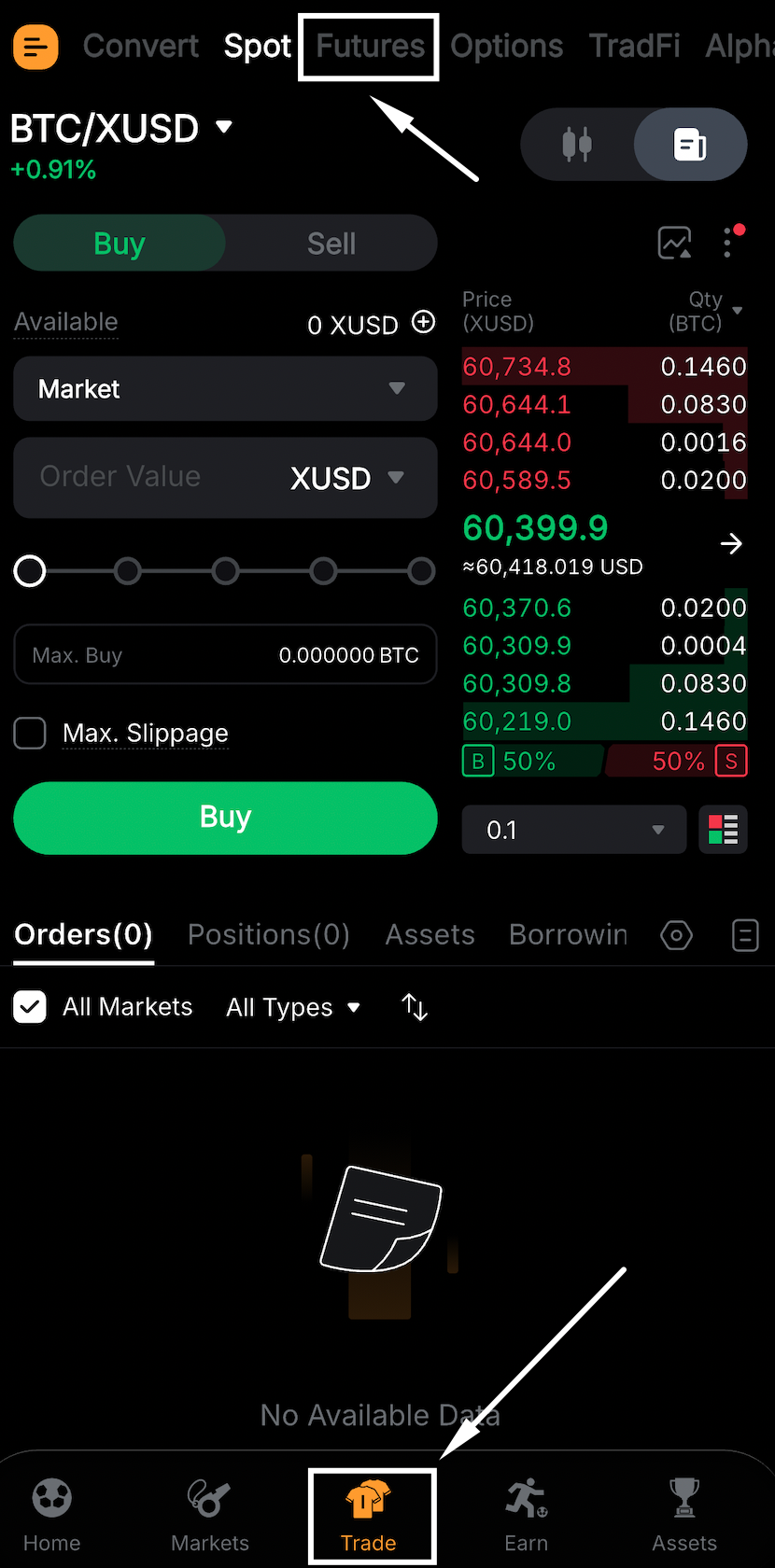
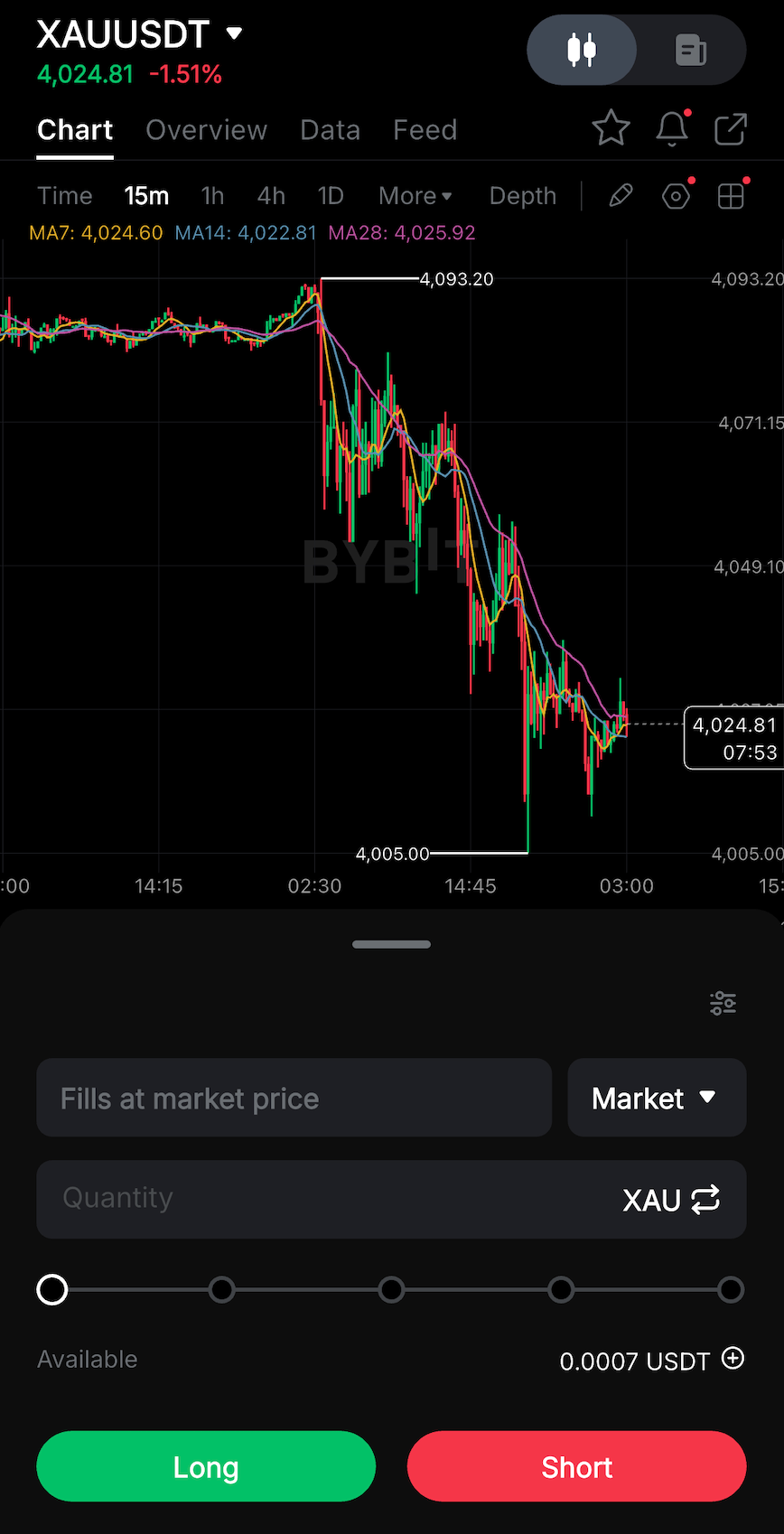
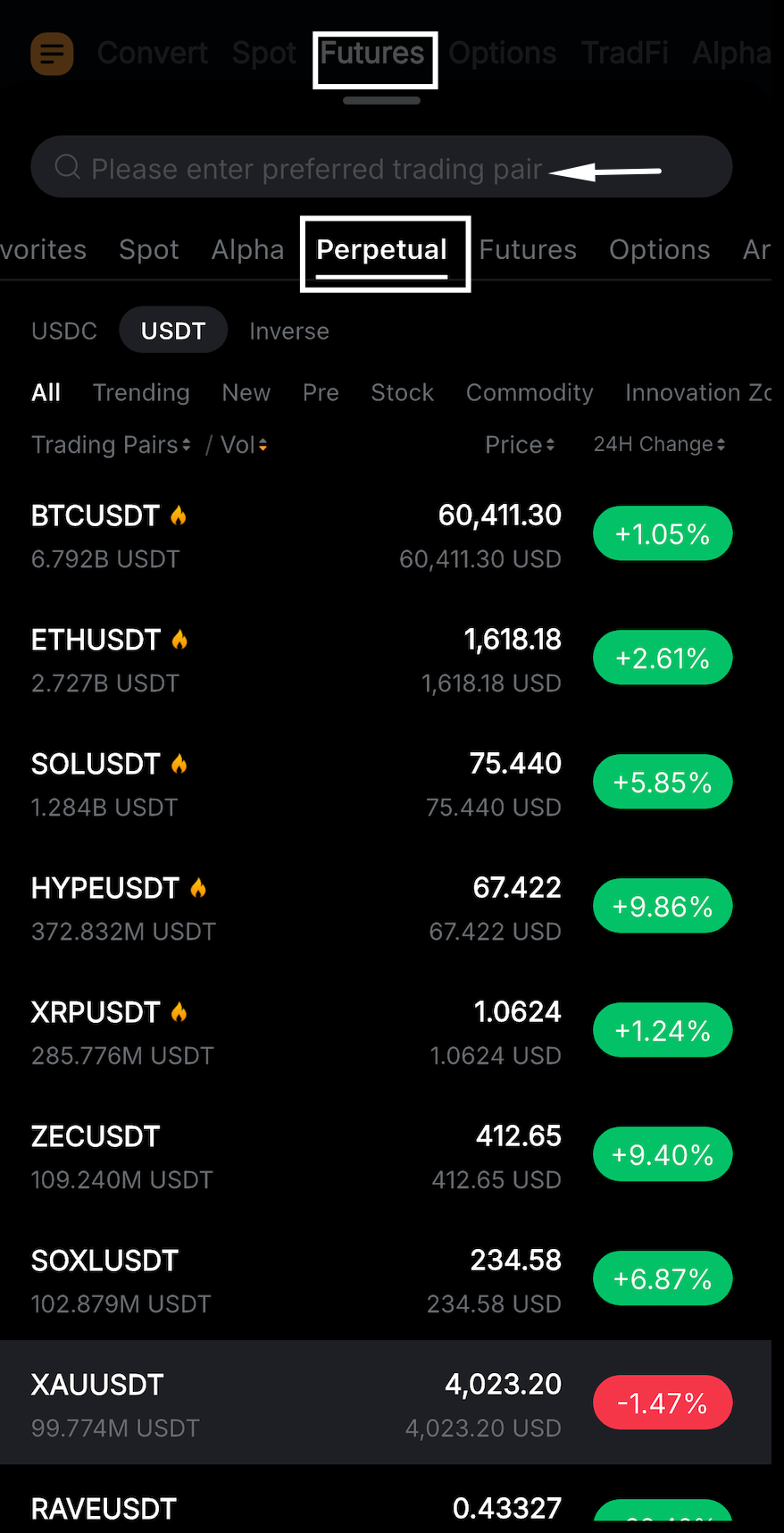
Step 3: Tap on the symbol selector at top-left and navigate to Perpetual → USDT → Commodity or Stock. Select your instrument. On first access, accept the TradFi risk disclosure. XAUUSD/XAGUSD traders must also complete the metals agreement.
Step 4: Set your direction (buy/long or sell/short), order type, leverage and size.
Step 5: Review your margin requirement and liquidation price, then tap on Confirm.
On the web:
Step 1: Go to the Futures trading page at bybit.com.
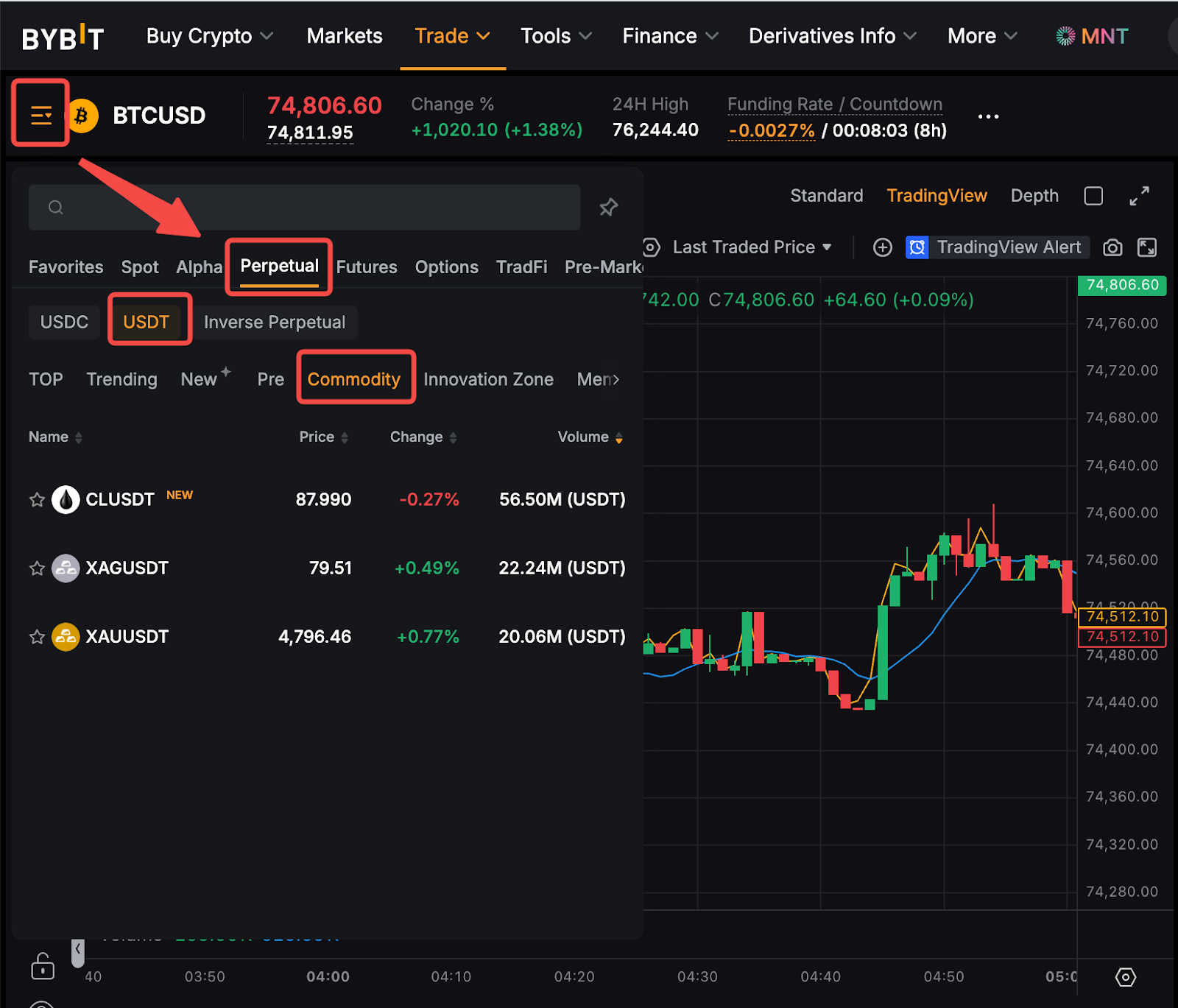
Step 2: Open the symbol drop-down in the top-left corner.
Step 3: Navigate to Perpetual → USDT → Commodity or Stock.
The activation and order flow mirrors the steps above for the Bybit App.
How to manage open positions
Open positions appear in the Positions tab at the bottom of the trading screen on the App, or in the order panel on the web. The key metrics to monitor are listed below.
Unrealized P&L: Updated in real time as the mark price moves relative to your entry price.
Margin ratio: Indicates how close the position is to the maintenance margin threshold. When the ratio reaches the maintenance level, liquidation is automatically triggered.
Estimated liquidation price: Displayed for each open position. Adding margin moves this level further from the current market price.
Stop-loss and take-profit orders: Can be set at order entry or added to an open position. Stop-loss orders cannot fully protect against gap risk at market open — see the risks section below.
Funding rate: Visible in the position details panel. This is charged or credited periodically for all open positions and is settled directly from the margin balance.
To close a position, tap or click on Close on the relevant row and confirm your order. Partial closes are available by entering a quantity smaller than the full position size.
What are the risks?
TradFi Perpetual contracts are not entry-level instruments. The following risks apply to every position.
Leverage can amplify losses: For example, a 5% adverse move at 20x leverage results in 100% margin loss and full liquidation.
Funding rate accumulation: The funding rate accrues at regular intervals for as long as a position is open. Holding over weekends or holidays adds more intervals and, in an unfavorable rate environment, erodes the margin balance.
Gap risk at market open: A price gap at market open can push through a stop-loss before it executes. This is a structural risk that cannot be fully mitigated.
Reduced liquidity outside market hours: When the underlying market is closed, spreads widen and execution quality may decline.
No asset ownership: You receive no dividends, voting rights or physical delivery of commodities.
Derivatives complexity: Traders unfamiliar with margin and funding mechanics should start with very small positions.
Platform counterparty risk: Bybit is the counterparty on all trades, so traders carry platform-level risk alongside market risk.
The bottom line
TradFi Perpetual contracts extend the Perpetual trading model to traditional assets. Gold, crude oil and major equities are accessible with leverage, in both directions, 24/7, from a single USDT-settled Bybit account.
The same mechanics that introduce the potential for additional profit introduce real risk. Leverage, funding rate accumulation, gap risk and thinner off-hours liquidity can all work against a position. Traders who understand these dynamics will find TradFi Perpetuals a practical instrument. New traders should start with small positions before committing meaningful capital.
#LearnWithBybit
