


What is Bybit AI Hub? A guide to AI-powered crypto trading

AI assistants have moved beyond research and summarization, and they’re now being embedded into financial workflows, from portfolio tracking to order execution. However, direct API trading has always demanded certain technical prerequisites: SDK configuration, authentication setup, and endpoint management that puts programmatic market access out of reach for most retail traders.
Bybit AI Hub changes the status quo. With it, you can now point any large language model (LLM) assistant at an AI-readable instruction and the assistant can execute trades, query market data and manage positions on Bybit — all with no installation, no configuration files and no code required.
Key Takeaways:
Bybit AI Hub lets any AI assistant use natural language instructions to execute trades, manage positions and query markets across 274 unique API endpoints.
With zero installation and built-in safeguards, such as confirmation cards and prompt injection protection, Bybit AI Hub opens professional-grade exchange access to traders who may not have a technical background.
What is Bybit AI Hub?
Bybit AI Hub is a hosted, AI-readable skill layer that sits between a user's natural language instructions and Bybit's trading infrastructure. When an AI assistant reads the skill definition, Bybit AI Hub gains the ability to interpret trading intent (e.g., "Open a BTC long position at 10x leverage") and translate it directly into the corresponding API call.
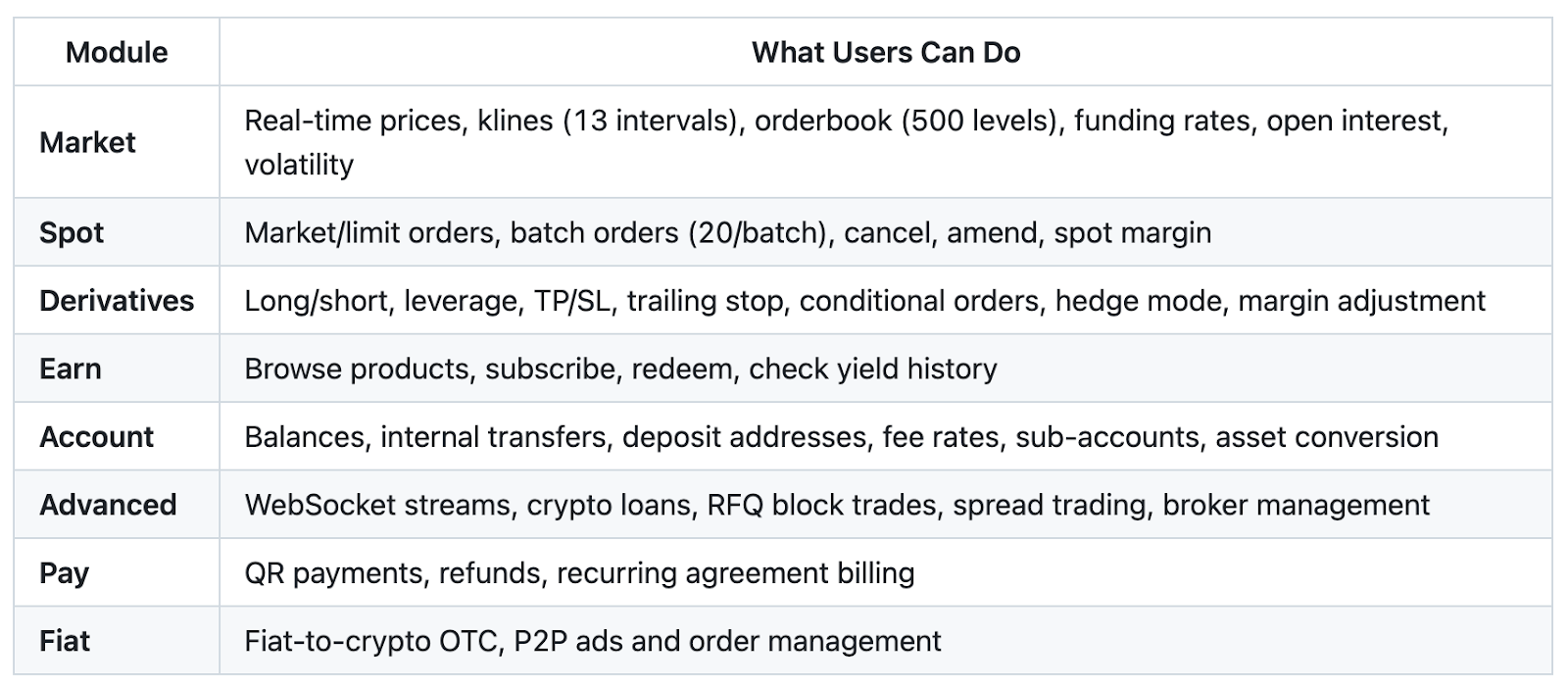
The AI tool currently covers 274 API endpoints across six major modules, spanning market data, spot trading, derivatives, Bybit Earn products, account management and advanced functions. This means users can perform end-to-end trading operations, such as analyzing markets, placing trades, adjusting positions and managing assets, through a single conversational interface, rather than through a brokerage dashboard or self-built integration.
How Bybit AI Hub works
When you paste the Bybit AI Hub Skill URL into any compatible AI assistant, the assistant fetches and reads the full skill definition. This definition maps natural language trading intent to specific supported functions: price queries, order placement, position management and more. The assistant then interprets user instructions and calls the corresponding endpoints. For trading operations (any action that moves funds or opens a position), a confirmation notice is displayed before execution; you must manually confirm the action to proceed.
The system features zero installation, automatic version updates on every skill read, and compatibility across major AI platforms, including ChatGPT, Claude and Gemini.
What you can do with Bybit AI Hub
Market data and analysis
When a trader needs real-time context before entering a position, the market module provides 23 endpoints covering the full analytical stack: spot, derivatives and options. Users can query live prices, pull K-line chart data across 13 time frames (1-minute through monthly), inspect order book depth up to 500 levels and retrieve current and historical funding rates. Volatility data and open interest figures across multiple granularities are also available.
Spot trading
Natural language commands map directly to the full order lifecycle. You can execute market buys and sells, place limit orders at specific price levels, modify the prices of pending orders and cancel individual (or all) open orders. Batch order placement supports up to 20 simultaneous limit orders per instruction, which is useful for scaling into positions across price levels. The spot module also covers spot leverage activation and leveraged token trading across its 22 endpoints.
Derivatives trading
The Derivatives module handles the full positioning workflow for Bybit derivatives trading, including support for Tether (USDT) Perpetuals, USDC (USDC) Perpetuals and USDC Inverse Perpetual contracts. You can open long or short positions with leverage-setting adjustments and set take-profit and stop-loss levels — all via natural language. Margin management and PnL queries are included across the module's 25 endpoints, making it the primary interface for active derivatives traders.
Earn products
You can interact with Bybit's wealth management suite of products without leaving your AI assistant. The Earn module supports product discovery for Bybit Earn savings plans, subscription to Flexible Term Bybit Earn plans, and asset redemption, as well as queries for current positions and earnings history. Flexible Earn, Fixed Deposit and Launchpool categories are all supported, with a total of five endpoints within the module.
Account and asset management
This module supports balance inquiries, internal account transfers, currency conversions and full transaction history viewing. Deposit address retrieval, recharge and withdrawal record queries, sub-account Subaccount creation and API key information are also part of the module’s features. With over 50 endpoints, this is the broadest module in the Bybit AI Hub, which reflects how much active portfolio management occurs outside the actual trade itself.
Advanced AI trading features
Beyond core trading, the platform also features additional modules that support QR payments, refunds and recurring billing through Bybit Pay, as well as fiat-to-crypto OTC, P2P ads and order management through Fiat. The platform’s advanced module covers WebSocket real-time market streams, flexible and fixed lending, institutional borrowing, block trading via RFQ, spread orders and fiat-to-crypto exchange tools. Broker commission management is also available for eligible accounts.
How Bybit AI Hub protects your trades
Conversational interfaces carry an inherent execution risk — namely, that misread intent can mean an unintended order. Bybit addresses this hazard through layered safeguards built directly into the skill. Every mainnet write operation (order placement, position changes, transfers) triggers a structured confirmation card. In addition, order execution requires the user to type CONFIRM instead of just manually approving a dialog. Orders exceeding 20% of the available balance (or a $10,000 threshold) trigger an additional warning before you may proceed.
API keys are masked to the first five and last four characters only. Additionally, new users default to the testnet until they explicitly switch to the mainnet. Prompt injection protection ensures that text fields returned by API responses are displayed, but never executed as instructions. Rate-limit handling includes built-in 429 backoff policies. Finally, the skill downgrades to read-only mode if any module fails to load correctly.
What’s next for Bybit AI Hub
Copy trading integration is a key functionality that will soon be implemented, bringing account order replication through the same natural language interface. Automated strategy tools — spot bots, Martingale bots, dollar-cost averaging (DCA) strategies and advanced order types, including TWAP and iceberg orders — are also scheduled, following the OpenAPI updates estimated to launch on Mar 18, 2026. As these features go live, the Bybit AI Hub’s coverage will expand further beyond the current 274 APIs, further increasing the range of agentic trading actions available through natural language prompts.
Closing thoughts
For most traders, the barrier to programmatic exchange access was never about understanding the market. Instead, the obstacle was the technical layer required to reach it. Bybit AI Hub removes that layer by making a professional-grade API stack accessible through any AI assistant, with no setup required. Retail traders gain the same execution infrastructure that previously required developer resources, and professional traders gain a faster, conversational path to execution.
To get started, paste the Bybit AI Hub Skill URL into your preferred AI assistant and try a simple query — like checking a live price or reviewing your account balance — to see how it works firsthand.
#LearnWithBybit