


Bybit funding rate and fee: What they are and how they work

Perpetual contracts are one of the most popular financial instruments in the crypto market because they never expire. That convenience, however, comes with a recurring cost that many traders overlook. This cost, known as the funding fee, quietly compounds over time. Understanding how the funding fee works can turn a hidden expense into a strategic tool for managing your positions instead.
Key Takeaways:
Peer-to-peer mechanism: The funding fee isn’t a Bybit charge — it’s a direct transfer between long and short position holders.
Price alignment: The primary purpose of the funding rate is to keep Bybit's last traded price anchored to the global spot price.
Automatic settlement: Fees are exchanged at fixed intervals, typically every eight hours — but only if you hold an open position at the exact settlement timestamp.
What is the funding rate?
The funding rate is a small periodic payment that keeps the price of perpetual contracts in line with the underlying spot market. It isn’t a Bybit fee, however. Instead, it’s a peer-to-peer transfer between traders:
Positive funding rate: Long position holders pay short position holders. This typically occurs when the market is bullish and the contract price is trading above the spot price.
Negative funding rate: Short position holders pay long position holders. This usually occurs in bearish markets when the contract is trading at a discount to the spot price.
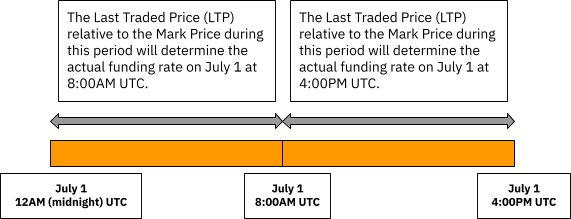
The funding rate is updated every minute based on the interest rate and premium index. Settlements occur at fixed intervals every eight hours, at 12AM (midnight) UTC, 8AM UTC and 4PM UTC.
Why the funding rate exists
Because perpetual contracts have no expiration date, they have no natural mechanism to converge with the spot price. The funding rate creates that pull. Think of it as the interest cost of holding a leveraged spot margin position.
When the contract price deviates too far from the spot price, the funding rate rises or falls to incentivize traders to take the opposing side. This pushes the contract price back toward the global spot average, keeping the two markets aligned over time.
How it affects your positions
The funding fee only applies if you hold a position at the exact settlement timestamp. If you close your position before the interval ends, you will not pay or receive a fee.
For long-term holders, these fees can compound significantly. In a range-bound market with a consistently positive funding rate, a long position holder will see their balance reduced at every eight-hour interval. Conversely, traders on the receiving side can earn a passive return simply by holding the less popular direction.
When the funding rate works for you — and against you
For you: Some traders build strategies specifically around collecting funding fees. By taking the short side when rates are heavily positive, traders earn a payment at each interval while waiting for a market correction. This approach is sometimes referred to as a carry strategy.
Against you: During periods of bullish market conditions, funding rates can turn sharply positive. A long position held through multiple settlement periods will see those fees steadily erode returns, even if the price remains flat.
As a market signal: The funding rate also serves as a real-time gauge of market sentiment. Extremely high or low rates often indicate an overextended market, which is a signal worth monitoring before you decide to enter or add to a position.
How Bybit calculates the funding rate
The funding rate (F) consists of two primary components:
Interest rate (I): Fixed at 0.03% per day, or 0.01% per eight-hour funding interval. Some pairs, like USDCUSDT or ETHBTCUSDT, have a 0% rate.
Average premium index (P): Measures the deviation between the contract price and the mark price. Bybit calculates this using a weighted average of premium index values across the settlement period. The closer to settlement time, the greater the weighting of the most recent premium index values.
Funding rate formula:
Funding rate (F) = clamp [average premium index (P) + clamp (interest rate (I) − average premium index (P), 0.05%, −0.05%), funding rate upper limit, funding rate lower limit]
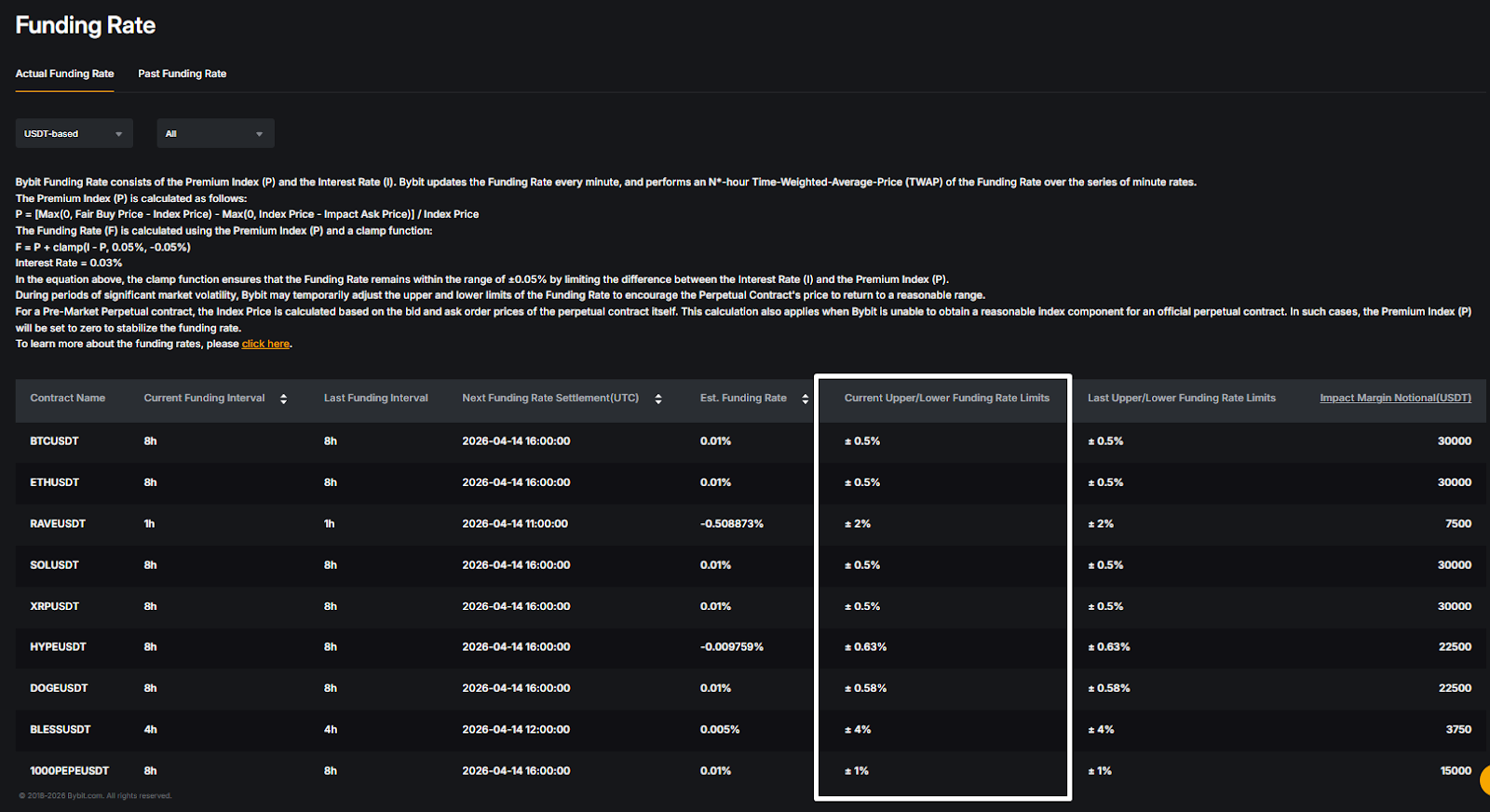
Upper and lower limits: Under normal circumstances, the funding rate upper limit equals the minimum of (initial margin rate − maintenance margin rate) × 0.75 or the maintenance margin rate. The funding rate lower limit is the negative of the same.
During periods of significant market volatility, Bybit may temporarily adjust these limits in order to encourage the contract price to return to a reasonable range.
Pre-market perpetuals: These follow different rules. During the call auction period, the funding rate is set to zero, and neither the premium index nor the interest rate is included in the calculation. During the continuous auction period, the rate is fixed at 0.005%, and is settled every four hours.
Funding fee calculation by contract type
The core formula is the same for all contract types:
Funding fee = position value × funding rate
What changes across contract types is the way that the position value is calculated:
Contract type | Position value formula | Fee currency |
Inverse contract | Quantity of contract ÷ mark price | Fee paid in the base coin (e.g., BTC) |
USDT Perpetual | Quantity of contract × mark price | Fee paid in USDT |
USDC Perpetual | Quantity of contract × mark price | Fee paid in USDC |
Example: Inverse contract
Trader A holds a long position of 10,000 BTCUSD contracts. The mark price is $8,000 and the funding rate is 0.01%.
Position value = 10,000 ÷ 8,000 = 1.25 BTC
Funding fee = 1.25 × 0.01% = 0.000125 BTC
Since the funding rate is positive, Trader A pays 0.000125 BTC to short position holders.
Example: USDT Perpetual contract
Trader A holds 10 BTC contracts. The mark price is 8,000 USDT and the funding rate is 0.01%.
Position value = 10 × 8,000 = 80,000 USDT
Funding fee = 80,000 × 0.01% = 8 USDT
Trader A pays 8 USDT to short position holders.
What to watch out for
Liquidation risk: If your available balance is insufficient to cover the funding fee, the fee is deducted from your position margin. This moves your liquidation price closer to the mark price, increasing the risk that your position will be closed. If your position margin turns negative, but your unrealized profit is sufficient to maintain the position, your position won’t be liquidated immediately. However, increasing your available balance is strongly recommended in order to reduce this risk.
The five-second window: Due to the complexity of settlement processing, opening or closing a position within five seconds before or after the funding timestamp does not guarantee its inclusion or exclusion from the fee exchange. Please note that Bybit does not offer reimbursements for such incidents.
Margin management: Maintain a buffer in your Unified Trading Account (UTA) during high-rate periods to prevent accidental margin depletion. This is especially important during volatile market conditions, when rates may spike unexpectedly.
How to check your funding fees
You can monitor your funding payments via two routes in your UTA:
1. Via Trade History: From the Orders drop-down menu in the navigation bar, select Unified Trading Order → Futures → Trade History.
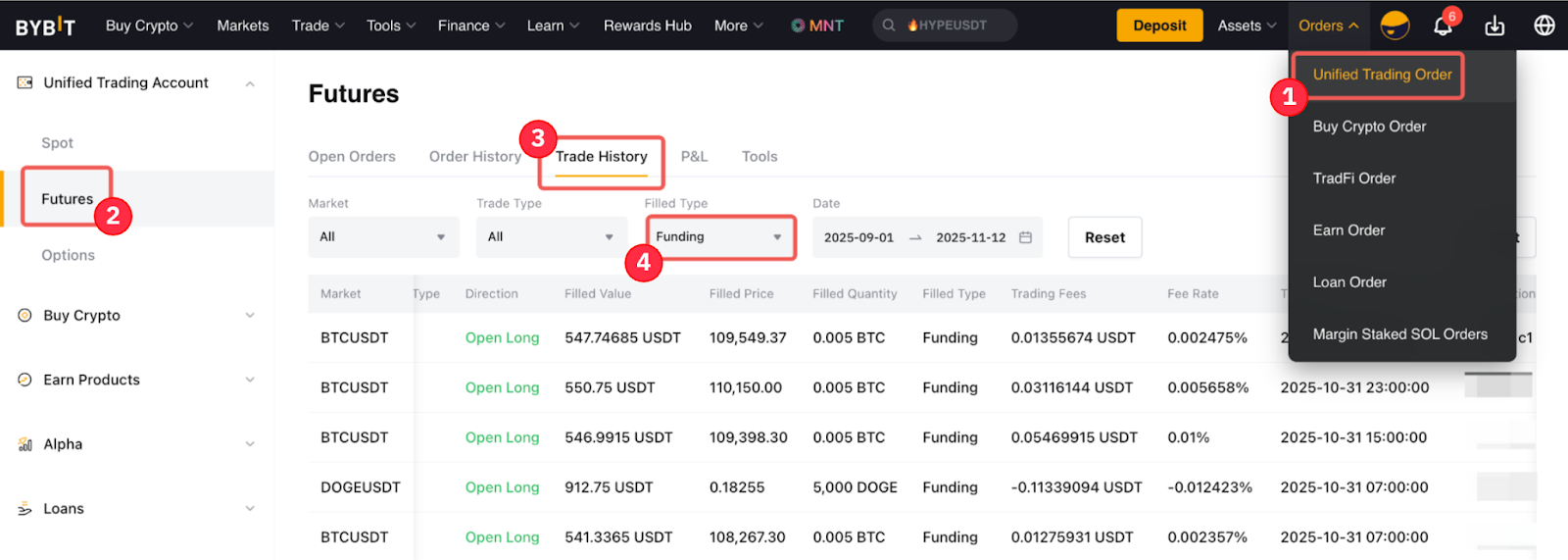
Set the Filled Type filter to Funding. A positive fee means you’ve paid, while a negative fee means you’ve received funds.
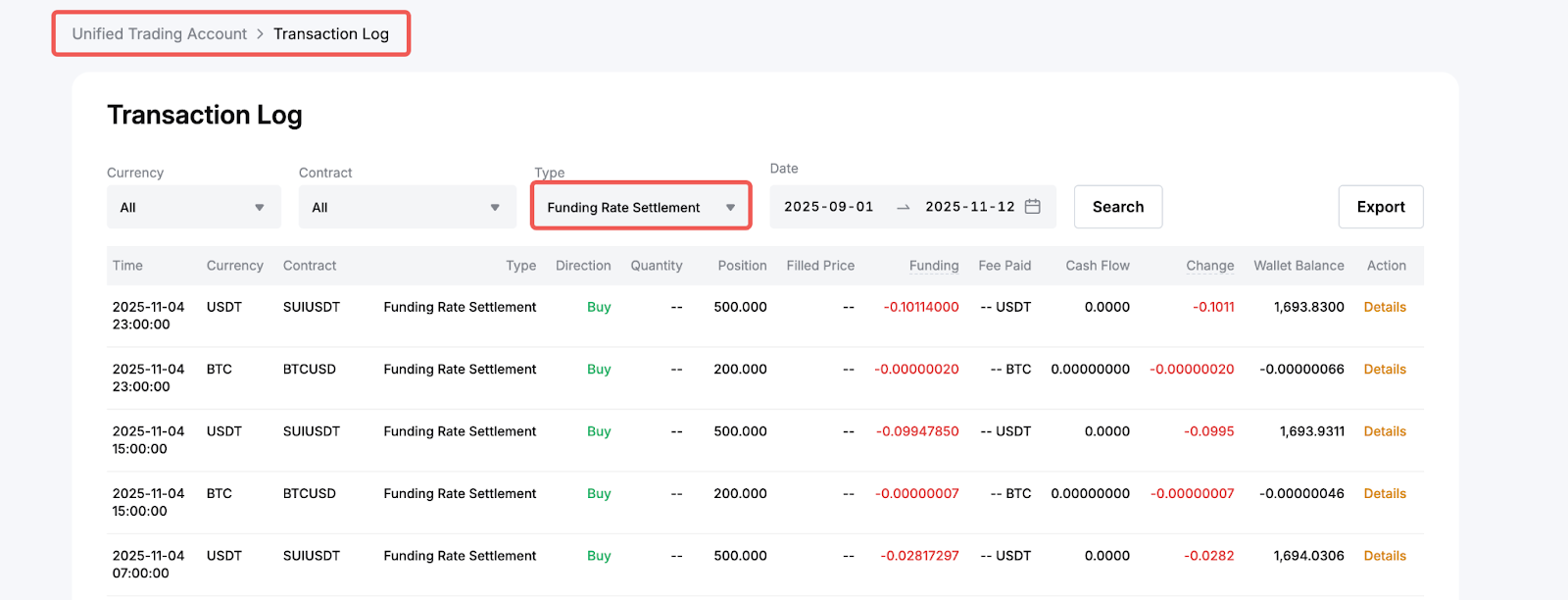
2. Via Transaction Log: Navigate to the UTA Transaction Log and filter by Funding Rate Settlement. The Funding column shows the fee that’s been paid or received at every settlement interval.
Conclusion
The funding rate is one of the most overlooked variables in perpetual trading. By monitoring this rate, you can turn a hidden cost into a competitive edge — ensuring you aren't caught off guard by margin deductions during volatile market conditions.
#LearnWithBybit