


How to spot trade on Bybit

Most beginners start their crypto trading journey with spot trades. These involve buying an asset outright, in most cases at whatever price the market shows right now.
Spot trading differs from the more complex derivatives trades in one core way: you hold the actual asset once the trade settles, rather than a contract that tracks its price. There are no expiration dates, funding fees or leverage (unless you choose to add it through margin).
In this guide, we define spot trading, see how it stacks up against derivatives and show you the exact steps to place your first spot order on the Bybit App.
Key Takeaways:
Spot trading involves buying or selling crypto at the current market price, with immediate settlement and direct ownership of the asset.
You can place a spot order on Bybit in six easy steps, starting with funding your Unified Trading Account (UTA) and ending with the final order confirmation.
Bybit charges a flat 0.1% fee on spot trades for non-VIP traders, while cancelled or unfilled orders cost nothing.
What is spot trading?
Spot trading is the direct exchange of one asset for another, typically at the price the market sets at that moment. For instance, when you spot buy BTC/USDT, you're paying Tether (USDT) to immediately receive Bitcoin (BTC), with that BTC landing in your account the moment the trade fills. No contract sits between you and the coin — which is why most beginners start here, rather than with the more complex world of derivatives.
The main type of derivatives contract is futures. These work entirely differently from spot trading, since you're trading a contract tracking the asset price, rather than owning the asset outright. The table below breaks down the key differences between spot trades and futures.
For a full walkthrough on futures trading, see our article titled How to Get Started with Crypto Futures Trading on Bybit.
| Spot | Futures |
Ownership | Own the asset | Trade a contract |
Expiration | No expiration | Perpetual/non-expiring, or a specific expiration date |
Funding fees | None | Funding fees may apply |
Risk level | Lower risk | Higher risk, due to leverage |
Best for | Beginning traders | More experienced traders |
How to spot trade on Bybit (step-by-step)
In this section, we’ll provide screenshots of the relevant steps in the Bybit mobile app. The flow on the desktop version of Bybit generally mirrors the same steps: navigate to Trade, then Spot, select the relevant pair and set its order parameters before confirming your transaction.
Note: Before placing your first trade, ensure that you already have the following:
A verified Bybit account, with Identity Verification complete
Funds sitting in your Unified Trading Account (UTA)
A basic grasp of trading risk, as you can lose money on any trade
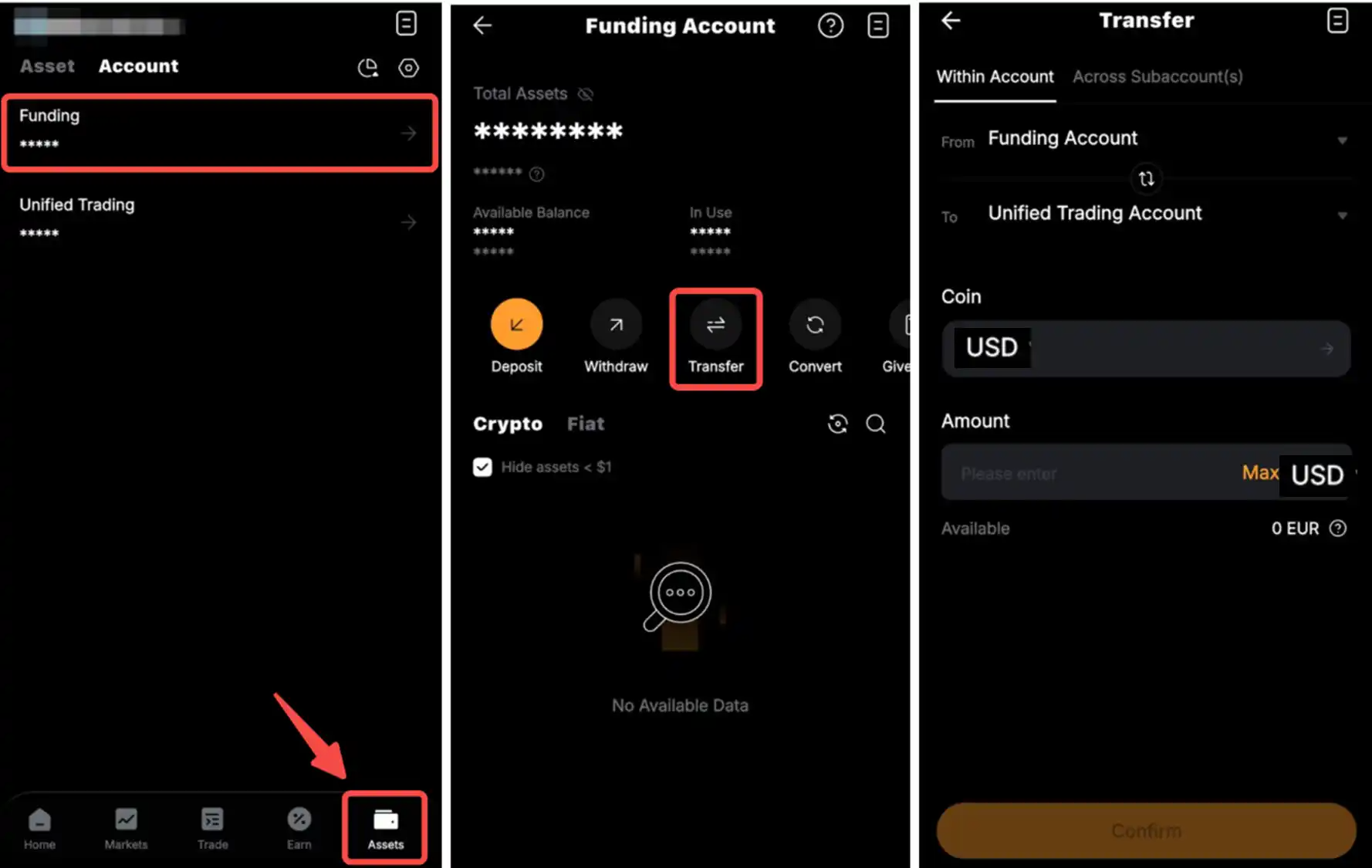
Step 1: Fund your Unified Trading Account. Crypto deposit, fiat deposit, P2P trade or card payment all can be used to fund your UTA. If your balance is currently in your Funding Account, transfer it to your UTA before trading by clicking on Transfer in your account’s interface.
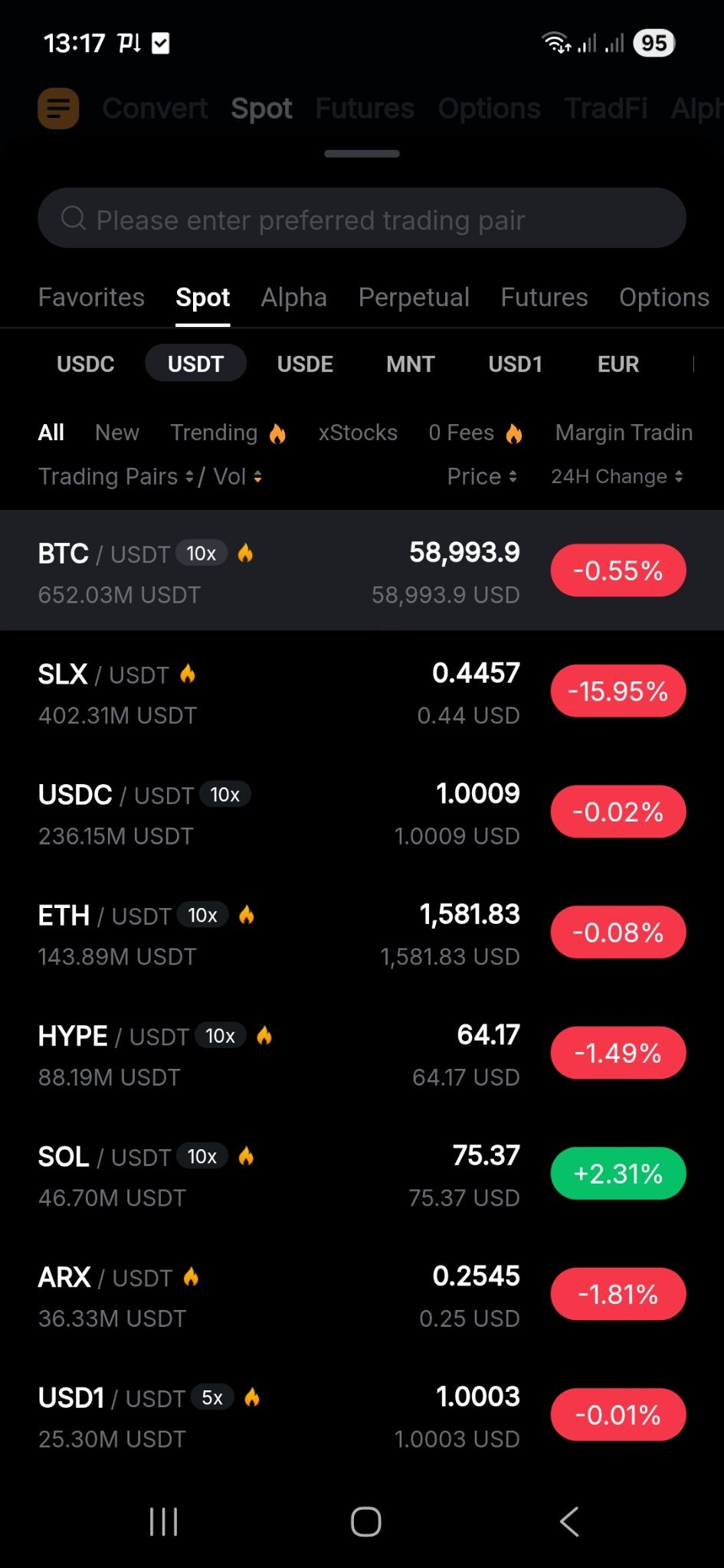
Step 2: Select a trading pair. On the Bybit App’s homescreen, tap on Trade, then Spot. On the default trading screen, tap on the trading pair name to bring up the drop-down list showing all available pairs. Alternatively, type a symbol directly into the search bar. A 10x label next to a pair indicates it supports margin trading. Tap on your preferred pair to open its trading screen.
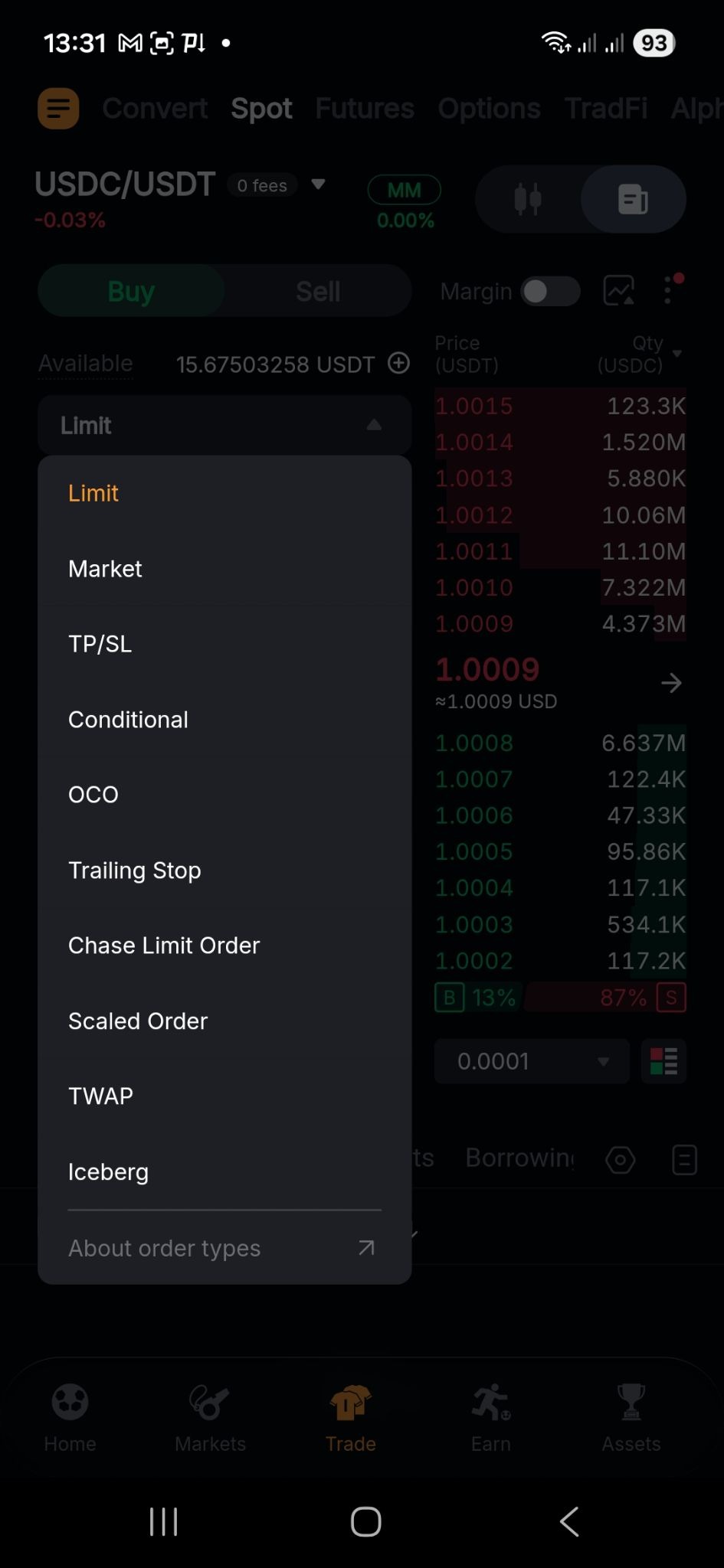
Step 3: Choose your order type and direction. On the pair’s trading screen, tap on Buy or Sell for order direction, then pick Market, Limit or Conditional for order type. Limit and Conditional orders require a target price or trigger price before you can submit the transaction.
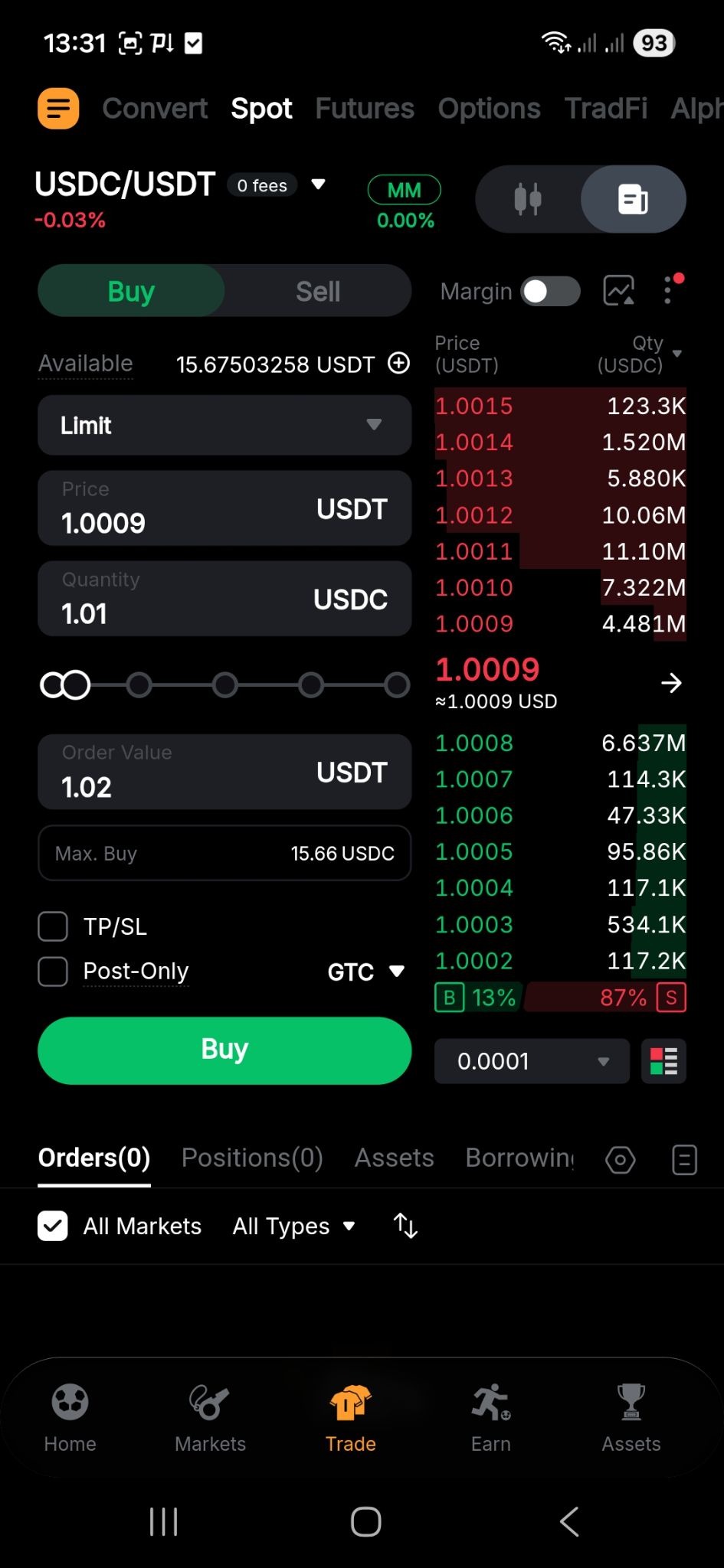
Step 4: Enter your order amount. You can enter either the value (how much to spend in the payment coin) or the quantity (how many tokens to buy). With one tap, a percentage slider lets you allocate a portion of your available balance. Selecting 100% can show a slightly different figure than expected, since Bybit applies a buffer against price movement between placement and execution.
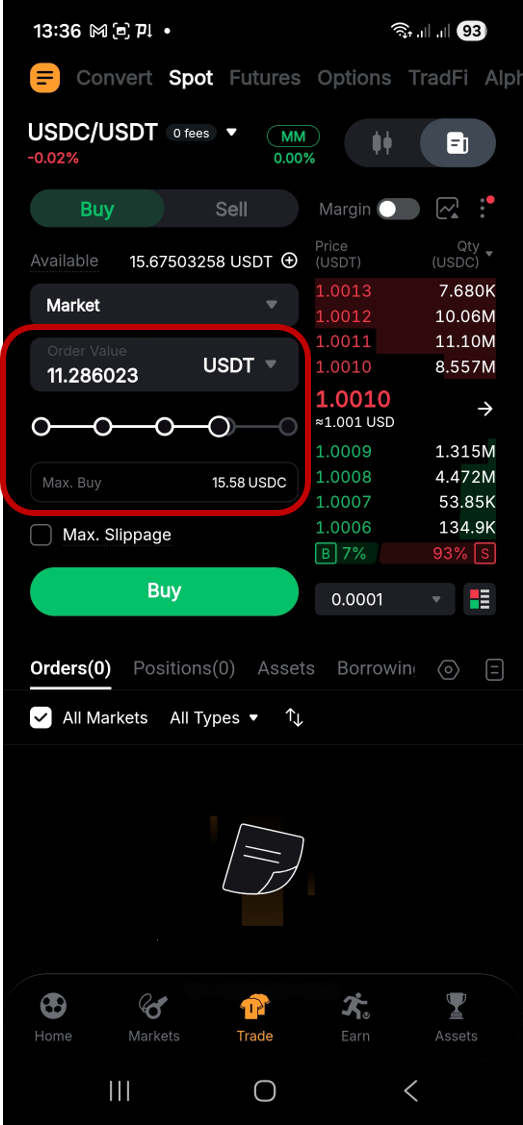
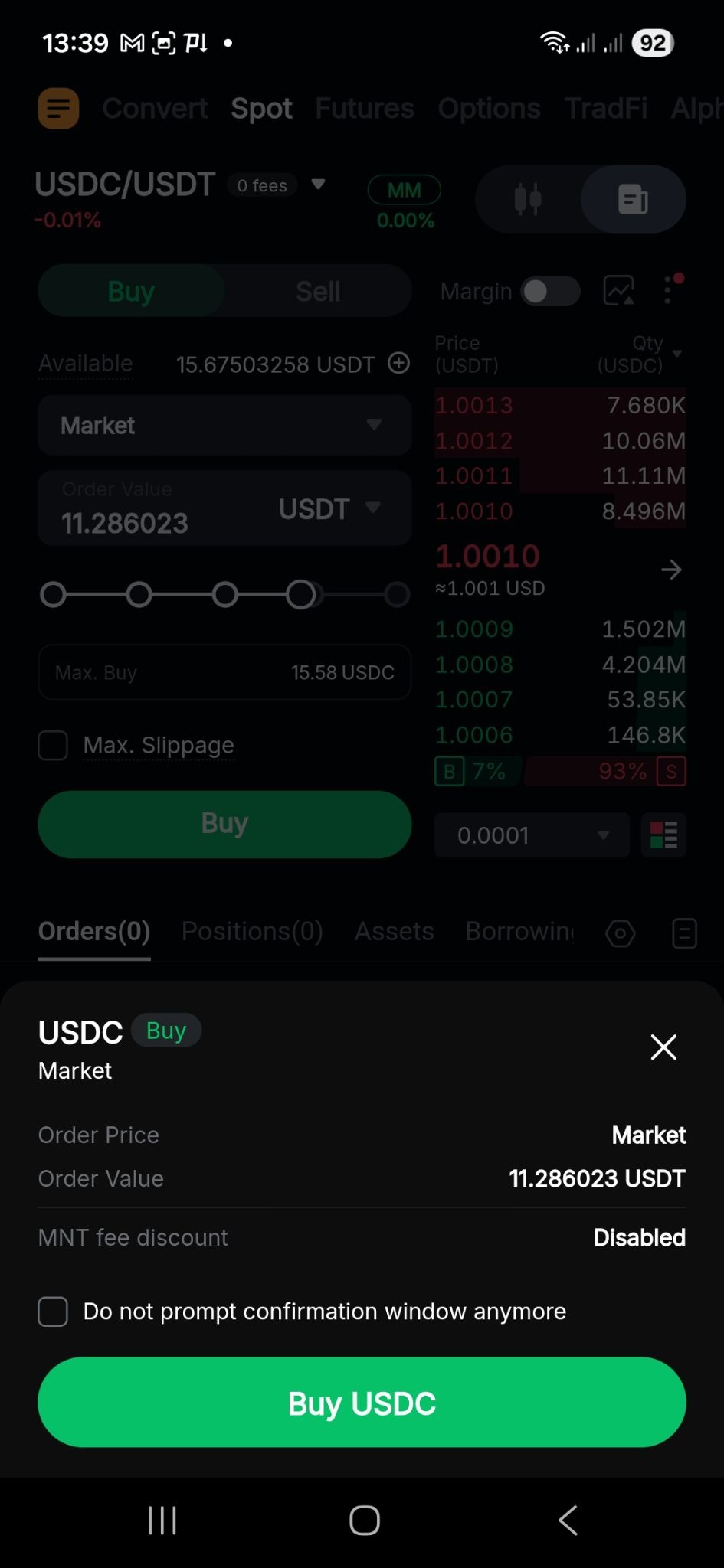
Step 5: Review your order and confirm. A confirmation window displays the price, quantity and total value of your order before anything executes. Check these details, then tap on Buy/Sell to submit. Market orders fill immediately, while Limit orders wait in the order book until your price has been reached.
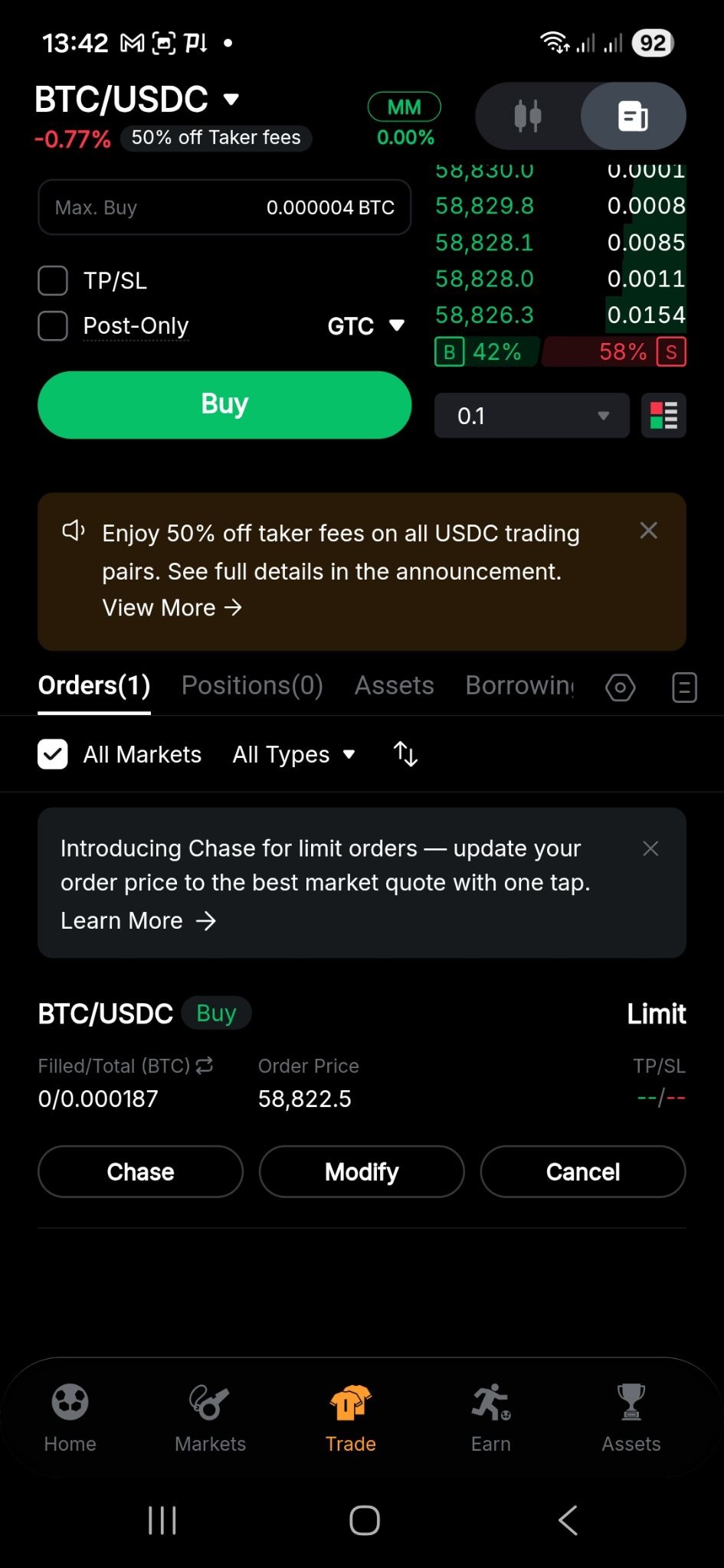
Step 6: View and manage your orders. Open orders appear under the Orders tab.
Modify lets you adjust the price or quantity on any unfilled order.
Cancel removes a single order.
Cancel All clears every open order at once.
Once a trade fills, it moves into Order History and Trade History.
Order types available on Bybit Spot
A market order is the most common and basic spot order type. It fills at the best available price in the order book the moment you submit it. This guarantees execution, but not price. Therefore, during volatile conditions or thin liquidity, your fill can drift from what you’ve seen onscreen a moment earlier. This gap is called slippage.
A limit order behaves differently. It only executes once the market reaches your specified price or better, trading certainty of execution for control over price. Let’s say BTC is trading at 60,000 USDT, and you set a Limit buy order at 58,000 USDT. The order sits untouched in the book until the price drops to 58,000 or lower, at which point it gets filled.
A conditional order triggers once a reference price (either the last traded price or the index price) hits a level you've set in advance. This aspect makes it useful for automating entries or exits around a specific threshold.
Beyond these three types of orders, Bybit Spot also supports several advanced order types, such as TP/SL, trailing stop, OCO, iceberg, TWAP, post-only and time-in-force orders. Each one serves a specific execution strategy. For more information on these order types, see Types of Orders Available on Bybit.
Spot trading fees on Bybit
Bybit charges a flat 0.1% fee on spot trades for non-VIP traders. This applies whether you're the maker or the taker. A maker places a Limit order that rests in the book and adds liquidity, while a taker executes against a standing order, which removes liquidity from the book. Both taker and maker pay the same 0.1% fee at this tier, while canceled orders or the unfilled portion of any order do not attract any fees.
Higher 30-day trading volumes unlock progressively higher VIP grades for users, with correspondingly lower spot rates. The VIP tier requirements and applicable fee rates may change periodically. Current numbers are available on Bybit's fee schedule page.
Adventure Zone pairs attract a higher fee of 0.2% both for makers and takers for non-VIP traders. This reflects the elevated risk profile of the early-stage tokens listed within the Adventure Zone platform.
Margin trading on Bybit Spot
Spot trading and margin trading aren't separate products on Bybit. Rather, margin is a setting you can switch on within the spot market itself.
Under two margin modes — Cross and Portfolio — you can borrow funds against your existing balance to increase position size beyond what your own capital allows, though only on pairs carrying the 10x (or other applicable leverage ratio) label. Borrowing on margin cuts both ways: gains scale up along with the position, but so do losses, and interest accrues on whatever you've borrowed for as long as the position stays open. Once the maintenance margin ratio (MMR) reaches 100%, Bybit automatically liquidates the position to recover the borrowed funds.
For a beginning trader, spot margin’s risk profile differs enough from a plain cash purchase to warrant a deliberate decision — as opposed to a toggle to flip without careful planning.
Other ways to spot trade on Bybit
Spot trading on Bybit isn't limited to crypto-to-crypto pairs. Fiat trading pairs let you trade fiat currency directly against crypto, such as USDT/EUR, through the same interface and order types covered above. Note that you'll need to deposit fiat into your Funding Account first, and then transfer it to your UTA.
xStocks bring tokenized equities, such as SPCX or NVDA, into the same spot interface. Each token tracks the economic exposure of its underlying equity, and a Multiplier mechanism adjusts for corporate actions, such as stock splits and dividend payouts.
Adventure Zone offers access to early-stage tokens with higher return potential and meaningfully higher risk. Spot fees are 0.2%, holdings are capped at 300,000 USDT per token. Please note that delisting remains a real possibility if a project underperforms.
Benefits of spot trading on Bybit
Direct asset ownership means the crypto you buy on Spot settles into your account outright, with no contract or expiration date standing between you and the token. Fee transparency keeps costs predictable, too — a flat 0.1% base rate with nothing hidden for regular pairs, which drops further once your trading volume qualifies for a VIP tier.
Deep liquidity on major pairs keeps spreads tight, which cuts down on slippage and improves execution quality when you're placing larger orders.
A wide asset selection spanning hundreds of crypto pairs — plus fiat and xStock pairs — means that you're rarely boxed into a narrow set of options. Optional margin extends buying power up to 10x on supported pairs for traders who want that type of exposure.
Risks of spot trading
Spot trading carries real risk, even without leverage in the picture, and beginning traders need to weigh each of these factors before committing capital.
Market volatility can move prices sharply within short windows. Crypto's swings tend to run wider than what you'd see in traditional asset classes.
Market orders are exposed to slippage during high volatility or thin liquidity. This means that your fill price can land somewhere away from the price you saw right before submitting your order.
Margin trading, where you choose to use it, amplifies both gains and losses while stacking ongoing interest costs for as long as the position stays open.
Adventure Zone tokens carry elevated risk that’s tied to their early-stage status, including the possibility of losing your full position if a project fails outright or gets delisted.
Holding crypto over time requires a working understanding of wallet security and withdrawal processes. A mistake in either area can cause permanent loss of funds, regardless of what the market is doing.
Fiat and xStock pairs introduce their own considerations, such as currency conversion timing or corporate action adjustments, that don't apply to a straightforward crypto-to-crypto trade.
Conclusion
Spot trading remains the most direct and straightforward way to buy and sell crypto. You own what you hold, the pricing is transparent and the order types cover most trading styles that beginners actually need. Bybit's Spot market pairs that simplicity with competitive fees and a wide asset selection spanning crypto, fiat and xStock pairs. To begin your Spot trading journey, sign up on Bybit to fund your account and place your first trade.
#LearnWithBybit?