


Bybit SpaceX IPO compliance and regulatory status: EU Prospectus + FINRA

SPCXx gives holders economic exposure to SpaceX equity through Bybit's IPO Express. But before taking a position, it helps to understand more than price exposure. The key structural questions are: who issues the token, where the underlying shares sit, what protections govern the collateral and what your actual legal position is as a holder. This article covers the regulatory classification, custody setup, verification mechanisms and rights profile of SPCXx.
Key takeaways:
SPCXx is issued under an EU-registered prospectus and structured as a tracker certificate, or bearer debt instrument, under MiFID II.
Corresponding SpaceX equity is held in segregated custody by a FINRA-regulated, SIPC-member broker, with quarterly ISAE 3000 audits and public proof of reserves.
Holders receive economic exposure to SpaceX equity performance, but not shareholder status, voting rights or corporate-law dividend entitlements.
What is SPCXx legally?
SPCXx is part of the xStocks framework, issued by Backed Assets (JE) Limited, a Jersey-based issuer operating under disclosed regulatory permissions. The product is offered under an EU-registered prospectus approved by the FMA of Liechtenstein, and xStocks are listed on the ESMA securities database, supporting their classification as securities under EU law.
Under MiFID II, each xStock is classified as a tracker certificate: a structured product constituting a bearer debt instrument. SPCXx carries no independent contractual or legal relationship with SpaceX Inc. Its financial value is derived entirely from the price of the underlying equity. Holders are creditors of Backed under the terms of the prospectus and Final Terms, not shareholders of the company whose equity backs the instrument.
This classification matters practically. It means SPCXx is subject to EU securities law disclosure requirements, sits on a regulated product registry and must conform to structured product standards, not the looser frameworks that govern some crypto-native tokenized instruments.
Who does what in the structure?
Three distinct entities handle issuance, custody and access, a separation that mirrors standard traditional finance structures for structured products.
Role | Entity | Regulatory status |
|---|---|---|
Issuer | Backed Assets (JE) Limited | Jersey-based; EU-registered prospectus via FMA Liechtenstein |
Primary custodian | Alpaca Securities LLC | FINRA-regulated; SIPC member |
Backup custodian | Incore Bank | Banking regulation |
Distribution / trading access | Bybit | IPO Express and secondary market |
Backed issues SPCXx under the prospectus. Alpaca holds the underlying SpaceX shares in custody, with Incore Bank available as a backup custodian. Bybit provides the access layer for IPO Express participation and secondary trading, while issuance and underlying-asset custody sit with Backed and Alpaca respectively.
How is SPCXx backed and verified?
SPCXx connects holders to real SpaceX equity through a layered structure built around segregation, independent oversight and periodic verification.
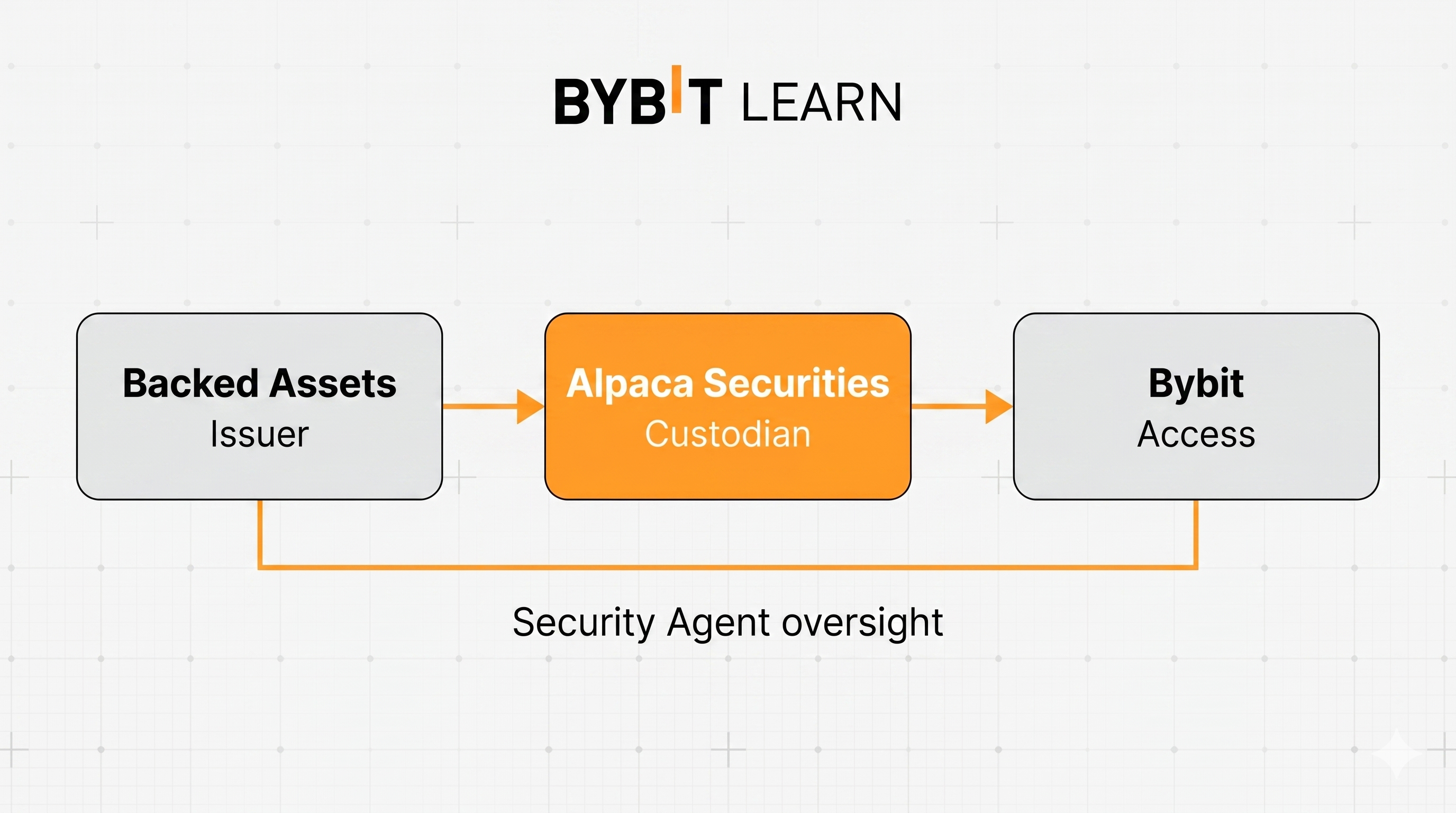
1:1 collateralization. xStocks are disclosed as 1:1 collateralized on an asset-by-asset basis. For SPCXx, the issuer acquires real SpaceX equity through underwriters as part of the IPO allocation process. This is not synthetic exposure via swaps or derivatives. In simple terms, the disclosed structure is designed so the number of SPCXx tokens in circulation is matched by corresponding SpaceX equity held in custody.
Segregated accounts. Each xStock product has its own dedicated sub-account. There is no commingling of assets between products, meaning SPCXx collateral cannot be used to cover obligations from other xStocks instruments.
Three-party Account Control Agreement. The structure involves three parties: Backed as issuer, Alpaca (or Incore) as regulated custodian and an independent Security Agent who holds visibility over the collateral at all times. The Security Agent can take control of the collateral under the Account Control Agreement if token holder rights are not upheld, providing a structural backstop independent of issuer action.
Quarterly ISAE 3000 assurance audits. An independent audit process verifies on a quarterly basis that on-chain token supply corresponds to shares held in custody. These audits are conducted under the ISAE 3000 assurance standard, which applies to non-financial information verification engagements.
Publicly verifiable proof of reserves. Real-time and historical reserve data is published via the xStocks Dashboard at xstocks.fi and backed.fi, giving users a public reference point for reviewing the backing status.
Bankruptcy-remote SPV. The structure is designed as a bankruptcy-remote special purpose vehicle. In the event of issuer insolvency, token holder claims are structured to be linked to the underlying asset value held in custody rather than treated as unsecured general creditor claims. Actual outcomes in any insolvency would depend on the Final Terms, applicable law and legal proceedings, but the disclosed architecture is designed to reduce this exposure.
For a full comparison of SPCXx versus traditional pre-IPO SPV structures, see Bybit SpaceX IPO Express vs. pre-IPO SPV structures.
What rights do holders have and not have?
Understanding both sides is essential before taking a position.
What you get:
Economic exposure to SpaceX equity price, backed by the 1:1 collateral structure described above.
Corporate action treatment: if dividends or stock splits apply, their economic value is reflected through the product mechanism (reinvestment, rebasing or token airdrops) rather than paid as direct shareholder distributions.
24/7 tradability on Bybit and self-custody capability through compatible wallets.
A contractual claim against Backed as issuer, supported by collateralization, segregated custody and Security Agent oversight.
What you don't get:
No voting rights or corporate governance participation in SpaceX.
No shareholder status in SpaceX Inc.
No shareholder-style dividend rights. Economic exposure to dividends, if any, is handled through the product mechanism rather than company-law shareholder distributions.
No direct share ownership. You hold bearer debt instruments, not share certificates.
These limitations are inherent to the tracker certificate structure used across traditional finance for exchange-traded structured products. They are not unique to the tokenized format.
What risks should users understand?
These are risks tied directly to the regulatory and custody structure, not market price risk.
Issuer risk. SPCXx represents a claim against Backed. The bankruptcy-remote SPV design and Security Agent provide disclosed protections, but the value of those protections depends on the arrangements functioning as documented under applicable Jersey and EU law.
Custodian risk. Share custody depends on Alpaca Securities maintaining proper operations. FINRA regulation and SIPC membership provide standard brokerage protections but do not guarantee against all scenarios, including events outside normal operational failure.
Jurisdictional classification. The tracker certificate classification applies under EU/MiFID II. Other jurisdictions may classify SPCXx differently, and the product is not available in all countries or regions. Users should confirm eligibility based on their jurisdiction.
Product terms govern. All rights, protections, corporate action mechanics and redemption procedures are defined in the prospectus and Final Terms published at assets.backed.fi/legal-documentation. That documentation, not this article, is the authoritative source.
The bottom line
SPCXx is a bearer debt instrument issued under a disclosed EU prospectus. It is backed 1:1 by corresponding SpaceX equity held in segregated custody by a FINRA-regulated broker, with quarterly independent audits and Security Agent oversight. The structure is designed to provide economic exposure with clear custody and verification layers, but it does not grant shareholder status.
The key question is not just whether the structure exists on paper, but how the disclosed protections are designed to work under stress.
#LearnWithBybit