


Space and Time (SXT): Real-time blockchain data with ZK integrity

Blockchain networks contain incredible amounts of data that may provide valuable insights for analysis and serve as inputs for apps, databases and analytics platforms. Unfortunately, data held in decentralized ledgers is mostly unstructured and expensive to access, and might not be verified for accuracy. For instance, when blockchain validators approve transaction blocks based on the respective consensus model used by the network, they simply confirm the correct format of the data.
In order to enhance the accuracy and validity of such data, the blockchain industry has implemented a range of solutions, including zero-knowledge (ZK) proofs. Unfortunately, standard ZK technology may involve complex data processing, and can become computationally expensive and poorly scalable. Even when implemented efficiently, ZK proofs don’t make blockchain data more accessible, though they do ensure data integrity and security.
Space and Time (SXT) is a decentralized platform that aspires to become a unified, structured warehouse of on-chain and off-chain data, enabling easy, quick and inexpensive access supported by ZK-proven data validation. The platform sources data from numerous blockchains and Web 2.0 systems, generates and stores cryptographic references for the data, organizes it in the standard relational database format and lets external sources — including data-driven applications and smart contracts — query it using the good ol’ SQL, a database query tool ubiquitously known in the developer and analyst communities.
Key Takeaways:
Space and Time (SXT) is a decentralized data warehouse that sources, indexes and provides access to on-chain and off-chain data from different blockchains and Web 2.0 databases via SQL queries.
The platform's native token, SXT, is used for staking, stake delegation, validator payouts, payments to access data via queries, rewards for data providers and governance.
SXT can be bought on Bybit as a USDT Spot pair.
What is Space and Time?
Space and Time (SXT) is a permissionless Layer 1 modular decentralized network that acts as an enormous warehouse of on-chain and off-chain data from various sources. It securely pulls and indexes external data for easy access by decentralized apps (DApps), protocols, enterprise systems and other platforms requiring flexible and efficient data usage.
The Space and Time blockchain features cross-chain connectivity to several decentralized networks for data collection, including Ethereum (ETH), Bitcoin (BTC), ZKSync, Polygon (POL), Sui (SUI) and Avalanche (AVAX). Web 2.0 systems and databases can also be used as off-chain data sources for the platform.
Space and Time acquires on-chain and off-chain data, assigns cryptographic digital fingerprint references and securely stores the signed references. This ensures that any data you access via the platform is verified and can be obtained efficiently and inexpensively.
Use cases for Space and Time
Developers and apps can run standard SQL queries on the data that Space and Time stores and organizes to feed it into their own systems or on-chain smart contracts, thus creating various use case opportunities to use the platform.
One potential use case is the tokenization of real-world assets (RWAs) into dynamic NFTs. Let’s say a real estate property is tokenized to be represented on-chain by an NFT that records its key parameters — market value, sale history, last renovation date and current rental income. As the parameters are updated in the real estate database connected to Space and Time, the updates are pulled in by the blockchain, verified cryptographically and sent to the NFT smart contract for relevant changes to the token’s dynamic values.
Space and Time can also be used for enterprise auditing purposes. Auditors and regulators can run queries on the financial data uploaded by a business entity via Space and Time, knowing that the data has been verified for authenticity and accuracy, thanks to the platform’s use of cryptographic proofs.
On-chain AI agents can also be deployed by web3 projects to automatically query Space and Time for necessary data to pull into their own applications, databases or smart contracts. The platform's use of the standard SQL format greatly simplifies the creation of such query agents and bots.
How does Space and Time work?
Space and Time has developed Proof of SQL™, a variation of ZK cryptographic proofs, to securely validate the authenticity and correctness of sourced data (which we'll touch upon later).
The Space and Time blockchain’s modular design features three specialized node types: Indexers, Validators and Provers. These nodes coordinate their work in order to complete the entire life cycle of data sourcing, validation, cryptographic reference storage and query retrieval.
Indexer nodes extract data from external sources, transform it into a relational format that aligns with SQL standards and submit it to the network for validation.
Validators check the data submitted by Indexers in order to ensure its integrity and accuracy and to commit cryptographic updates to the blockchain. In essence, these cryptographic updates are verified references to the original data. To agree on the correctness of each data update and ensure network security, Validators use a Byzantine Fault-Tolerant (BFT) model that allows them to reach consensus, even in the presence of some nodes acting maliciously.
When a platform user — which could be an app, smart contract, external enterprise system, AI agent or data analyst — sends an SQL query request to retrieve some information, Prover nodes execute the query against the cryptographic indexed data stored in Space and Time. Provers process user requests and send back the results of the queries, along with ZK proofs. The ZK proofs succinctly prove two things with one single data bit:
The data queried by the client is valid and tamperproof
The SQL query was correctly executed on the requested data
The entire process — from “ingesting” data to generating the final results for user queries — is based on trustless data processing.
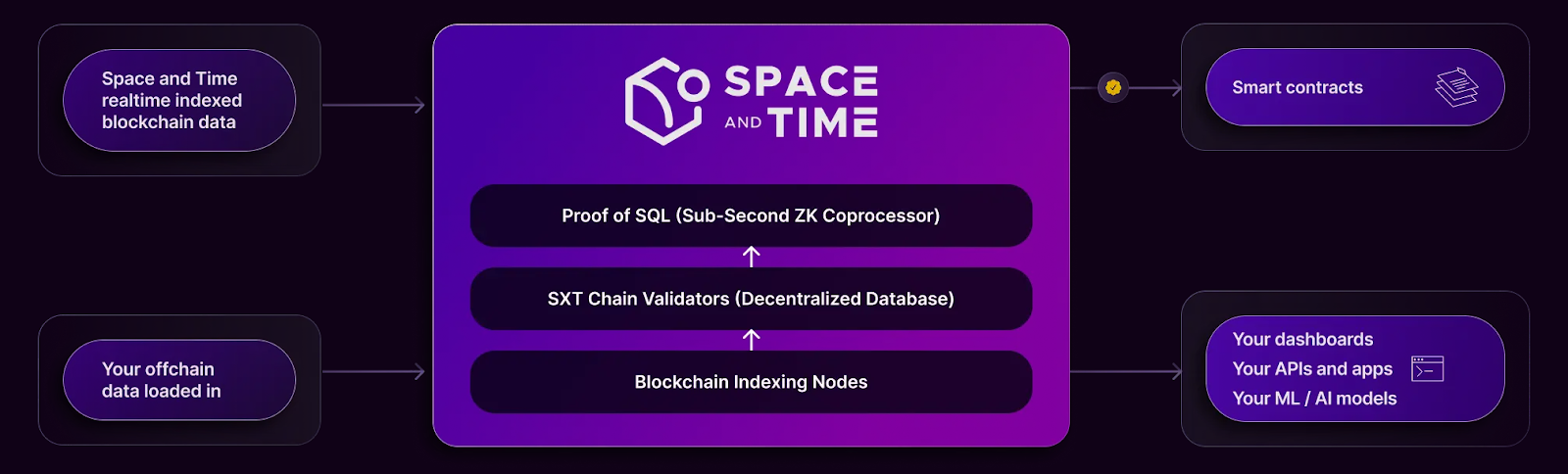
Source: spaceandtime.io
Space and Time key features
Decentralized data warehouse
Space and Time acts as a giant decentralized data warehouse that many entities across both the web3 and Web 2.0 domains can use to ensure they access structured and verified data. The primary records in the warehouse are tables that contain cryptographic references to the actual on-chain and off-chain data, which can be queried in a secure, scalable and efficient manner.
Typical blockchain records on most networks represent vast piles of unstructured data from which it’s difficult to cross-verify or derive insights. Using Space and Time's data warehouse, apps and smart contracts can efficiently extract exactly what they need without combing the unstructured records held by numerous blockchains and Web 2.0 databases.
Proof of SQL
Space and Time's Proof of SQL is a custom-built, high-performance cryptographic proof. It attests that specific SQL queries have been executed in a valid and consistent way. Unlike generic ZK proofs, which confirm data’s validity without revealing all of its internal details, Proof of SQL proves that the results you get based on your query are exactly what you've requested. As a sub-second ZK coprocessor, Proof of SQL can aggregate and verify analytics over millions of rows within less than a second.
Developers can use Proof of SQL to generate cryptographic proofs from any SQL-compatible data source — centralized or decentralized — and return those proofs to smart contracts (on-chain) or external verifiers (off-chain).
SXT Chain
The backbone of Space and Time is its SXT Chain, a Layer 1 network designed specifically to act as a tamperproof data repository. Together with its cryptographic proof mechanism (Proof of SQL) and the trio of node types, Space and Time’s blockchain creates opportunities for real-time data queries, updates and verifications for decentralized finance (DeFi) protocols, decentralized identity management solutions, audit systems and other applications.
In essence, any protocol, smart contract or app that requires quick access to data it doesn’t internally possess can benefit from using the SXT Chain.
Space and Time ecosystem tools
Space and Time DB and APIs
ZK-based validation systems often have computational overheads that make them less than ideal for certain apps requiring quick data access for running front-end analytics or on-chain data queries. For such use cases, Space and Time offers a custom product, Managed DB via APIs, that enables running optimistically validated queries on blockchain data. Thanks to optimistic validation, it’s even more efficient to execute these queries and deliver results.
A set of APIs facilitates efficient queries of underlying data via the Managed DB. The product lets you access all of the data held by the SXT Chain, as well as indexed blockchain data from numerous mainnet and testnet platforms.
Space and Time Studio
Space and Time Studio. an easy-to-use platform that offers an AI-powered interface to develop SQL queries, uses natural language prompts. Users unfamiliar with SQL can easily generate queries by specifying their requirements to the AI tool.
Space and Tokens
The Space and Tokens platform allows developers to simulate various tokenomics models, forecast their tokens’ performance and develop detailed analytics and dashboards related to their tokens’ economies. The platform acts as a simulation environment in which aspiring token issuers can model various elements of tokenomics, such as buybacks, burning models, staking, vesting and more.
Users can add and remove tokenomics elements. or adjust them to find optimal models. Price forecasts are generated by Space and Tokens to guide users on the possible outcomes of selecting specific tokenomics features. The platform even offers templates for token economies based on the parameters of distinguished and successful crypto projects, such as Chainlink (LINK), Polygon (POL) and Cosmos (ATOM).
What is the Space and Time crypto token (SXT)?
The platform's native token, SXT, is designed for several key functions. One of these is staking. Validators stake the token to secure the right to perform their duties on the platform and earn staking rewards in SXT. The SXT Chain supports stake delegation — i.e., anyone who doesn't want to set up and run a validator node can delegate their SXT tokens to their chosen validator and earn a share of the staking rewards.
The platform's users — apps, external databases, smart contracts, oracles, analysts and any other entity that pulls data from Space and Time — pay to run their queries in SXT tokens.
Data publishers can earn SXT tokens by making their datasets available on Space and Time for other users to query.
The project's white paper also specifies that SXT will be used for governance, with token holders voting on the platform's future direction and changes to it.
SXT has a total and maximum supply of 5 billion tokens. The chart below shows its supply allocation shares.
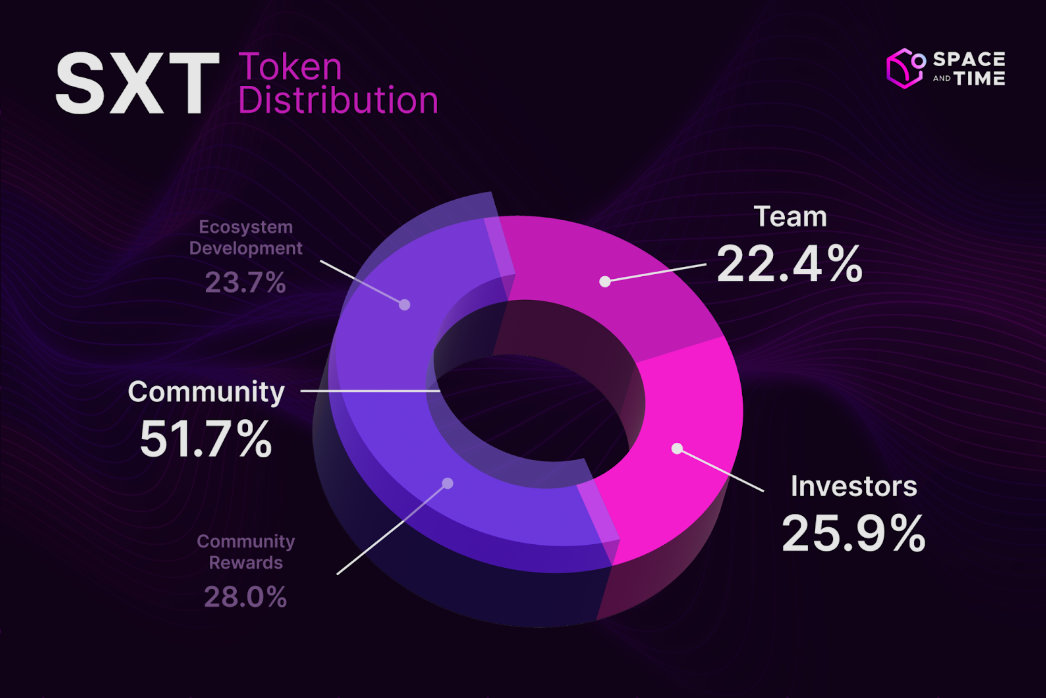
Source: spaceandtime.io
Where to buy the Space and Time crypto token (SXT)
The SXT token is available on Bybit’s Spot market as a swap pair with the USDT stablecoin (SXT/USDT). You can also use the token for trading via Bybit’s Spot Grid Bot, which allows you to automate your grid trading strategy to capitalize on asset price fluctuations by buying low and selling high at predetermined price points.
Space and Time (SXT) price prediction
As of Jun 6, 2025, the SXT token has been on the market for nearly a month. It’s currently trading at $0.09376, a 42.3% drop from its all-time high of $0.1621 on May 8, 2025.
SXT’s long-term price outlook is quite bullish.DigitalCoinPrice expects the token to trade at $0.31 by 2027 and $0.49 by 2030, whilePricePrediction is forecasting average prices of $0.26 by 2027 and $0.82 by 2030.
Closing thoughts
Space and Time’s modular decentralized network has taken on an essential role in the blockchain industry. While popular blockchains store enormous amounts of data, few platforms currently act as centralized depositories in which this data may be indexed, stored, accessed or cross-verified. At the same time, the need for such a structured, easily accessible and industry-wide repository is evident — and the Space and Time network provides a viable solution.
As more data moves to blockchain, Space and Time’s core service will prove increasingly relevant for analysts, developers, DApp operators, enterprises still reliant upon Web 2.0 systems and countless others who may use SQL to source both on-chain and off-chain data.
#LearnWithBybit