


Sophon (SOPH): The ZK chain that understands consumers

In the crypto industry, every new project talks about "mainstream adoption," but few actually build for it. Sophon is a decentralized platform that takes a different path, one that aims to deliver the blockchain version of Facebook. The project's goal is to power consumer-facing apps that people actually use, from gaming and social media to media and culture — not protocols for protocols' sake, but infrastructure on which developers can build products to reach millions.
Sophon runs as a Layer 2 blockchain on ZKsync's Elastic Chain, built with ZK Stack and powered by a Validium architecture. That means high throughput, cheap fees and a user experience designed to feel like Web 2.0. With features like gasless transactions, account abstraction and smooth onboarding, it's designed for everyday apps, not just for decentralized finance (DeFi).
With a heavy focus on user-friendly tools, economic alignment and real application utility, Sophon is pitching itself as the consumer layer of crypto — as opposed to just another smart contract platform.
Key Takeaways:
Sophon (SOPH) is a blockchain network designed to make web3 gaming, social media and entertainment applications accessible to all users, including those without much experience in the world of crypto.
The platform is a Layer 2 Validium that’s part of the broader ZKsync Elastic Chain ecosystem, and utilizes Avail as its data availability layer.
The network's native token, SOPH, is used for gas fee payments, staking, governance and ecosystem rewards. You can buy SOPH on Bybit as a USDT Perpetual contract.
What is Sophon?
Sophon (SOPH) is a Layer 2 blockchain designed specifically for culture-focused, consumer-facing applications — gaming, social media, entertainment and everything in between. Sophon wants to bring mainstream users on-chain by making crypto infrastructure feel seamless, intuitive and as familiar as using a Web 2.0 app.
Built on the ZKsync Elastic Chain framework, Sophon operates as a Validium blockchain scaling solution. This means that execution happens off Ethereum (ETH), and data is posted off-chain via Avail (AVAIL), but security is maintained through zero-knowledge (ZK) proofs. The result is high throughput and low fees — exactly what's needed to make mainstream use cases viable.
Unlike most Layer 2s built for developers and traders, Sophon is aimed at builders who care about storytelling, communities and interactive experiences. It's not just about better scaling — it's about changing what gets built in the first place.
At its core, Sophon wants to onboard people who don't care about DeFi trading intricacies or gas optimization — or even what a crypto wallet is. That's why its infrastructure is designed around native account abstraction, invisible wallets, access-verified user credentials and flexible login systems. Friction is minimized at every step.
But Sophon isn't just an infrastructure. It's also building a whole ecosystem — discovery layers, reputation systems and reward programs — all of which are designed to support both creators and users. The idea is to turn crypto into a cultural layer people engage with daily.
Sophon was founded by Swiss crypto builder Sebastien A., previously Head of DeFi at ZKsync, and is supported by the Sophon Foundation. The chain was first announced in 2023, with its testnet launching in mid-2024 and its mainnet going live in December 2024. Since then, the Sophon team has focused on refining user onboarding, growing its ecosystem and moving toward decentralization through Light Nodes and validator expansion.
How does Sophon work?
Sophon is built to handle real consumer-scale applications while keeping things decentralized under the hood. Its infrastructure relies on two types of Sophon nodes — Full Nodes and Light Nodes — along with a rewards model tied to Guardian participation.
Full Nodes are heavyweight participants. They store the entire blockchain history, and are responsible for sequencing and validating blocks. At this stage, Sophon Labs operates the sole Full Node with authority to submit batches to Ethereum. However, the project’s road map includes opening this role to other nodes through a consensus mechanism, eventually decentralizing block production.
In contrast, Light Nodes don't store the full chain history. Instead, they use data availability sampling, pulling random pieces of data from new blocks to verify their integrity. These nodes run efficiently with minimal hardware, making it easy for everyday users to contribute to the network.
To tie Light Nodes to the rewards system, Sophon uses a Guardian model. Guardians hold special NFTs representing membership and the right to earn a share of SOPH rewards. If a Guardian runs their own Light Node, they earn the full allocation. If not, they can delegate their NFT to an existing node operator and share the rewards. Node operators also set a small commission fee for the service, typically 1–3%.
This architecture lowers the entry barrier for network participation while preserving a path to complete decentralization. Whether you're tech-savvy or just want passive exposure, there's a role to play.
Sophon's ZK Stack–powered blockchain
Sophon is built using the ZK Stack, the same modular framework that powers ZKsync. It functions as a Validium chain — meaning that transactions and state changes take place off-chain, while validity proofs are submitted to Ethereum. Data availability is outsourced to Avail, which keeps transaction fees low without compromising verifiability.
This lets the Sophon network stay fast and low-cost, even as usage scales. It batches activity, proves correctness via ZK proofs and posts these proofs to Ethereum for security. That way, even though the data lives off-chain, trust in the system doesn’t break — it scales.
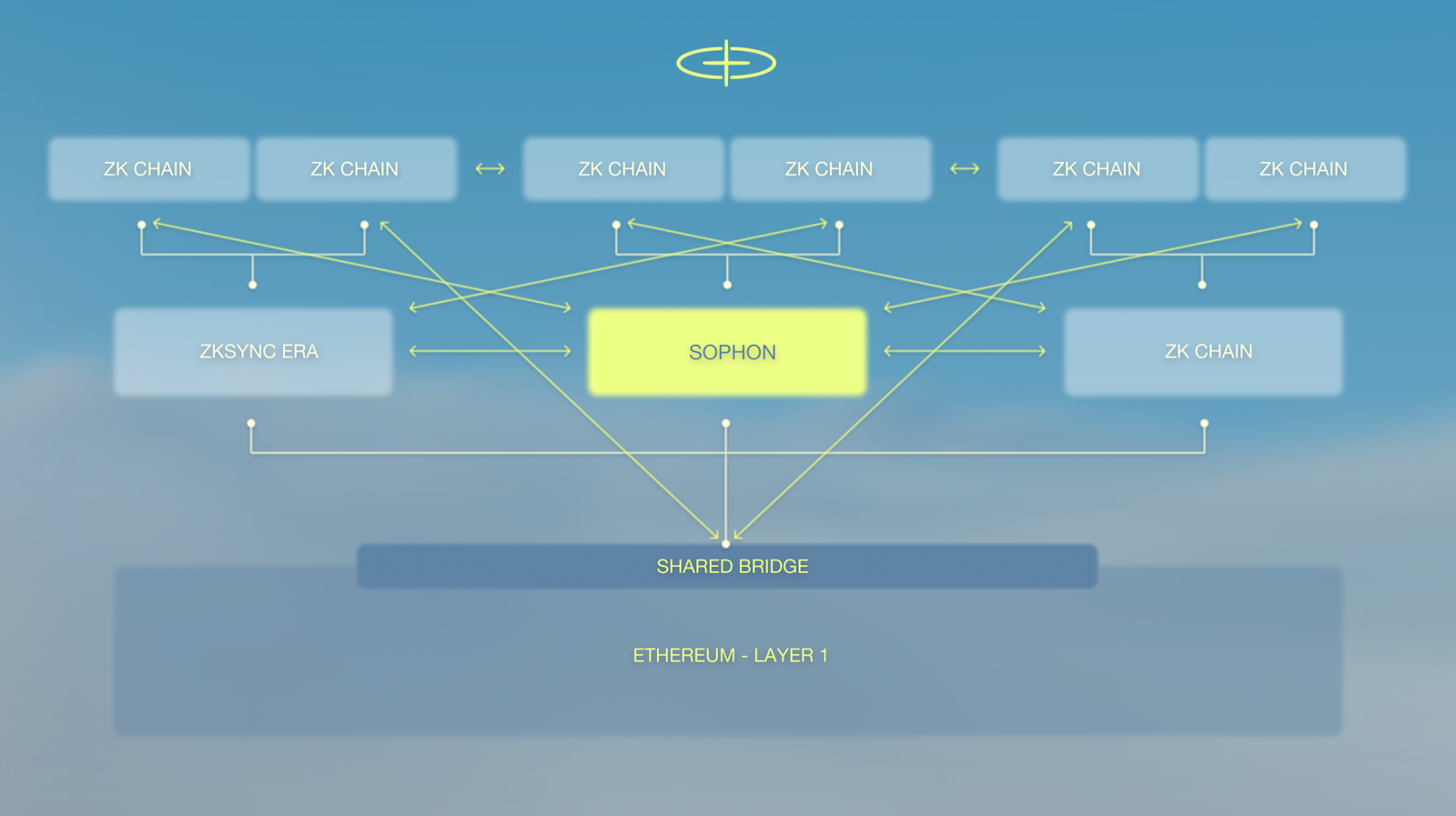
By using the ZK Stack in this setup, Sophon becomes part of the larger blockchain ecosystem of the ZK Elastic Chain, promising interoperability and shared liquidity between ZK-powered blockchains in the future.
This integration into the ZK Elastic Chain means the Sophon ecosystem won’t remain isolated. As more ZK Stack–based chains launch, they’ll be able to interoperate, share liquidity and tap into each other’s user bases and applications. That opens the door for seamless cross-chain experiences — such as messaging, gaming and asset transfers — without clunky bridges or siloed ecosystems.
Source: docs.sophon.xyz
What is Sophon OS?
Sophon OS is the broader operating system powering the entire Sophon ecosystem. At its core is the Sophon blockchain — a ZK Layer 2 built on the ZK Stack — but Sophon OS extends far beyond the chain itself. It combines infrastructure, identity, social data and rewards into a unified platform designed to help developers launch web3 consumer apps that feel like traditional web apps without sacrificing decentralization or ownership.
Sophon OS is modular and built to evolve. Alongside the Sophon blockchain, it includes several key components — Sophon Home, Sophon Account, Sophon+ and the Social Oracle. Each one plays a distinct role in shaping users’ interaction with apps, as well as the way developers build on-chain experiences that are smoother, more engaging and easier to onboard into.
Sophon Home
Sophon Home is the user's central hub within the ecosystem. It's a personalized dashboard aggregating everything happening across Sophon-powered apps and games. Users can track activity, achievements and rewards all in one place.
Over time, Sophon Home becomes more tailored to the individual — surfacing relevant apps, updates and opportunities based on the user's unique history and preferences. It also serves as the primary interface for claiming rewards and managing one's identity and reputation across the network.
Sophon Account
Sophon Account is the core identity system of Sophon OS. It simplifies web3 onboarding by abstracting away wallet complexity. Users can sign in using familiar methods like Google, Telegram or Discord. Behind the scenes, the system generates a self-custodial wallet using account abstraction.
Users can interact with apps directly without browser extensions or wallet installations. Sophon Account also supports Guardian recovery options and modular security features. Developers can integrate this system into their apps to lower friction and retain full on-chain user security.
Sophon+
Sophon+ is the OS rewards layer. Instead of locking users into individual loyalty programs, it tracks engagement across the entire ecosystem. Completing missions in different apps earns users Plus Points. These Sophon points can be redeemed in the Sophon+ Store for digital and physical rewards.
Season 1 of Sophon+ runs until Sep 30, 2025. Points expire at the end of each season, pushing users to stay active and claim rewards in time. Staking SOPH or using a Sophon Account boosts point earnings, creating a direct incentive to stay within the Sophon ecosystem.
Sophon’s Social Oracle
The Social Oracle is Sophon’s on-chain engine for tracking user activity and behavior, while also protecting their privacy via ZK technology. It indexes social data — such as in-game actions, app usage and interaction history — and turns it into a composable reputation layer.
This lets apps build dynamic experiences based on user performance or credibility. For example, a game could restrict advanced features to users with high on-chain reputations, or a DeFi app could offer lower fees to consistently active wallets. The Social Oracle is the data infrastructure that ties identity and engagement together, powering personalization, confidentiality and trust across the OS.
What is the Sophon crypto token (SOPH)?
SOPH is the native token powering the Sophon blockchain and broader Sophon OS. It’s used for gas payments, staking, governance and ecosystem rewards. All transactions on the Sophon network require SOPH for gas, making it essential for both users and developers.
The SOPH token also plays a key role in maintaining the Sophon network. Validators and Light Node operators earn SOPH for their services, while SOPH staking is expected to support protocol security and future governance. Long-term holders may receive additional benefits through systems like Sophon+ or the Guardian Program.
SOPH was launched in late May 2025. Before the network's mainnet launch in December 2024, the project conducted an airdrop campaign, Sophon Farm Phase 1, with rewards distributed to early supporters who participated in Sophon missions, node operations and ecosystem activities. This approach was designed to build an active, committed community from day one. The rewards from the airdrop were unlocked on the SOPH's token generation event (TGE) in May.
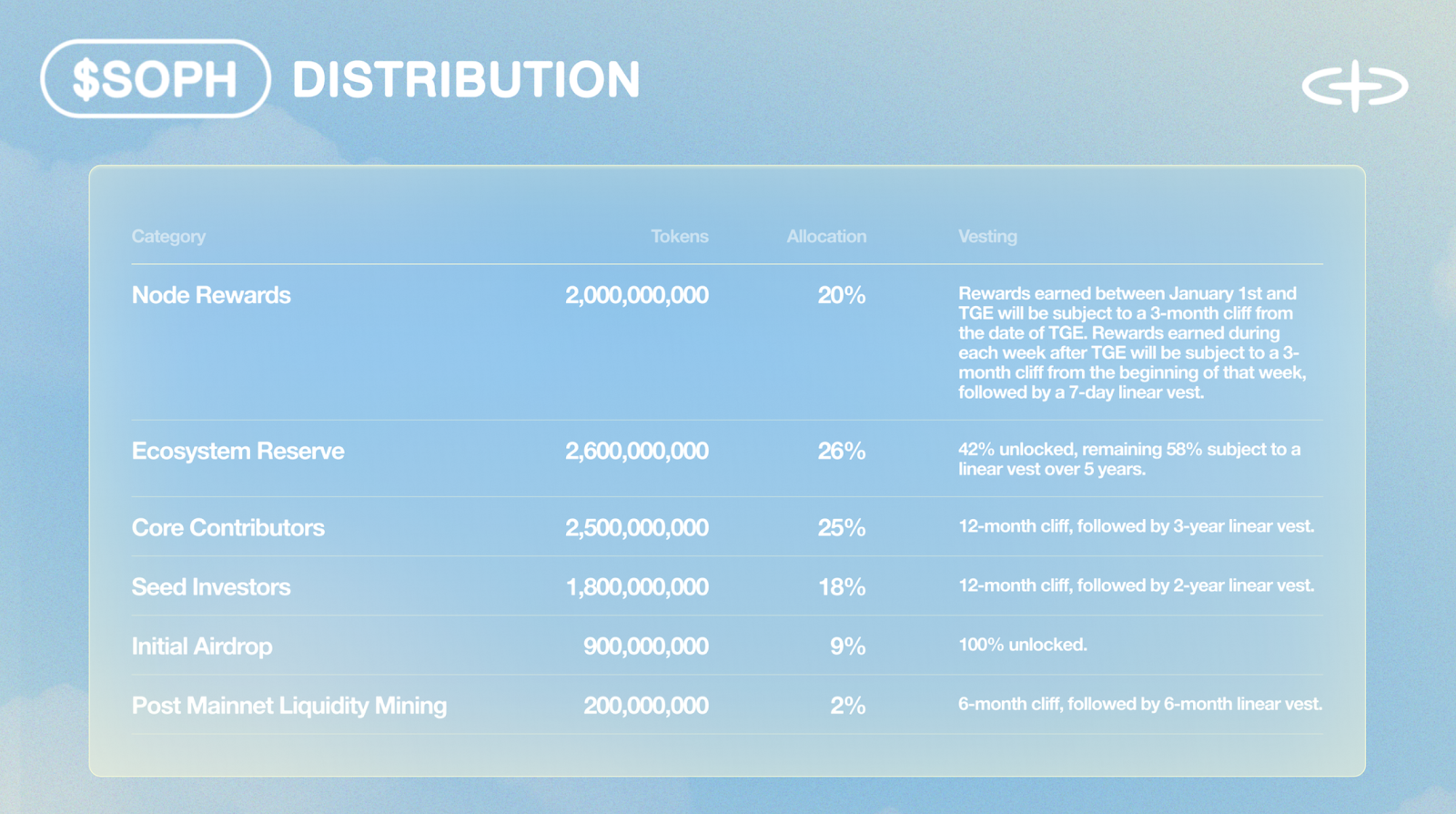
SOPH has a fixed total and max supply of 10 billion tokens. Supply allocation shares and vesting periods are per the chart below.
Source: docs.sophon.xyz
Most categories follow long-term vesting schedules to reduce short-term sell pressure and encourage sustainable growth.
In short, SOPH is more than a gas token — it’s the incentive and coordination layer behind Sophon’s ecosystem of consumer-focused apps, social infrastructure and modular blockchain services.
Where to buy the Sophon crypto token (SOPH)
The SOPH token is available on Bybit as a USDT-based Perpetual contract, which you can trade with up to 50x leverage via Bybit Futures bots, such as Futures Grid, Futures Martingale and Futures Combo.
Sophon crypto (SOPH) price prediction
As of Jun 24, 2025, the Sophon token has been on the market for less than a month. It’s currently trading at $0.0356, a 67.9% drop from its all-time high of $0.1108 on May 28, 2025, and a 12.4% increase from its all-time low of $0.03163 on Jun 22, 2025.
SOPH's long-term price outlook is bullish. CoinCodex expects the token to trade at $0.045 in 2027 and $0.09 in 2030, while DigitalCoinPrice is forecasting even higher average prices of $0.13 in 2027 and $0.19 in 2030.
Despite these relatively optimistic forecasts, it’s worth considering the token's limited history on the market. As SOPH develops a more sustained price history, these estimates may change. And as always, before investing in the crypto asset, you’re encouraged to do your own comprehensive research on SOPH and its future market prospects.
Closing thoughts
Sophon is among the pioneers using blockchain technology to open up the world of consumer crypto to mainstream users. Most projects in the blockchain space have focused on crypto-native audiences, limiting the technology's adoption to Web 2.0 users.
The project’s team has found an eloquent way to bring crypto-powered consumer experiences to anyone with an internet connection and an interest in gaming, entertainment or social media. Moreover, the entire blockchain infrastructure used by Sophon boasts excellent scalability, low costs and Ethereum's famed security — all of the necessary ingredients to power high-throughput consumer applications on-chain.
#LearnWithBybit