


SOON (SOON): The key to Solana’s cross-chain expansion

Ethereum (ETH) 's processing engine, the Ethereum virtual machine (EVM), has been at the forefront of enabling smart contract functionality on blockchains. However, the EVM has several limitations, making it less efficient for many use cases. Specifically, EVM handles all transactions via a single-threaded model, leading to performance bottlenecks. Additionally, it has an inefficient gas fee determination system, based on a global model, whereby high-impact transactions drive the overall fees on the network for everything, including decentralized apps (DApps) that feature a low transactional footprint.
Solana (SOL)'s native execution engine, the Solana Virtual Machine (SVM), solves these problems by enabling parallelized processing and local fee markets, so each transaction pays gas fees commensurate with its processing load on the network. Unfortunately, the standard SVM on Solana features little interoperability with Ethereum and other Layer 1 environments.
SOON (SOON) is a decentralized platform that leverages a fork of SVM to enable efficient Layer 2 (L2) chains on various Layer 1 (L1) networks, including Ethereum. The SOON project has developed an ecosystem of tools under the SOON Adoption Stack (SAS) banner to help developers integrate its variation of SVM into various L1 networks.
In this article, we’ll examine this novel web3 project that aims to "bring Solana everywhere."
Key Takeaways:
SOON (SOON) is a collection of decentralized technologies designed to enable SVM-based L2 rollups on virtually any L1 network, including Ethereum and Bitcoin (BTC).
The SOON platform consists of three main components — the SOON Mainnet rollup, which utilizes SVM and settles on Ethereum; the SOON Stack rollup development framework; and the InterSOON cross-chain communications protocol.
The platform's native token, SOON, is used for gas fee payments, governance and staking, and for rewards to ecosystem builders.
What is SOON?
SOON (SOON) is a decentralized platform that uses Solana's SVM technology to power Layer 2 (L2) chains that settle on Ethereum and other Layer 1 (L1) networks. SOON represents a stack of technologies — united under the Super Adoption Stack (SAS) framework — designed to bring SVM's benefits to as many L1 networks in the industry as possible. The SAS framework consists of the SOON Mainnet L2 network; the SOON Stack, which provides tools to deploy SVM-based L2 chains on popular L1 platforms; and the InterSOON cross-chain messaging protocol.
All of these technologies serve the general mission of enabling SVM-powered, efficient L2 networks on various L1 blockchains.
The key benefits SOON offers revolve around SVM's technical superiorities over EVM and other popular virtual engines used in the blockchain industry. Because of SVM, the Solana blockchain is well-known for its industry-leading throughput capacity and scalability, achieved thanks to multiple technological innovations, the most impactful of which is SVM's parallelized processing capacity. Unlike EVM, which handles all transaction processing via a single thread, SVM processes transactions by using many parallel threads, which significantly boosts performance and throughput.
Additionally, SVM enables local fee markets that regulate gas fees based on the resources consumed by individual transactions. Transactions that utilize more network resources incur higher gas fees, ensuring fair pricing and helping to reducing congestion. Although complex transactions also incur higher fees in EVM, its global fee model forces all transactions to compete for block space in a single auction — often leading to inflated costs, even for simple operations. SOON's technology now expands these technological and cost benefits to other L1 environments.
SOON’s innovations
SOON has taken the technical efficiencies of SVM to an entirely new level by introducing its decoupled SVM model, which separates the execution and settlement layers of the processing engine. The decoupling lets SOON-built L2 networks settle on L1 chains securely and efficiently, providing the perfect mix of SVM-powered performance and the security of chains such as Ethereum. As of the end of May 2025, SOON has implemented its decoupled SVM technology to allow settlement on two very popular L1 blockchains — Ethereum and BNB Chain (BNB) — as well as the Ethereum-linked Base Layer 2.
The SOON project was founded by Joanna Zeng in mid-2024, and introduced its Alpha Mainnet in January 2025. In late May 2025, the project debuted SOON, its native crypto token.
How does SOON work?
The SOON ecosystem is designed to provide a set of tools to easily launch L2 rollups on top of any L1 network. Rollup networks greatly improve transaction capacity, scalability and costs on blockchains. The Solana L1 chain has a lesser need for such solutions, thanks to SVM's technical properties, which ensure high throughput and low costs.
On the other hand, because of their less efficient processing engines, networks like Ethereum and Bitcoin greatly benefit from using L2 chains. SOON's decoupled SVM model separates transaction execution and settlement layers. While SOON's SVM handles the execution layer, the final settlement of transactions is done on the host L1 chain. This brings the benefits of SVM to any L1 network.
SOON’s rollup technology
The SOON Stack allows developers to launch rollups that utilize zero-knowledge (ZK) fraud proofs, which combine the properties of ZK and optimistic verification. This is a significant improvement over the typical fraud proofs utilized by optimistic rollups. In a typical optimistic rollup, fraud proofs are attached to blocks submitted to Layer 1. There's usually a time window (e.g., seven days), during which validators on L1 can challenge a fraud proof. If the challenge window is over, and no validator has raised objections, the transactions are finalized on L1. The typical seven-day window makes the complete finalization of transactions processed by optimistic rollups a slow process.
In contrast, SOON's fraud proofs are enhanced with ZK validation, reducing the total processing window from a week to about a day.
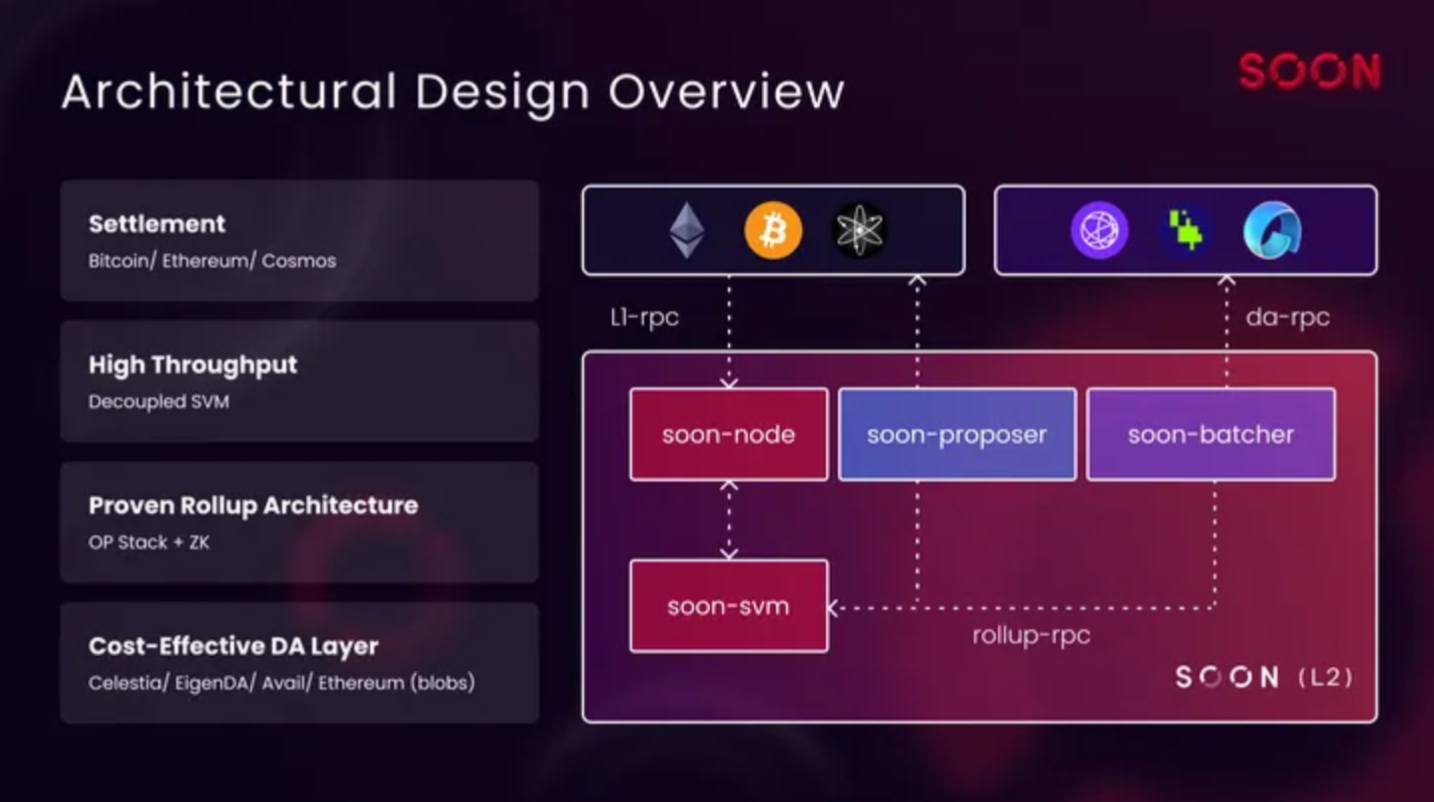
Additionally, any rollup launched using the SOON framework can be designed in a fully modular fashion, with separate layers handled by different platforms. We’ve noted above that SOON rollups use the SVM as their execution layer, and an L1 network as the settlement layer. The third key component in any blockchain network, the data availability (DA) layer, is also externally handled using specialized data availability solutions such as EigenDA, Avail (AVAIL) and Celestia (TIA).
Source: medium.com
SOON’s key features
Decoupled SVM
The decoupled SVM is a key feature that lets SOON-based rollups enjoy fast transaction finalization on L1, high throughput and excellent scalability. To achieve complete decoupling of key functions performed by the SVM, SOON separates the block derivation procedure from execution. The basic design of SOON rollups is optimistic. In an optimistic rollup, the sequencer — the critical node that batches and organizes transaction blocks — requires data from L1 to construct blocks on the rollup/L2.
This derivation of data from L1 is what the SOON project calls the "derivation layer." In a standard optimistic rollup, derivation and execution are handled in a unified, monolithic fashion. In a SOON-based rollup, however, the derivation layer based on Optimism is decoupled from the SVM execution layer. This modular split has numerous benefits, including high performance, tighter security, greater flexibility and more efficient utilization of resources.
Merkleization solution
Merkleization is the process of organizing blockchain data into Merkle trees for secure verification. It's a critical part of blockchain data architecture. Solana's native Merkleization process has several limitations, including excessive complexity and slow proof generation.
The standard Solana Merkleization splits transaction proofs into many separate parts, and only updates the state snapshot every few days.
SOON has improved the Merkleization process by making state proof updates occur more frequently, and with more complete state information included directly inside the blocks. This allows validators to quickly and reliably verify the accuracy of the rollup's state at any point. It also results in more efficient state management and enhanced performance.
Horizontal scaling
Horizontal scaling involves improving the capacity of a blockchain network by adding more machines/nodes. It's the direct opposite of the vertical scaling approach, whereby the network’s capacity is beefed up by making each existing node more powerful. Traditional blockchains rely mostly on vertical scaling to support their operations.
In contrast, SOON adopts horizontal scaling to support scalable growth, improved decentralization and flexible integration of additional network nodes. This model enables efficient load distribution across nodes, reduces single points of failure and allows the network to utilize more cost-effective standard hardware. As a result, SOON’s scaling effectively offers near-unlimited growth potential.
SOON core products
SOON Mainnet
The SOON Mainnet is the first rollup developed by the project's core team using the SOON Stack. It functions as a general-purpose L2 network that settles on Ethereum. Developed by the SOON team, the SOON Mainnet is a significant showcase of the framework's capabilities. It combines Ethereum's security with the decoupled SVM's technical efficiencies.
Besides being an efficient Layer 2 for Ethereum, the SOON Mainnet is pivotal in bringing together the developer communities of Solana and Ethereum, two of the leading blockchain ecosystems. By involving Ethereum's vast developer community, SOON also aims to achieve the mass adoption of SVM technology in the blockchain world.
Launched in January 2025, the SOON Mainnet has grown to over 280,000 unique addresses by the end of May 2025. In addition to its SVM-powered speed and scalability benefits, the network boasts very low transaction fees, typically measured in tiny fractions of a cent.
SOON Stack
The SOON Stack is a comprehensive toolset for developers to easily build and deploy SVM-powered L2 rollups for any L1 network. While the SOON Mainnet is the most notable chain developed using the stack, two more rollups have been launched using the framework since late May 2025.
One of these is svmBNB, which uses the decoupled SVM as its execution engine and BNB Chain as its settlement layer. The other one is soonBase, which settles on Base, one of Ethereum's most popular L2 networks.
InterSOON
InterSOON is a cross-chain messaging protocol designed to facilitate easy communication and asset transfers between SOON Chains, which are rollups developed with the SOON Stack. At the underlying level, the protocol's cross-chain capabilities are powered by Hyperlane (HYPER), one of the major players among cross-chain protocols.
Networks that integrate InterSOON for cross-chain operations can communicate via a standardized messaging system that eliminates the need for custom bridges and token-wrapping procedures. When assets are transferred between InterSOON-powered networks, they stay in their original, native form. This helps avoid the liquidity fragmentation problem caused by bridging solutions that convert transferred assets into wrapped formats during cross-chain transactions.
Simpfor.fun V2
Simpfor.fun V2 is a decentralized finance (DeFi) app on the SOON network that’s designed explicitly for copy trading. DeFi enthusiasts at all experience levels can enjoy a specialized set of tools to support their copy trading strategies. Simpfor.fun V2 offers one-click copy trading on the Hyperliquid crypto perpetuals exchange, comprehensive data analytics tools and personalized analytics on traders to help you choose your preferred master trader. The platform also plans to introduce tokenized gold trading in the future.
What is the SOON crypto token?
SOON is the platform's governance and core utility token. It acts as the native asset for the SOON Mainnet and other SOON chains. The SOON token is used for paying transaction fees on these networks, and is also used for governance. Token holders have the right to vote on critical issues related to the SOON ecosystem, including protocol upgrades, ecosystem fund distributions and other key matters.
SOON is also used for rewards to developers working on the ecosystem's growth. Additionally, the platform will introduce a SOON staking mechanism to boost the performance and security of network operations.
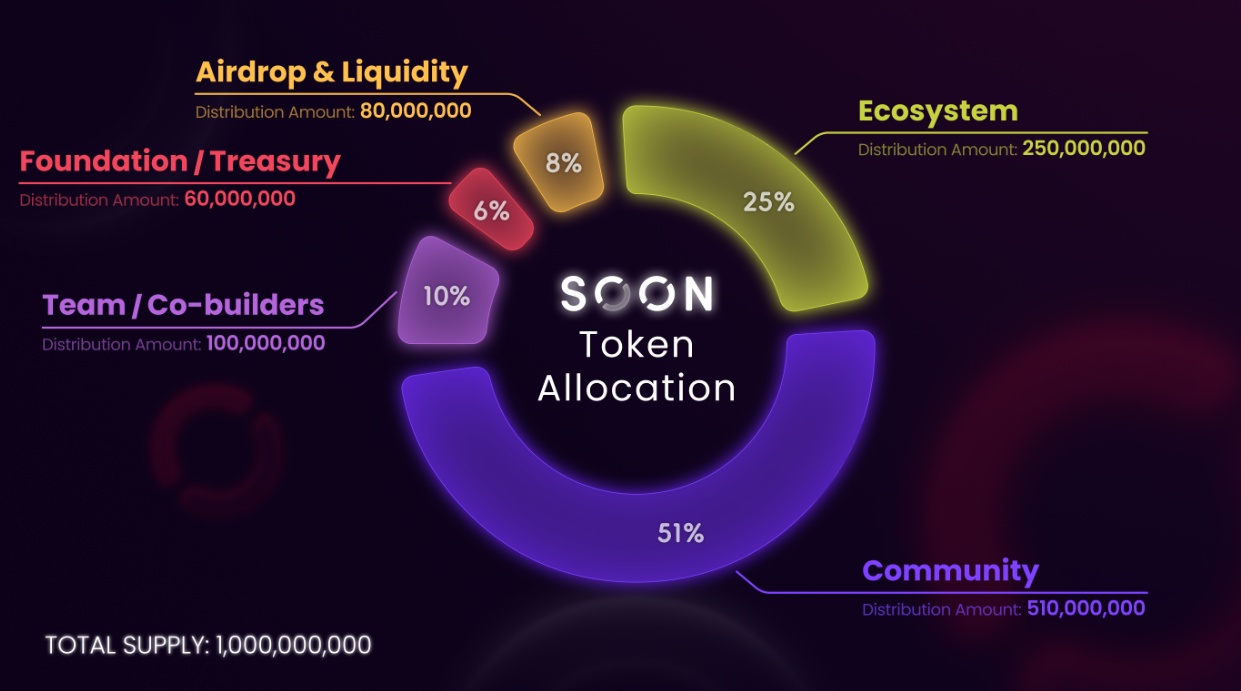
SOON was launched in late May 2025, with an initial total supply of 1 billion. The token has no maximum supply limitation. Its supply allocation shares are shown in the image below.
Source: docs.soon.network
Eight percent of the supply is allocated to airdrops and liquidity incentives. Now that the May 2025 launch of the SOON token has taken place, the project plans to allocate 1.5% of the total supply to incentives for Simpfor.fun V2 referrers. Specifically, streamers who use a Simpfor.fun link to attract traders to the platform through their video streams will be eligible for airdrop allocations.
Where to buy SOON
The SOON token is available on Bybit as a USDT-based Perpetual contract that allows you to trade the token with up to 50x leverage.
SOON crypto price prediction
As of Jun 16, 2025, the SOON token is trading at $0.2079, a 64.5% drop from its all-time high (ATH) of $0.5857 on May 23, 2025, and an 12.5% increase from its all-time low (ATL) of $0.1851 on Jun 14, 2025.
SOON’s long-term price outlook is quite bullish.DigitalCoinPrice expects the token to trade at $0.73 in 2027 and $1.09 in 2030, whileCoinCodex is forecasting average prices of $0.267 in 2027 and $0.548 in 2030.
Closing thoughts
The SVM ecosystem is now supported by a new player — one that might help Solana's processing engine reach virtually any Layer 1 environment. The SOON Mainnet has already built a bridge for SVM to the vast world of Ethereum. Meanwhile, the svmBNB and soonBase ready-to-use platforms help developers accustomed to BNB Chain and Base utilize SVM (or more specifically, an innovative version of SVM in the form of SOON's decoupled SVM).
The SOON platform is still a new undertaking: the SOON Mainnet was launched only in January 2025, while the SOON token celebrated its market debut in late May. However, despite the project's novelty, the host of innovations that it’s introduced is already impressive.
Although many still view Solana's native SVM as the industry's top performer, wait until they find out about SOON's decoupled SVM, an innovation that brings Solana-like speeds and costs to virtually any Layer 1 blockchain.
#LearnWithBybit