


ao Computer (AO): The hyper parallel future of computing

Arweave (AR) is among the crypto industry's oldest and most prominent distributed storage projects. Offering a unique decentralized storage model called the blockweave, the project has been at the forefront of driving the crypto revolution over the past seven years. In early 2025, the Arweave project launched the mainnet of its decentralized computing system — ao Computer (AO). This signified the beginning of a new era for the veteran of web3 storage. With the launch of ao Computer, the project adds highly scalable computational capacity to its well-regarded storage platform.
ao Computer features a hyper parallel processing function that allows it to handle numerous client requests while independent execution paths are running simultaneously. This creates opportunities for scalability at unprecedented levels. Using a unique system based on messages that go through processing by three key process units, ao Computer features an architectural design that’s no longer restricted by throughput capacity. In addition, messages are stored permanently and immutably on Arweave's famed storage platform. In essence, ao Computer has turned Arweave from a massive decentralized hard drive into a full-fledged processing environment.
In this article, we'll examine this innovative project that has the potential to redefine the way businesses and individuals use Arweave.
Key Takeaways:
ao Computer (AO) is a decentralized, hyper parallel and trustless computing platform that leverages Arweave for storage.
The platform's native token, AO, is used for staking, payments for the use of on-platform computations and rewards to ecosystem developers.
AO can be bought on Bybit a USDT Spot pair.
What is ao Computer?
ao Computer (AO) is a decentralized, trustless computing system based on the Arweave distributed storage platform that uses hyper parallel processing to achieve unprecedented scalability. The system processes all execution requests and data using standardized messages that interact with processes on the platform, creating an interconnected environment. The most critical innovation that ao Computer offers is hyper parallel processing, whereby all processes and interactions are handled independently and concurrently. Many software developers would call this mode of processing multi-threaded.
Using trust-minimized, decentralized parallel processing, ao Computer creates a computing environment in which scalability and capacity are no longer restrained. The messages that the protocol handles are stored on Arweave, which essentially acts as an immutable hard drive for the ao Computer’s processing engine.
Arweave itself is well-known in the blockchain industry for its unique and highly efficient distributed storage solution. All the data on Arweave is immutably stored in a decentralized fashion, with the network nodes incentivized to provide permanent storage. Unlike standard blockchains, in which each block is linked to the previous one, Arweave uses a linkage model called Blockweave, which links each block to the previous one as well as to a random recall block to enable Proof of Access (PoA) — a consensus mechanism that requires miners to prove they can access old data. In this way, the blockweave model makes decentralized data storage more affordable, scalable and secure.
ao Computer: A game-changer
Before the introduction of ao Computer, Arweave had been used mostly for passive storage, albeit cheap, permanent and highly secure. The arrival of ao Computer adds significant computational capacity to Arweave, potentially turning it into a hotspot for decentralized apps (DApps), artificial intelligence (AI) agents and dynamic storage solutions.
While Arweave is the overall platform’s hard drive, ao Computer is its operating system. By integrating ao Computer, Arweave essentially becomes a full-stack decentralized computing environment, in certain ways similar to a platform like the Internet Computer Protocol (ICP).
In fact, its interconnected web of processes and messages makes ao Computer a unified hyper-parallel computer capable of handling a huge number of client requests simultaneously.
While Arweave, launched back in 2018, is among the oldest decentralized networks in the crypto space, ao Computer is a recent innovation: the unified computing environment’s mainnet debuted in February 2025. Both Arweave and ao Computer were founded by technology entrepreneur Sam Williams.
ao Computer’s architecture
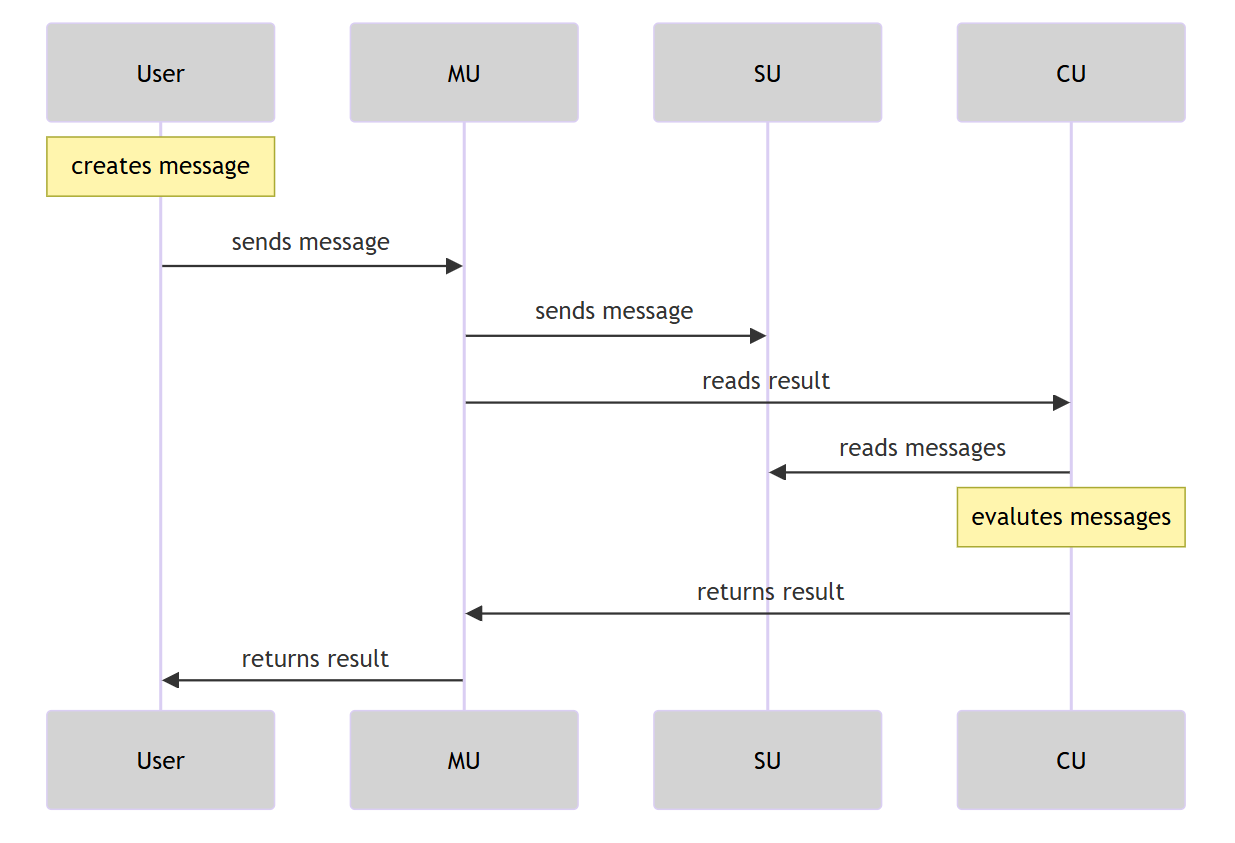
ao Computer’s overall architecture involves three main data processing units — the Messenger Unit (MU), Scheduler Unit (SU) and Compute Unit (CU) — working together to process user messages and return finalized results. The user (this could be an application, service or even an AI agent initiating some computing request) sends a message that’s passed to the MU, which then processes and forwards it to the SU. Then, the SU stores the messages on Arweave and schedules them for processing by the CU, which runs computations and provides the final output messages back to the MU. Finally, the MU delivers the output messages back to the user. The image below shows the overall architectural setup of this process.
Source: Cookbook_ao.arweave.net
Processes
Processes are ao Computer network modules that are responsible for processing messages of all kinds on the platform, including relevant messages from users and system-generated messages, with final results delivered back to the user. The key role of processes is to accept an input message and return a finalized result. ao processes maintain independence from each other, which enables them to execute tasks in a hyper-parallelized mode, offering ao extremely scalable computing power to its user community.
Messages
Messages are the primary data units on the ao Computer platform. They’re used by processes to execute user requests, pass data between processes and return results to users. Messages connect processes into a unified web, similar to the way in which hyperlinks on the internet connect websites.
Reproducible message logs stored on Arweave allow ao's node network participants to verify all transaction activity in a trustless way.
ao supports messages based on Arweave's ANS-104 data item format. Message processing based on the standardized format ensures that the messages are interoperable and can leverage existing smart contract systems on Arweave.
Messenger Units
MUs are the platform units responsible for accepting, routing and delivering messages. Processes create messages that are passed between different unit layers by MUs. In essence, MUs represent ao Computer's message-routing layer.
Scheduler Units
SUs ensure that messages are properly ordered and organized for further processing by appropriate computing units. While MUs are the platform's message-passing layer, SUs represent the message-ordering layer. SUs also store the messages and interaction logs on the Arweave network.
Compute Units
CUs are responsible for the actual computations needed to execute corresponding dynamic operations requested by messages. They provide the results of computations back to the MUs for final delivery to the client. The network's computing process status depends upon the work done by the CUs.
ao Computer key features
Parallel processing
Parallel processing, a key feature of ao, offers extreme scalability. Processes involved in handling user requests are all executed in an independent, parallel way, creating a “hyper parallelized” system with scalability features akin to sophisticated Web 2.0 traditional computing environments.
The parallel processing capacity of ao is starkly different from the typical single-threaded format of transaction execution used by Ethereum (ETH) and most other blockchains.
Modular architecture
ao Computer is based on a modular design in which each unit handles separate functions. Additionally, it features a high degree of composability, so that a different self-contained process may represent each function of the user app. For instance, a login module for a gaming app can be handled by one ao process, while another process may be responsible for in-game purchases. These processes can be customized or replaced, based on client requirements, making the entire process stack fully composable.
To further improve the platform's modularity and customizability, ao has introduced the AO-Core protocol, which supports running ao processes via the standard and well-familiar HTTP messaging protocol. AO-Core also allows these processes to securely prove and verify each step of their state changes within HTTP messages.
AO-Core’s operating system, HyperBEAM, allows nodes to choose the devices they would like to run. Each device is essentially a modular blockchain service. As such, HyperBEAM and its underlying AO-Core protocol further boost the platform's modularity by allowing different nodes to flexibly offer separate services.
Trustless intelligence
ao Computer integrates AI algorithms, including large language models (LLMs), that can execute their functions and output results based on decentralized, trustless computations. For instance, when a user app runs its predictive AI model by inputting some crypto price data and receives the corresponding financial value forecasts, the app's operator can be certain that all the data has been processed trustlessly by the ao network, ensuring privacy and security, preventing data breaches and ensuring the absence of interference from a centralized party.
How to get started with ao Computer
For developers
To start using ao Computer as a developer, you'll need to install aos, the operating system built on top of the protocol. Once aos is installed, you can run it by typing aos.
You can also install ao connect, a JavaScript/TypeScript library that lets you interact with ao from Node.js® or a browser.
Game developers should also consider two valuable tools integrated with the platform specifically for gaming apps — the Reality Protocol, which lets you create spatial worlds on ao, and the loomSDK, designed to let WebGL-based Unity applications interact with the Arweave chain through ao connect.
For users
Non-technical blockchain users can explore ao Computer's growing collection of DApps from different niches, including decentralized finance (DeFi) and gaming. Examples of DeFi apps include a unified liquidity solution, Astro, and Permaswap, its decentralized exchange (DEX). One example of an AI-powered game is AO-Effect.
What is the AO crypto token?
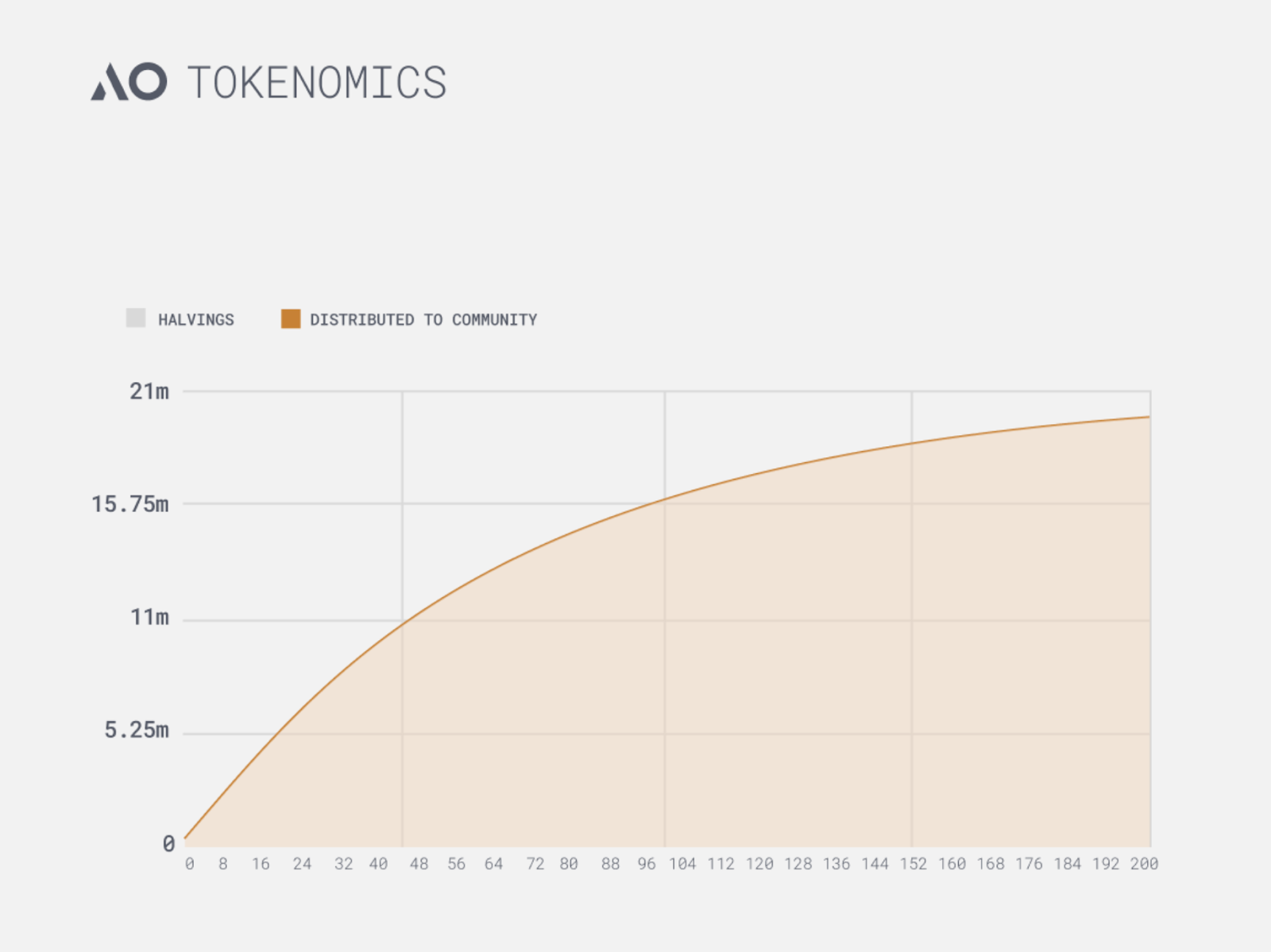
ao Computer's native token, AO, was launched in early 2024 through a 100% fair launch mechanism. AO's tokenomics features mirror some of Bitcoin's (BTC): maximum supply limitation of 21 million tokens, gradual release through a regular minting mechanism and emission halving every four years. Its fair launch mechanism allocates all 21 million AO tokens to the community contributing to ao Computer: 36% to Arweave (AR) token holders and 64% to users who bridge assets from other networks to AO.
Although AO's tokenomics has a quadrennial halving rule, emission halving doesn't occur all at once, as with Bitcoin. Instead, there's a gradual curve over which token releases decline smoothly.
The AO token has several functions on the platform, including:
Staking: To provide computational services on the network, nodes must stake AO.
Payments for the use of on-platform services: Users pay in AO tokens to run their computations and leverage AO's processing capacity.
Rewards to developers/ecosystem growth funding. AO allocations are used to incentivize developers and projects that contribute to the growth of the ao Computer ecosystem.
Source: mirror.xyz
As of Jun 11, 2025, AO’s total supply (that is, all the tokens minted so far) stands at 4,183,207. According to the token’s release schedule, the entire supply of 21 million will be distributed by around August 2037.
Where to buy the AO crypto token
You can buy the AO token on Bybit as a Spot pair with USDT (AO/USDT).
ao Computer (AO) price prediction
As of Jun 12, 2025, the AO token was trading at $17.88, a 64.5% drop from its all-time high of $50.01 on Apr 7, 2025, and a 63.6% increase from its all-time low of $10.84 on Apr 16, 2025.
AO’s long-term price outlook is quite bullish. CoinCodex expects the token to trade at a high of $34.49 in 2027 and $75.74 in 2030, while CoinDataFlow is more conservative, forecasting a maximum price of $12.74 in 2027 and $30.97 in 2030.
Closing thoughts
The ao Computer platform is among the most innovative decentralized physical infrastructure network (DePIN) projects introduced in recent years. With its extremely scalable hyper parallel processing capacity and Arweave-based storage, ao Computer can challenge many centralized providers and competing web3 projects in this area. Because its modular design supports functional composability, the platform becomes a natural choice for DApps, blockchain services and AI agents that need to be flexible, adjustable and responsive to the constantly changing nature of the blockchain industry.
#LearnWithBybit