


What is VeChain (VET): Building a sustainable future for all

Sustainability is now the name of the game across many industries. The blockchain industry is one of them, with several projects aiming to reduce the energy impact of their operations or support green causes in other ways. However, on closer inspection, sustainability has received much less attention in the world of blockchain technology than many people may assume. Indeed, the industry's two leading data portals, CoinGecko and CoinMarketCap, have no "Sustainability" or similar category, despite coming up with hundreds of other classifications.
Some smaller-cap projects outside of the top 100, such as Powerledger (POWR) and IOTA (IOTA), do focus on supporting environmental causes. But in the entire list of top 100 cryptocurrencies by market cap, only one project can confidently be described as having sustainability as its key pillar — VeChain (VET).
With a market cap of $2 billion (as of the time of writing on Apr 22, 2025), VeChain stands head and shoulders above any other crypto project in the sustainability niche. The project has been fully operational since 2018, and is among the oldest environmentally focused blockchain initiatives. In short, if we talk about sustainability and blockchain, it would be disingenuous not to mention VeChain and its Layer 1 network, VeChainThor (VTHO).
Having championed green blockchain causes since 2018, VeChain announced a significant upgrade initiative in late 2024 to be rolled out in stages during 2025. Called Renaissance, it’s envisioned to further solidify VeChain's position as the leader of eco-friendly blockchain use and introduce a host of technical improvements. In fact, 2025 is the year of the most fundamental upgrade to this notable industry player in its entire history on the market, so it's precisely the time to revisit this project in our coverage.
Key Takeaways:
VeChain (VET) is a blockchain platform that’s dedicated to supporting sustainable use cases across different industry sectors.
Technology entrepreneur and CEO Sunny Lu co-founded VeChain in 2015, with the project's Layer 1 network, VeChainThor (VTHO), launched in 2018.
VeChain uses two native tokens: the VET token is utilized for value storage and transfer, governance and access to features and products, while the VTHO token is designed for gas fee payments.

What is VeChain?
VeChain (VET) is a decentralized project designed to support sustainability-focused blockchain use cases across various industry verticals. The company was first conceptualized and founded as a blockchain project in 2015 by Chinese technology professional Sunny Lu. It launched its Layer 1 network, VeChainThor (VTHO), in mid-2018, becoming one of the first decentralized initiatives to support eco-friendly applications on-chain. The VeChainThor network features low transaction fees and high levels of scalability.
For years, the VeChain blockchain has remained probably the leading decentralized platform in the niche of sustainability. As of April 2025, it retains the leadership position, and is ranked 56th among all cryptocurrencies, with a market cap of $2 billion.
VeChain's sustainable blockchain technology
Many blockchains claiming to support environmental causes typically use the proof of stake (PoS) consensus algorithm, which is indeed much more energy-efficient than the power-hungry proof of work (PoW) validation used by Bitcoin (BTC). By using PoS, these blockchains have boldly announced that their energy use is much lower than Bitcoin's. While this is true, these platforms are essentially general-purpose networks that don't specifically design their operations with any particular sustainability use case in mind.
Instead of these two typical consensus mechanisms, the VeChainThor blockchain uses proof of authority (PoA), touted to be even more energy-efficient than the standard PoS employed by Ethereum (ETH), Solana (SOL), Cardano (ADA) and many other leading smart contract chains. In a typical PoA consensus, a smaller number of validators with "authority" — i.e., a history of reliable behavior on the network — are entrusted to process blocks. This is in contrast to PoS, whereby many validators take part in the staking contest to outperform each other in terms of token holdings. They then receive the right to validate the next block, and have to constantly align their consensus process with other nodes.
As a result, PoS is usually less energy-efficient than PoA. VeChain's PoA model elegantly combines efficient processing, minimal energy use and high levels of enterprise-grade security.
The VeChainThor blockchain network's processing engine also features compatibility with the Ethereum virtual machine (EVM), making cross-chain communication with the Ethereum world much easier for VeChain developers and decentralized apps (DApps).
VeChain's sustainable focus
PoA block validation isn’t the only sustainability-minded feature of VeChain. Unlike many other popular chains, VeChain also directly enables sustainability use cases, primarily by utilizing its tamperproof and transparent data-tracking mechanism. Thus, enterprises across different industries can track and reliably verify the origin of goods and their sustainability status for eco-friendly supply chain management. For instance, supermarket chains can use the platform to track and verify the carbon footprint of the produce they source; logistics companies can calculate the overall emissions generated along their supply chains; and fashion brands can track sustainable sourcing of materials used for their product lines.
Besides its own blockchain, the project also offers a blockchain-as-a-service (BaaS) platform, VeChain ToolChain, to help businesses integrate VeChain's technology into their business processes via standardized smart contract services.
To further position itself as a champion of sustainability, VeChain launched VeBetterDAO (B3TR) in 2024. This DAO represents an on-chain ecosystem of DApps that reward VeChain users for completing various eco-friendly tasks, such as using reusable coffee cups, shopping for organic products, picking litter off streets and more. VeBetterDAO is the project’s foray into the individual consumer side of environmentalism, which complements the VeChain platform’s long-standing sustainability features for the enterprise world.
VeChain Renaissance upgrade
In late 2024, VeChain first announced its planned multi-stage upgrade, Renaissance, to make the platform even more efficient. Its changes are envisioned to take place gradually throughout 2025, and possibly beyond. The Renaissance upgrade touches many parts of the platform, with three key areas involved — a new VeChain staking and node model, technical updates and changes to the dual token mechanism. We'll cover the first two areas below, and the changes to VeChain’s tokenomics in the next section.
New staking and node model VeChain’s PoA block validation model uses a group of 101 trusted Authority Masternodes (AMs) who will fully transition to Validators under the new Renaissance model by December 2025. Each Authority Masternode is approved by the VeChain Foundation. These nodes are responsible for generating transaction blocks. You’ll need to stake at least 25 million VET to participate in block production, which occurs in fixed 14-day cycles.
Under the platform’s pre-Renaissance model, there are two more types of specialized nodes — Economic and X-Nodes — who stake their tokens to a selected AM/Validator and participate in governance on the platform. After the Renaissance upgrade is fully rolled out, Economic nodes and X-Nodes will be replaced by a tiered system of Delegator nodes.
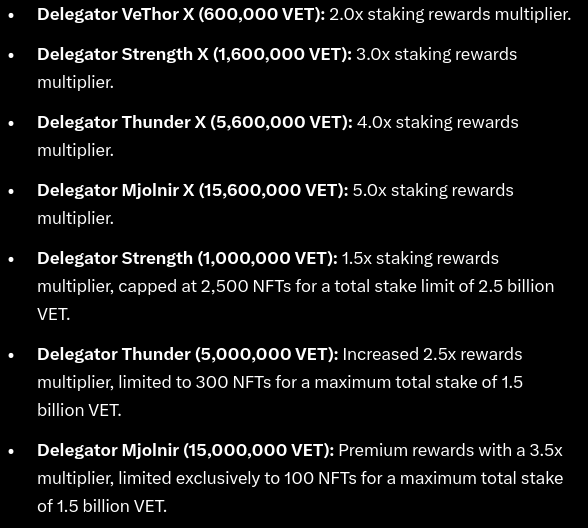
Delegators will need to stake a certain amount of VET tokens to mint Delegator NFTs, which will entitle them to different grades of staking reward multipliers. The more you stake, the higher grade of NFT you receive, and the higher your staking rewards will be. When blocks are produced, AMs/Validators will receive 30% of the total block reward, with the remaining 70% going to holders of the Delegator NFTs.
The image below shows the new Delegator NFT–tiered model, with minimum VET staking requirements and reward multipliers.
Source: X.com/VeChainOfficial
Technical updates
While the VeChainThor network is EVM-compatible, there are still differences between its technical parameters and the standard EVM used by Ethereum. For this reason, the Renaissance upgrade aims to reach full EVM compatibility, including implementing the JSON-RPC (JavaScript Object Notation remote procedure call) extensively employed within the Ethereum blockchain.
As part of the Renaissance upgrade, the project will also introduce a new set of tools to achieve more seamless cross-chain capabilities. This will involve integrating new bridges, stablecoins, wallets and DApps.
VeChain dual token model
The VeChain token model has always been based on two cryptocurrencies: VET and VTHO. VET is the utility token that acts as the main means of value storage and transfer on the platform, while VTHO is used to pay for gas. Now, the Renaissance upgrade also changes the way the dual-token mechanism operates.
Before the upgrade fully kicks in, VTHO is still generated by simply holding VET. After the Renaissance, only staked VET will generate new VTHO for the holder. This should better align VTHO with the active participation of users on the platform. VTHO's inflation rate will also be cut by over 70%, as its issuance will be aligned to a new emission model that considers the total amount of VET staked on the platform.
To further reduce the inflationary properties of VTHO, 100% of all base transaction fees on the network, which are all paid with VTHO, will be burned.
VeChain (VET)
VET is the platform’s value transfer and storage token. It’s also used for governance and access to various features and apps on the network. VET is a supply-capped token with a max supply of just over 86.7 billion. These properties will not change following the Renaissance upgrade.
VeThor (VTHO)
VTHO, which is used to pay for gas fees on VeChainThor, is an inflationary token with an uncapped supply. It currently has a total supply of almost 88,7 billion. As noted above, after Renaissance, VTHO will be generated via staking only, and will feature a burn mechanism to reduce its inflation rate.
Where to buy VeChain (VET)
You can buy the VET token on Bybit's Spot market as a swap pair with USDT, and on the Derivatives market as the VETUSDT Perpetual contract.
In addition, you can take advantage of Bybit’s event dedicated to the VET token to grab a share of a 27 million VET prize pool. New users can earn VET rewards by accumulating a deposit volume of at least 5,000 VET, or by depositing at least 100 USDT and trading 100 USDT worth of VET via their first Spot trade using their Bybit account. Meanwhile, existing users can also qualify for rewards by trading at least 500 USDT worth of VET on the Bybit Spot market. The event runs through Apr 28, 2025, 9AM UTC.
VeChain (VET) price prediction
As of Apr 23, 2025, the VET token is trading at $0.02576, which is 90.8% lower than its ATH of $0.281 on Apr 19, 2021, and 1,243.2% higher than its ATL of $0.001917 on Mar 13, 2020.
Long-term price forecasts for VET are mostly bullish. DigitalCoinPrice predicts an average rate of $0.088 in 2027 and $0.14 in 2030, while PricePrediction expects the token to trade at $0.069 in 2027 and $0.1996 in 2030.
In the long term, VET might even rise to $1, at least according to PricePrediction’s forecast. Its portal is highly optimistic, estimating that VET will hit the $1 mark in 2034.
Is VeChain (VET) a good investment?
You might consider investing in the VeChain token VET based on the following:
VeChain is the leading smart contract blockchain specializing in sustainability use cases. As the push for green initiatives gains traction in the business world, the platform stands to benefit from these developments.
The project team actively supports VeChain development, as evidenced by the major Renaissance upgrade. This is an excellent indicator that VeChain still has plenty of steam, even after being established for years on the crypto market.
In early 2025, VeChain submitted white papers for VET and VTHO to the European Securities and Markets Authority (ESMA) in order to achieve registration under the Markets in Crypto-Assets (MiCA) framework. This event should lead to more active use of the cryptocurrencies within the highly regulated environment of the European Economic Area (EEA).
Closing thoughts
When Sunny Lu created VeChain in 2015, his vision focused on sustainability issues. VeChain's work in this area has led to the creation of the first decentralized network truly dedicated to making a tangible environmental impact. The entire VeChain ecosystem — including the VeChainThor blockchain platform, VeBetterDAO and VeChain Toolchain — continues to serve as a significant enabler of sustainable technology in the business world.
Now, with the Renaissance upgrade being rolled out for the duration of 2025, VeChain aims to solidify its leadership in this sphere. With the Renaissance upon us, it's hard to see any blockchain platform that could challenge VeChain in the area of sustainability anytime soon.
#LearnWithBybit