


Aztec (AZTEC): Bringing privacy to Ethereum with client-side proving

For over a decade, Ethereum (ETH)'s name has been virtually synonymous with concepts such as decentralized applications (DApps) and smart contracts. However, the blockchain's architecture is defined by radical transparency: every account balance, smart contract state and transaction detail is recorded on a public ledger for all to see. While this ensures trustless auditability, it creates a critical friction point for users and institutions requiring confidentiality for payroll, proprietary trading or numerous other privacy-conscious use cases.
As demand from the enterprise world for "programmable privacy" grows, Ethereum's unrestrained transparency acts as a barrier to the broader adoption of blockchain technology.
Aztec (AZTEC) is a Layer 2 rollup that addresses this issue by extending Ethereum with zero-knowledge proofs and customizable transparency. The platform introduces a hybrid-state model that allows developers to combine public and encrypted data. By enabling selective transparency, Aztec supports privacy-focused decentralized finance (DeFi) solutions and helps expand the use of blockchain in the business world.
Key Takeaways:
Aztec is a privacy-focused Layer 2 rollup that brings programmable, confidential smart contracts to the Ethereum ecosystem.
The platform features a hybrid execution model that uses client-side proving to keep transaction data private, while settling securely on the public Layer 1 Ethereum Mainnet.
Aztec's native token, AZTEC, is used for gas fee payments, governance, staking, block rewards and ecosystem development incentives.
What is Aztec?
Aztec (AZTEC) is a decentralized Layer 2 rollup network for Ethereum that pioneers the concept of programmable privacy. While traditional blockchains force a binary choice between total transparency and complete anonymity, Aztec introduces a hybrid environment in which public and private states coexist as required by business logic and confidentiality considerations. This allows developers to build DApps that protect sensitive user data, such as transaction amounts or account balances, without sacrificing the trustless security of the Ethereum Mainnet.
Technically, the Aztec network functions as a zero-knowledge (ZK) rollup, but with a unique architecture designed for confidential smart contracts. It moves away from the standard Ethereum virtual machine (EVM) model, which requires all full nodes to re-execute every transaction publicly.
Instead, Aztec employs a dual-execution model. Private transactions are processed locally on a user’s device via the Private Execution Environment (PXE), which generates ZK proofs to verify validity without revealing all of the data. These proofs are then submitted to the network, where the Aztec Virtual Machine (AVM) handles the public state and coordinates the final execution. By serving as a "privacy-first" scaling solution, Aztec aims to make blockchain technology viable for enterprise finance, confidential identity management and private DeFi.
Aztec launched its privacy-focused Layer 2 network, the Ignition Chain, in late 2025, describing it as the first fully decentralized Layer 2 for Ethereum. On Feb 12, 2026, the project debuted its native cryptocurrency, the AZTEC token.
While Aztec joins a long list of Layer 2 networks servicing Ethereum in this highly competitive niche, it’s the first major Layer 2 initiative focused primarily on privacy and fully private smart contracts. In contrast, the majority of other rollups in the industry, such as Arbitrum (ARB), Optimism (OP), Polygon (POL), and numerous others, have focused on improving the cost and speed of Ethereum transactions.
By enabling selective data disclosure (whereby a user can prove they’re solvent without revealing their exact net worth), Aztec provides a vital platform for real-world business applications on Ethereum.
How does Aztec work?
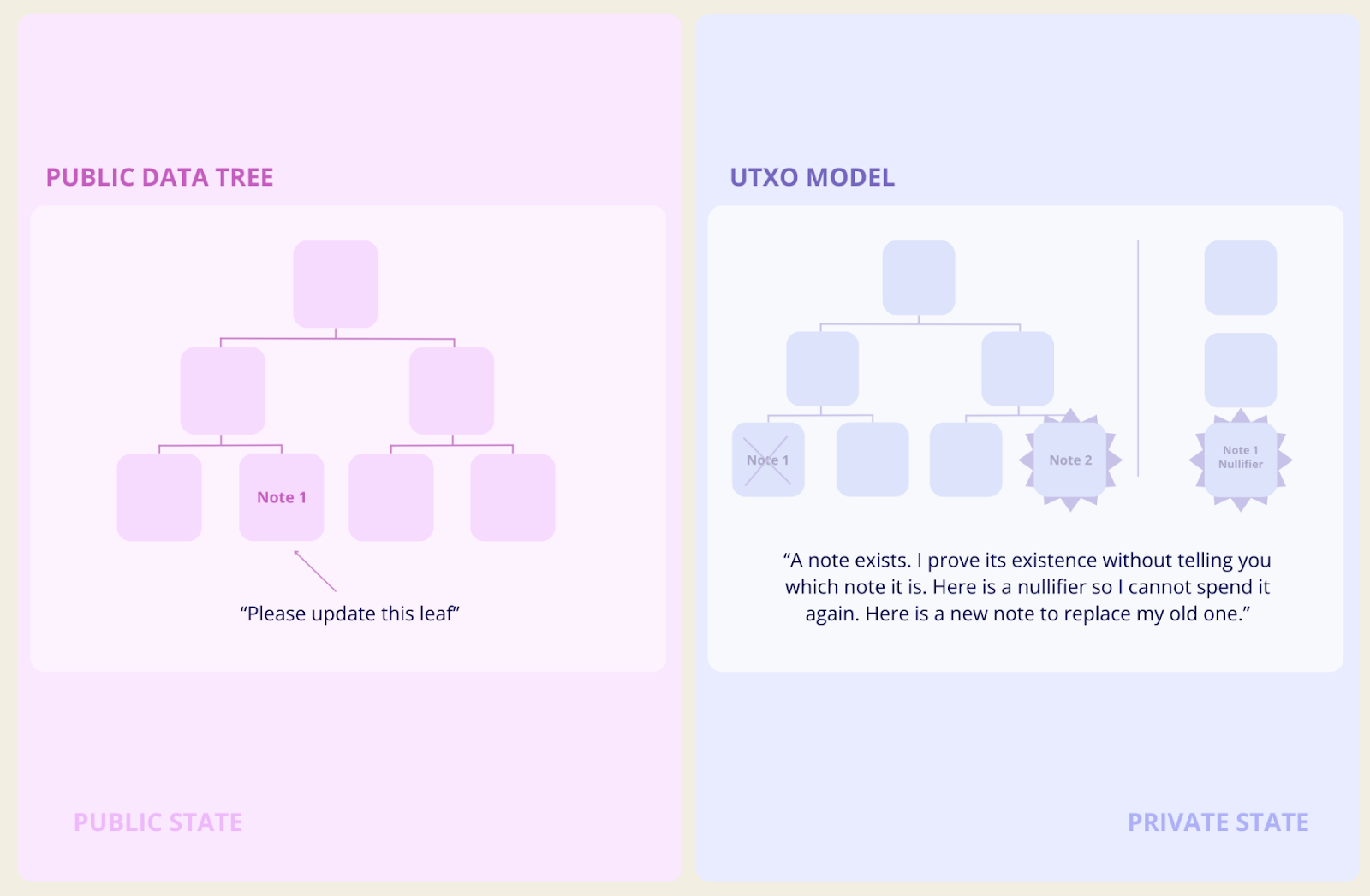
Aztec operates through a dual-execution model that separates public data from private computations, fundamentally changing how a rollup interacts with Ethereum. At the core of this system is a hybrid state tree. Public state is managed in a transparent Merkle tree, similarly to Ethereum, while private state is stored as encrypted "notes" within a UTXO-based tree. This distinction is critical: in the public state, everyone sees the change in balance, but in the private state, a user "spends" a note and creates a new one. However, only the owner of the note can see its contents.
Source: docs.aztec.network
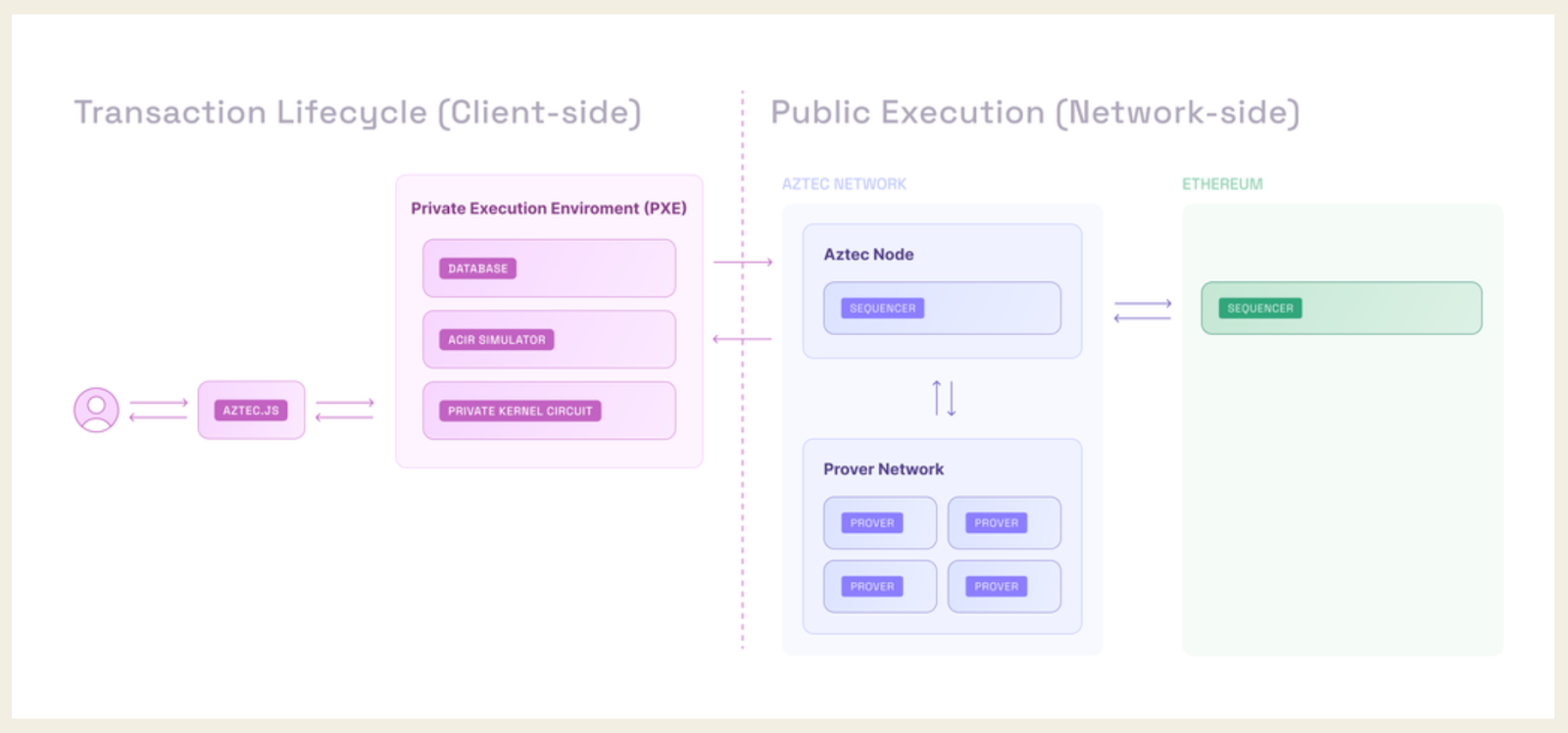
When a user interacts with a private smart contract, the transaction logic is executed locally on their own device (wallet) rather than via the network's validators. Developers write these contracts using Noir, a domain-specific language designed for zero-knowledge privacy. The user's device runs in PXE mode, which uses the Noir-defined logic for cryptographic proof generation. This proof demonstrates that the action follows the contract's rules without revealing any of the underlying inputs. This local execution ensures that sensitive data never leaves the user's hardware in an unencrypted form.
Once generated, these individual user proofs are sent to a Sequencer, which orders transactions and bundles them into a rollup block. To manage the complex relationship between private and public data, Aztec employs a "Kernel Circuit." This is a recursive circuit that verifies individual user proofs, and ensures they do not conflict with the network's current state.
Once the Sequencer has built a valid block, it passes the data to a Prover. The Prover generates a final, comprehensive validity proof for the entire rollup, which is then submitted to the Aztec smart contract on Ethereum Layer 1.
Source: docs.aztec.network
This multi-layered proof system allows thousands of private transactions to be verified by Ethereum in a single transaction. Because the Sequencer only sees the proofs and not the plaintext data, the network maintains total privacy. This asynchronous message-passing model also allows for "L1-L2 Portals," which act as a communication channel between Ethereum Layer 1 and Aztec Layer 2. The portals enable private assets on Aztec to interact directly with public Ethereum liquidity, while keeping the user's specific identity and local state hidden from the broader market.
Aztec key features
The defining characteristic of Aztec's privacy features is client-side proving, a significant departure from Ethereum’s traditional execution model. In Ethereum’s architecture, every full node on the network must re-execute every transaction in order to verify its validity. This re-execution model necessitates total transparency, as validators cannot verify what they can't see. This creates a privacy ceiling that Ethereum — and most other blockchains, for that matter — cannot break without fundamental changes to their core operational mechanism.
Aztec flips this paradigm by shifting the computational burden to the user side via the PXE. With client-side proving, the heavy lifting of executing a smart contract and generating a cryptographic proof takes place locally on the user's wallet. The network's nodes only need to verify the resulting proof, a process that’s significantly faster and more private than re-execution. The table below compares Ethereum’s network-side execution with Aztec’s highly innovative client-side private execution.
| Ethereum (network-side) | Aztec (client-side) |
Data visibility | Fully public to all nodes | Encrypted; private to the user |
Verification | Nodes re-run the transaction | Nodes verify a ZK proof |
Privacy | Pseudonymous but transparent | Programmable confidentiality |
Scaling | Limited by node re-execution | Highly scalable via ZK rollups |
Aztec also features native account abstraction as the account contract runs on the user's wallet, ensuring that every account is a smart contract by default. This enables various features, such as multisig security and social recovery without third-party plug-ins.
Furthermore, the L1-L2 communication portal system allows Aztec to preserve the privacy of the user's transaction history while interacting with Layer 1. Users can deposit funds from Ethereum into Aztec, conduct private transactions and then interact with public Layer 1 protocols like Uniswap (UNI) and Aave (AAVE) through specialized bridge contracts.
What is the AZTEC crypto token?
The AZTEC token is the native cryptocurrency of the Aztec network. It was launched following the token generation event (TGE) on Feb 12, 2026. AZTEC's debut follows a series of token sale rounds during which the project raised around $180 million from several high-profile participants, including Ethereum co-founder Vitalik Buterin and a16z crypto (Andreessen Horowitz).
AZTEC is an ERC-20 token on the Ethereum Mainnet. Its main functions include staking, governance, gas fee payments and block rewards for sequencers and provers.
AZTEC is an inflationary token. Its total supply is 10,350,000,000 AZTEC, of which around 2.9 billion are in circulation as of mid-February 2026, just days after its TGE.
The token’s total supply distribution shares are shown in the table below.
Project team | 21.06% |
Investors | 27.25% |
Token sale, including private and public sale rounds | 21.96% |
Ecosystem growth grants for early contributors and community | 10.73% |
Future incentives for network participants | 4.88% |
Reserved for the project's Foundation | 11.71% |
First-year network rewards | 2.41% |
Importantly, the token acts as the network’s "mana," the unit used to pay for gas. While Aztec supports fee abstraction through fee paying contracts (FPCs), allowing users to pay in other digital assets, those fees are ultimately settled with the network's service providers in AZTEC. The FPC functionality therefore provides community members with the flexibility to choose assets while retaining AZTEC's value as a fundamental pillar of the platform's ecosystem.
AZTEC staking
Staking is a critical network security function for Aztec's decentralized infrastructure. To participate in the network as a Sequencer (the entity responsible for ordering transactions and block production), an operator must lock a minimum of 200,000 AZTEC tokens. This stake serves as collateral, ensuring that operators act honestly. Any malicious behavior, such as data withholding or proposing invalid blocks, can result in slashing, whereby 1% of the staked tokens (2,000 AZTEC) are deducted from the offending operator’s balance for each violation. After three consecutive slashing penalties, the Sequencer is permanently banned from the network.
Token holders who cannot (or don't want to) run their own Sequencer nodes can also earn block rewards. The protocol supports delegation through a noncustodial system. Users can delegate their AZTEC to professional Sequencers for a share of network rewards.
Delegators can choose an operator with whom to stake their tokens, based on factors such as the commission rate and whether the operator allows the delegator to retain their direct governance rights.
Sequencers must maintain high performance, with current network statistics showing an attestation rate above 99% since the Aztec Ignition Chain's launch.
Governance on Aztec
Aztec employs a multi-stage on-chain governance system that balances technical expertise with community oversight. The process begins with Phase 1: Sequencer Signaling. Active stakers indicate support for a specific protocol upgrade. Once a proposal reaches the required threshold of sequencer support, it moves to Phase 2: Proposal Creation.
After a proposal is created, it enters Phase 3, a mandatory three-day delay before actual voting can start. Then, in Phase 4, all eligible voters (i.e., operators with staked funds on them, as well as ordinary users who've delegated their tokens but have retained direct voting rights) can cast their governance votes.
The voting period typically lasts seven days, followed by Phase 5, a 7-day execution delay. This delay provides a grace period for the community to react, and for node operators to upgrade their software before the change is finalized. Finally, in Phase 6, the approved proposal is technically implemented.
One intriguing feature of Aztec's governance mechanism is the ability for token delegators to retain their direct voting rights, if their chosen Sequencer offers this option. This approach ensures that while Sequencers manage the network's daily operations, the broader community has a say on major changes to the protocol's parameters, core logic or token economics.
Where to buy AZTEC
The AZTEC token is available on Bybit’s Spot market as a swap pair with the USDT stablecoin. You can also take advantage of the current Bybit campaign dedicated to the AZTEC token to earn AZTEC rewards. The campaign allows new verified users to earn AZTEC tokens from a 3,000,000 AZTEC prize pool by accumulating a deposit volume of at least 4,000 AZTEC, or by depositing 100 USDT and trading 100 USDT worth of AZTEC via their first trade.
Existing users can also earn from a 3,500,000 AZTEC prize pool by trading at least 500 USDT worth of AZTEC on the Spot market. The campaign is valid through Feb 26, 2026, 11AM UTC.
Closing thoughts
When an enterprise moves its operations on-chain, transaction privacy is among the primary considerations, along with regulatory compliance, tax advice and technical performance. Aztec's zero-knowledge cryptography, privacy infrastructure, private functions and programmable smart contracts create enormous opportunities for real-world applications. Thanks to Aztec, institutional entities can now conduct transactions and implement trading strategies with confidence, knowing that the Aztec platform's core privacy mechanism is protecting their sensitive information.
#LearnWithBybit