


Bybit AI Subaccount: How to Use Risk Parity Yield Optimizer

Idle capital sitting in a single product earns whatever that product pays, nothing more. Bybit's Earn suite spans Easy Earn, On-Chain Earn and a set of Structured Products — Dual Asset, Double-Win, Discount Buy, Smart Leverage and Liquidity Mining — each with a different risk-and-return profile. Spreading capital across several of these products gives it more balance, but tracking that many mechanisms and rebalancing by hand is tedious. However, an AI Subaccount lets you delegate that allocation work to an AI assistant within limits you set in advance.
This guide describes what each product category actually does, how they all differ in risk and how to set up an AI Subaccount to manage an allocation across all of them.
Key Takeaways:
Bybit's Earn products span a wide risk spectrum: Easy Earn prioritizes capital preservation, Structured Products like Dual Asset and Double-Win tie returns to price outcomes, and BYUSDT lets idle yield-bearing assets double as trading margin.
An AI Subaccount lets you delegate allocation and rebalancing decisions to an AI assistant, within asset caps, transfer controls and leverage limits you define.
This approach suits idle capital, not funds you may need on short notice for active trading.
Building blocks for diversified yield
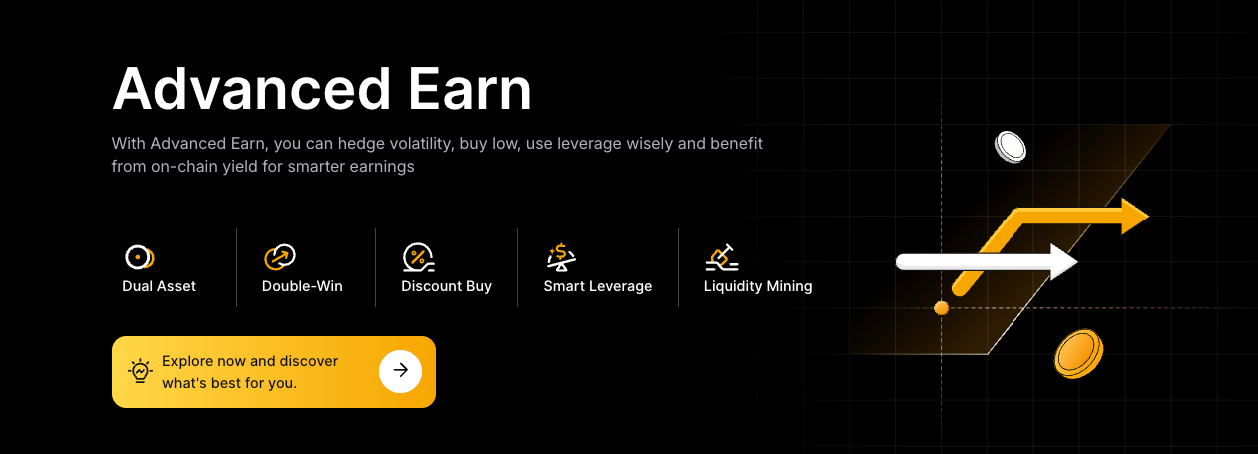
Bybit's Help Center groups Earn products into several categories: Easy Earn, On-Chain Earn and a set of Structured Products marketed together as Advanced Earn — namely, Dual Asset, Double-Win, Discount Buy, Smart Leverage and Liquidity Mining. BYUSDT sits alongside these as a way to keep Easy Earn capital usable as trading margin. Each product behaves differently.
Product | Mechanism | Risk profile |
|---|---|---|
Easy Earn | Hourly accrual, daily distribution, redeemable anytime in the Flexible Term option | Low — capital preservation focus |
On-Chain Earn | Yield sourced from on-chain protocols, rather than Bybit's internal lending | Varies — tied to underlying protocol risk |
Dual Asset | Settles in either USDT or the crypto asset, depending upon benchmark vs. settlement price; Buy Low and Sell High variants | Moderate — outcome is asset-dependent, not principal-at-risk |
Double-Win | Range-bet structure; total loss of principal if settlement price lands inside the chosen range | High — binary outcome, real total-loss risk |
Discount Buy | Discounted entry on coin purchases under defined conditions | Moderate |
Smart Leverage | Leverage is applied within defined risk parameters | Higher — leverage amplifies both gains and losses |
Liquidity Mining | Yield from providing liquidity, with an associated liquidation price | Moderate to higher — exposed to liquidation risk |
BYUSDT | Tokenized Easy Earn holdings usable as UTA margin, while still earning base yield | Low — 100% collateral-backed, 1:1 redeemable |
Easy Earn
Easy Earn pays yield on USDT holdings, with rates that can vary by tier. Balances up to a threshold may receive a higher platform reward APR, while amounts above it earn a lower base APR. Yields accrue hourly and distribute daily, with redemption available without a fixed lockup in the Flexible Term option.
Dual Asset
Dual Asset is a short-tenor product (one, three or five days) offered in two variants:
Buy Low, whereby you invest USDT toward a target price below the current market price
Sell High, where you invest the crypto asset toward a target price above it
If the settlement price lands at or below your benchmark, you receive principal and yield in USDT. If it lands above, you receive both in the crypto asset instead — useful for accumulation — but the asset you receive is not guaranteed to match what you expected.
Double-Win and the other Structured Products
Dual Asset sits alongside four other Structured Products marketed together as Advanced Earn: Double-Win, Discount Buy, Smart Leverage and Liquidity Mining. Double-Win carries the most distinct risk profile of the group, as it pays out only if the settlement price lands outside a range you choose. If the price settles inside that range, the entire investment amount is lost. This is a stated, by-design outcome, not an edge case. It makes Double-Win meaningfully riskier than Dual Asset, despite both products falling under the same Structured Products umbrella.
On-Chain Earn
On-Chain Earn sources yield from on-chain protocols, rather than Bybit's internal lending pool. This means that its risk and return profile is tied to the underlying protocol, rather than to a Bybit-managed mechanism. It sits in a separate category from both Easy Earn and the Structured Products group.
BYUSDT
BYUSDT is a tokenized representation of USDT held in Flexible Easy Earn. Swapping into BYUSDT lets you use that balance as margin in your Unified Trading Account (UTA) under Cross Margin or Portfolio Margin mode, while it continues generating yield — though only the base APR applies, not the platform reward portion. This makes BYUSDT useful for capital you want to earn yield, while keeping it available as collateral, rather than sitting fully idle or fully committed to trading.
Why pair this with an AI Subaccount?
Manually splitting capital across three products and rebalancing as conditions change is tedious, particularly at scale. An AI Subaccount lets an AI assistant manage this allocation on your behalf, but only within an asset cap, transfer permissions and a leverage limit you configure directly. It can shift capital between products, but never beyond what you’ve allocated.
Whom this product is for
Conservative investors seeking passive yield without actively managing multiple products themselves
Users with large idle balances who want capital diversified, rather than concentrated in one product
Traders who want idle stablecoins to remain productive without losing the option to use them as margin
Setup guide
This guide assumes you have already created an AI Subaccount and connected it to an AI assistant.
Fund your AI Subaccount: Transfer the USDT you want to allocate across the three products.
Set your asset cap and leverage limit: Decide the maximum the AI assistant can hold, and whether any leverage should be permitted for this strategy.
Give your AI assistant a standing instruction: Describe how you want capital split, and under what conditions it should shift between products.
Specify your Dual Asset preferences: Set your preferred tenor and the manner in which benchmark prices should be chosen relative to current market price.
Confirm the initial allocation: Review your AI assistant's proposed split before any funds move.
Monitor and adjust periodically: Check holdings across all three products, and refine your instructions as needed.
Use cases
Split capital between Easy Earn for stability and a small Dual Asset position for a defined accumulation bet, while keeping Double-Win exposure minimal or excluded (given its total-loss risk).
Allocate a portion to On-Chain Earn for diversification away from Bybit's internal lending mechanism, sized according to your comfort with protocol-level risk.
Convert a portion of an Easy Earn balance into BYUSDT before opening a new position, so that existing yield isn’t interrupted by funding the trade.
Best practices
Start conservatively and adjust over time. Giving a larger initial allocation to Easy Earn, with smaller positions in higher-risk Structured Products, is a reasonable starting point.
Size Double-Win allocations deliberately. Its binary, total loss–or–payout structure makes it a poor fit for capital you cannot afford to lose entirely.
Review allocations monthly. Yield rates and settlement conditions across products change, so a static split can drift from your original intent.
Reserve only idle capital for this strategy. Funds you may need for active trading on short notice are a poor fit, since these positions take time or carry conditions to unwind.
Risk considerations
Double-Win carries real total-loss risk. A settlement price inside the chosen range means the entire investment is lost — one of two possible outcomes by design.
Dual Asset can settle in either asset. A position may resolve into the crypto asset, rather than USDT — a designed outcome, not a malfunction. However, this changes the asset you hold afterward.
On-Chain Earn risk depends upon the underlying protocol. Yield and risk are not entirely governed by Bybit in the same way as Easy Earn or Structured Products.
Yield rates are not guaranteed. Rates across Easy Earn, BYUSDT and other products can change, and any strategy works with currently available rates, not historical ones.
All trading risk sits with you. Bybit does not control, monitor or guarantee an AI assistant's outcomes. Please review permissions carefully before funding your Subaccount.
The bottom line
Bybit's Earn products span a wide range of risk, from Easy Earn's capital-preservation focus to Double-Win's binary total-loss structure. Using an AI Subaccount to manage an allocation across several of these products turns a manual, ongoing task into a standing strategy bounded by limits you control. Diversification reduces concentration in any single mechanism, but it doesn’t remove the risk specific to each product — and that should inform how much capital you commit, and to which products overall. Looking to balance risk and reward with precision? Explore more AI-powered yield strategies on the Bybit AI Sub-Account Campaign page.
#LearnWithBybit